Publications /
Annual Report
Book / Report
Back
African Peace and Security Annual Conference (APSACO) - 10th edition: SUMMARY REPORT
Authors
Policy Center for the New South
October 30, 2026

The tenth edition of the African Peace and Security Annual Conference (APSACO) reflected a decade-long commitment to advancing dialogue on Africa’s evolving peace and security landscape. Bringing together senior policymakers, military officials, diplomats, scholars and practitioners, the conference provided an opportunity not only to assess the continent’s current security environment but also to reflect on the profound transformations that have reshaped Africa over the past ten years. 

The discussions took place against an international backdrop characterized by geopolitical competition, the erosion of multilateralism, declining external financial support, and the emergence of new regional security configurations. Across all panels, participants agreed that Africa is entering a new era in which greater responsibility for peace and security increasingly rests with African institutions and governments themselves. 

One of the dominant themes throughout the conference was the transformation of regional security governance. The emergence of the Alliance of Sahel States (AES), alongside the evolution of Economic Community of West African States (ECOWAS) and the African Union’s Peace and Security Architecture, reflects deeper political and institutional changes taking place across the continent. While speakers expressed different perspectives regarding these developments, there was broad consensus that regional fragmentation should not prevent continued dialogue and cooperation among African states. 

The conference also highlighted the growing limitations of conventional security approaches. Participants repeatedly argued that military responses alone cannot resolve Africa’s contemporary security crises. Terrorism, violent extremism, organized crime, and institutional fragility are increasingly interconnected, requiring integrated responses that combine security, governance, development and political dialogue. 

Another central theme was the future of peace operations. Drawing on lessons from missions deployed across the continent over the past decade, speakers emphasized that peacekeeping remains an indispensable instrument but cannot substitute for political settlements or effective national institutions. Future peace operations must become more adaptive, locally owned and closely connected to long-term development objectives.
RELATED CONTENT

  • July 19, 2022
    Les missions militaires de l’Union européenne (UE) en Afrique revêtent aujourd’hui, à l’heure de la réinvention du partenariat euro-africain, une importance considérable. Alors que Bruxelles entend plus que jamais s’imposer comme l’un des garants de la sécurité au niveau mondial, tout en se mesurant aux nouveaux rapports de force mondiaux, elle tient parallèlement à devenir un acteur incontournable en matière de paix, de surcroît motivé par la prolifération des risques ...
  • Authors
    May 27, 2022
    How did an insurrection in Northern Mozambique escalate into a crisis that is drawing myriad external actors, and risks destabilizing the region? What are the colonial and Cold War origins of this conflict in Cabo Delgado? Why is Rwanda such a prominent intervener? How are tensions between Kigali, Maputo and Pretoria playing out in the peacekeeping operation now underway? ...
  • Authors
    Sabine Cessou
    May 17, 2022
    Ce thème, abordé au Centre HEC de Géopolitique à Jouy-en-Josas, lors de la 12e édition des Dialogues stratégiques avec le Policy Center for the New South, une rencontre semestrielle, a permis de revenir dans le détail sur cette zone qui relie la Méditerranée à l’océan Indien, à la jointure de trois continents : l’Asie, l’Afrique et l’Europe. Cette route maritime qui s’étend sur plus de 2 200 km, pour une largeur qui varie de 300 km à moins de 30 km entre Djibouti et le Yémen, r ...
  • May 13, 2022
    Depuis 2016, le Policy Center for the New South et le Centre HEC de Géopolitique organisent chaque année deux éditions des « Dialogues Stratégiques ». Cette plateforme d’analyse et d’échange réunit des experts, des chercheurs provenant de différents think-tanks et du monde académique, d...
  • Authors
    Laura Sanders
    May 12, 2022
    An HRW report details the massacre of at least 300 civilians in the central Malian town of Moura — the deadliest single atrocity in the country’s decade-long armed conflict. Most of the victims were from the Peuhl ethnic group. The widespread political and social exclusion of the Peuhl puts them at further risk of this type of violence and drives a cycle of grievances and fear that empowers violent extremist organizations (VEOs) and impedes peacebuilding. National governments and in ...
  • Authors
    March 16, 2022
    Of all the regions included in this report series, Tillabéri is the region that scores best when it comes to both general community resilience, as well as traditional and religious authorities’ functioning. The region is not as exposed to shocks as Est (Burkina Faso) and Ménaka (Mali), and its ability to recover from shocks is high compared to the other regions. Trust in traditional and religious authorities is comparatively high as is their equal treatment of different subgroups in ...
  • Authors
    Mathieu Pellerin
    March 2, 2022
    La situation sécuritaire dans le Sahel central est à ce point dégradée que la menace djihadiste déborde désormais sur la partie nord des pays côtiers d’Afrique de l’Ouest. Les régions de l’Est et des Cascades au Burkina Faso ou celles de Sikasso et de Kayes au Mali constituent des bases arrière permettant aux groupes djihadistes – et principalement à la Jama’at Nasr al-Islam wal Muslimin (JNIM) pour l’instant – de s’étendre au Bénin, en Côte d’Ivoire, et dans une moindre mesure au T ...
  • Authors
    March 1, 2022
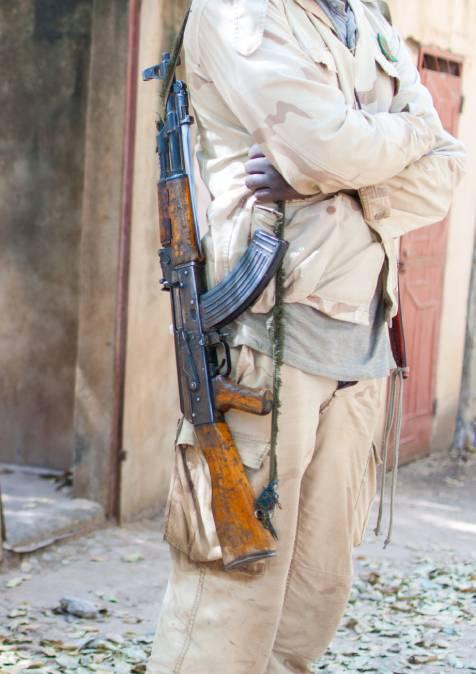
    Dans un contexte de gouvernance complexe, où autorités traditionnelles et modernes se côtoient même si leur pouvoir décroît, le Mali connait depuis de nombreuses années une situation sécuritaire alarmante, notamment dans le centre du pays. La montée des tensions entre communautés agricoles et pastorales est aggravée par la présence de groupes extrémistes. La population du Cercle de Niono, dans la région de Ségou, a été victime de violences inouïes pendant plusieurs mois avant que de ...
  • Authors
    Jakana Thomas
    Lauren Van Metre
    February 28, 2022
    This article was initially published on usip.org   The presence of CBAGs raises issues that force a rethink of local implementation of peacebuilding processes. The RESOLVE Network’s multiyear research on Community-Based Armed Groups (CBAGs) has established critical findings for the international community on how to engage, manage and transform violent actors in conflict-affected states. While mitigation efforts tend to target anti-state extremist org ...
  • Authors
    Pierre Englebert
    February 11, 2022
    Almost ten years after the beginning of the security crisis in the Sahel, Burkina Faso, Mali, and Niger face a graver predicament than ever before. In the throes of multiple insurgencies, they and their foreign patrons, including France, have shown the limits of military containment. While these three countries are the victims of terrorist aggression, their crises also have deep domestic roots, including long-standing patterns of state abuses of their populations, even in the more d ...