Publications /
Annual Report
Book / Report
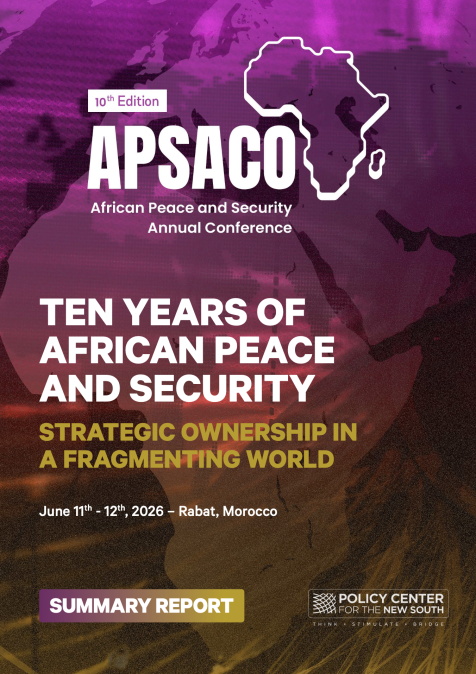
The tenth edition of the African Peace and Security Annual Conference (APSACO) reflected a decade-long commitment to advancing dialogue on Africa’s evolving peace and security landscape. Bringing together senior policymakers, military officials, diplomats, scholars and practitioners, the conference provided an opportunity not only to assess the continent’s current security environment but also to reflect on the profound transformations that have reshaped Africa over the past ten years.
The discussions took place against an international backdrop characterized by geopolitical competition, the erosion of multilateralism, declining external financial support, and the emergence of new regional security configurations. Across all panels, participants agreed that Africa is entering a new era in which greater responsibility for peace and security increasingly rests with African institutions and governments themselves.
One of the dominant themes throughout the conference was the transformation of regional security governance. The emergence of the Alliance of Sahel States (AES), alongside the evolution of Economic Community of West African States (ECOWAS) and the African Union’s Peace and Security Architecture, reflects deeper political and institutional changes taking place across the continent. While speakers expressed different perspectives regarding these developments, there was broad consensus that regional fragmentation should not prevent continued dialogue and cooperation among African states.
The conference also highlighted the growing limitations of conventional security approaches. Participants repeatedly argued that military responses alone cannot resolve Africa’s contemporary security crises. Terrorism, violent extremism, organized crime, and institutional fragility are increasingly interconnected, requiring integrated responses that combine security, governance, development and political dialogue.
Another central theme was the future of peace operations. Drawing on lessons from missions deployed across the continent over the past decade, speakers emphasized that peacekeeping remains an indispensable instrument but cannot substitute for political settlements or effective national institutions. Future peace operations must become more adaptive, locally owned and closely connected to long-term development objectives.