Publications /
Book / Report

Back
Africa Economic Symposium (AES) 3nd edition - SUMMARY REPORT
Authors
General rapporteur Mahmoud Arbouch
September 2, 2025

The Africa Economic Symposium (AES) has firmly established itself as one of the flagship annual events of the Policy Center for the New South, alongside the Atlantic Dialogues and the African Peace and Security Annual Conference (APSACO). Now in its third edition, AES continues to provide a unique platform for economists, policymakers, and academics from across the continent and beyond to exchange perspectives on the pressing macroeconomic and structural challenges facing Africa. Its mission remains to foster rigorous, evidence-based debates that inform policymaking and support long-term strategies for Africa’s development in an era of uncertainty. 

The 2025 edition, convened under the theme “Bold Moves amid Global Shifts,” explored the difficult policy trade-offs confronting African governments as they navigate a volatile global environment. The continent’s recovery from COVID-19 has been uneven, while debt pressures, supply chain disruptions, and geopolitical tensions weigh heavily on fiscal and economic resilience. Structural challenges such as persistent unemployment, low productivity, and the exclusion of Africa’s youth continue to hinder inclusive growth, even as policymakers are called upon to adapt to deep systemic uncertainty. 

The symposium underscored that many African states are increasingly resorting to short-term stabilization measures—such as accumulating reserves and postponing reforms—that may provide immediate security but risk delaying the structural transformation urgently needed. Against this backdrop, AES 2025 called for a careful balance between fiscal prudence, social investment, and the pursuit of sustainable growth, placing emphasis on reforming governance, improving macroeconomic management, and accelerating structural change. 

The discussions highlighted the urgent need to rethink Africa’s economic strategies in a shifting global order. From debt sustainability and the role of central banks to the promise of financial innovation, digital inclusion, and new instruments such as central bank digital currencies, the symposium emphasized that policy choices must align with long-term transformation goals. The debates also explored the opportunities and challenges of regional integration, trade connectivity, and development finance, all of which are essential levers for Africa’s resilience and prosperity. 

As in previous editions, the Annual Report on African Economies was launched alongside the symposium, offering an in-depth analysis of the continent’s macroeconomic dynamics and structural transformation pathways. More than just a publication, the report reflects the collective intellectual effort of leading scholars and practitioners, providing evidence-based insights to guide decision- makers. Together, the symposium and the report reinforced the Policy Center for the New South’s commitment to fostering forward-looking economic thinking that moves beyond short-term headlines to tackle Africa’s enduring challenges.

RELATED CONTENT

  • July 11, 2025
    In this episode, we discuss whether Africa’s sub-regions foster unity or deepen divides, examine how they handle political crises, and consider the impact of global powers on regional dynamics. We explore what’s needed for stronger cooperation and how Africa can preserve its diversity w...
  • July 9, 2025
    Developing countries have few options to deal with the ongoing tariff war amid unpredictable shifts in global supply chains. However, regional economic integration offers a strategic path of development in these uncertain and challenging times. Helped by geographical proximity and cultural familiarity, countries in a region can benefit greatly from promoting trade with one another, reaping the benefits of comparative advantages and economies of scale—if they are able to establish a ...
  • July 8, 2025
    حلقة اليوم من برنامج حديث الثلاثاء تناقش اتفاقية التبادل الحر بين المغرب وتركيا، التي وُقعت عام 2004 ودخلت حيز التنفيذ سنة 2006 بهدف تعزيز التجارة الثنائية. رغم ارتفاع حجم المبادلات، سجل الميزان التجاري عجزاً متزايداً لصالح تركيا تجاوز 3 مليارات دولار سنة 2024، رغم تعديل الاتفاقية سنة 2...
  • Authors
    Seydina Alioune NDIAYE
    July 8, 2025
    La stabilité apparente des taux directeurs de la BCEAO (Banque centrale des États de l'Afrique de l'Ouest) masque une réalité bien plus préoccupante : un resserrement monétaire non déclaré dans la zone UEMOA (Union économique et monétaire ouest-africaine) et une rareté accrue de la liquidité qui frappe tout le système. Nous proposons une analyse en profondeur des mécanismes de cette crise bancaire latente, ses manifestations concrètes sur le tissu économique et ses implications pour ...
  • July 04, 2025
    This episode explores how poverty, inequality, and climate change fuel insecurity and instability, often pushing fragile states toward militarization at the cost of social welfare. It exa ...
  • July 2, 2025
    Dans un contexte devenu plus incertain et plus compliqué à la suite des décisions de la nouvelle administration américaine, les impératifs de la lutte contre le changement climatique et de la transition énergétique et écologique demeurent.Les banques centrales peuvent et doivent apporter leur contribution à cette transition, en « verdissant », dans une proportion à définir, la politique monétaire qu’elles mènent. Concrètement, cela veut dire compléter la palette des object ...
  • Authors
    July 1, 2025
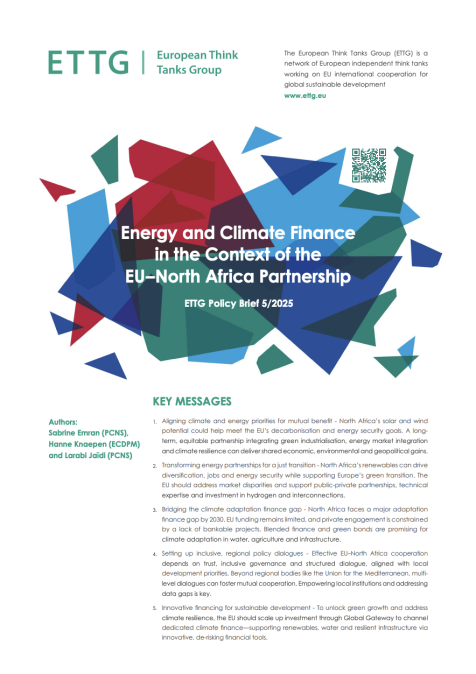
    This Paper was originally published on ettg.eu KEY MESSAGES1. Aligning climate and energy priorities for mutual benefit - North Africa’s solar and wind potential could help meet the EU’s decarbonisation and energy security goals. A longterm, equitable partnership integrating green industrialisation, energy market integration and climate resilience can deliver shared economic, environmental and geopolitical gains. 2. Transforming energy partnerships for a just transition - ...
  • Authors
    Hanne Knaepen
    July 1, 2025
    This Blog was originally published on ettg.eu Europe and North Africa are intensifying cooperation, driven by shared interests in renewable energy deployment, trade and industrialisation. This renewed focus is opening doors for deeper energy partnerships, including on green hydrogen, and offers North African countries new opportunities to expand into European markets. At the same time, it raises concerns about the uneven distribution of benefits and insufficient international f ...