Publications /
Book / Report

Back
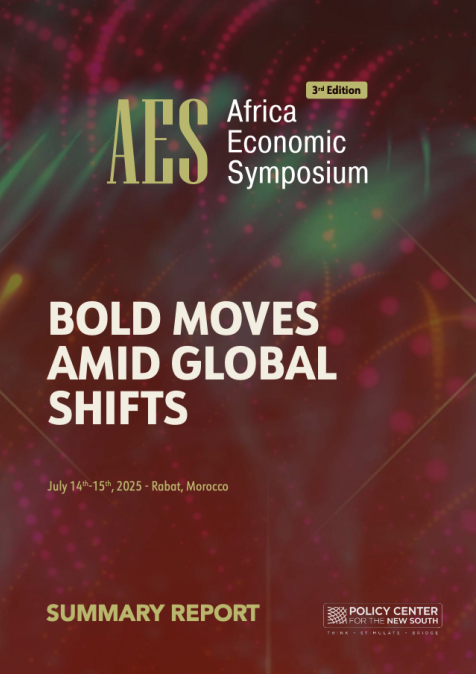
Africa Economic Symposium (AES) 3nd edition - SUMMARY REPORT
Authors
General rapporteur Mahmoud Arbouch
September 2, 2025

The Africa Economic Symposium (AES) has firmly established itself as one of the flagship annual events of the Policy Center for the New South, alongside the Atlantic Dialogues and the African Peace and Security Annual Conference (APSACO). Now in its third edition, AES continues to provide a unique platform for economists, policymakers, and academics from across the continent and beyond to exchange perspectives on the pressing macroeconomic and structural challenges facing Africa. Its mission remains to foster rigorous, evidence-based debates that inform policymaking and support long-term strategies for Africa’s development in an era of uncertainty. 

The 2025 edition, convened under the theme “Bold Moves amid Global Shifts,” explored the difficult policy trade-offs confronting African governments as they navigate a volatile global environment. The continent’s recovery from COVID-19 has been uneven, while debt pressures, supply chain disruptions, and geopolitical tensions weigh heavily on fiscal and economic resilience. Structural challenges such as persistent unemployment, low productivity, and the exclusion of Africa’s youth continue to hinder inclusive growth, even as policymakers are called upon to adapt to deep systemic uncertainty. 

The symposium underscored that many African states are increasingly resorting to short-term stabilization measures—such as accumulating reserves and postponing reforms—that may provide immediate security but risk delaying the structural transformation urgently needed. Against this backdrop, AES 2025 called for a careful balance between fiscal prudence, social investment, and the pursuit of sustainable growth, placing emphasis on reforming governance, improving macroeconomic management, and accelerating structural change. 

The discussions highlighted the urgent need to rethink Africa’s economic strategies in a shifting global order. From debt sustainability and the role of central banks to the promise of financial innovation, digital inclusion, and new instruments such as central bank digital currencies, the symposium emphasized that policy choices must align with long-term transformation goals. The debates also explored the opportunities and challenges of regional integration, trade connectivity, and development finance, all of which are essential levers for Africa’s resilience and prosperity. 

As in previous editions, the Annual Report on African Economies was launched alongside the symposium, offering an in-depth analysis of the continent’s macroeconomic dynamics and structural transformation pathways. More than just a publication, the report reflects the collective intellectual effort of leading scholars and practitioners, providing evidence-based insights to guide decision- makers. Together, the symposium and the report reinforced the Policy Center for the New South’s commitment to fostering forward-looking economic thinking that moves beyond short-term headlines to tackle Africa’s enduring challenges.

RELATED CONTENT

  • Authors
    May 5, 2025
    Last week marked my twenty-third consecutive week attending the World Bank and IMF Spring Meetings in Washington, DC. While I no longer participate in the official sessions, I continue to be invited to the many side conventions and debates that surround them.A key moment is always the release of the IMF's World Economic Outlook report. This year, it drew particular attention due to curiosity about how the institution would project the impacts of the tariff war initiated by Trump’s s ...
  • May 2, 2025
    This Opinion was originally published in Project Syndicate As the US-China rivalry intensifies, both powers are courting mineral-rich African countries in an effort to secure critical raw materials. Translating Africa's vast natural-resource wealth into lasting development requires an infrastructure-led strategy that delivers long-term value for local communities. ...
  • Authors
    Danielle Alakija
    May 1, 2025
    The author of this opinion, Danielle Alakija, is a 2024 alumna of the Atlantic Dialogues Emerging Leaders Program. Once upon a time—or so the story went—the Global South was cast to the margins of the global development narrative. Assigned a supporting role in someone else’s story, it was exploited for its resources and subdued by the authoritative tone of external narrators. This image, painted in tones of crisis and dependency, continues to echo through textbooks and news cy ...
  • Authors
    Isabela Carvalho
    April 30, 2025
    The author of this opinion, Isabela Carvalho, is a 2018 alumna of the Atlantic Dialogues Emerging Leaders Program. In today’s interconnected world, knowledge plays a vital role in driving change and shaping solutions. Yet despite the rise of digital tools and global collaboration, persistent gaps in how knowledge is managed and shared continue to limit the Global South’s ability to fully harness its potential. Strengthening resilient knowledge ecosystems fosters inclusive ...
  • April 29, 2025
    At the recent World Bank and IMF Spring Meetings, heightened attention focused on the IMF’s downgraded global economic forecasts. Global growth is now projected at 2.8% for 2025 and 3% for 2026, down from 3.3% in 2024, largely due to rising trade barriers initiated by Mr. Trump’s second...
  • April 28, 2025
    In this episode, we discuss the Economic Report on Africa 2025, focusing on the African Continental Free Trade Area (AfCFTA) and its transformative potential. We explore how North African ...
  • April 23, 2025
    The United States is at a critical juncture, facing a pivotal dilemma: preserving global leadership in a world it no longer fully controls. While it proclaims its primacy in the liberal international order, its actions tell a different story—one marked by tariffs, reshoring policies, and an open attempt to contain China’s rise. This strategy is driven less by long-term vision than domestic political calculus, underscoring the urgent need for strategic recalibration. ...