
This episode explores Africa's role amid a shifting global order marked by fragmentation and competing blocs. It examines whether African states are passive responders or active shapers of new strategic alignments like BRICS+ and South–South cooperation. The discussion also addresses Africa’s push for reform in multilateral institutions and the emergence of potential continental consensus. Looking ahead, the episode highlights key challenges and opportunities defining Africa’s strategic trajectory over the next decade.
RELATED CONTENT
-
 October 15, 2026The Policy Center for the New South, in partnership with The Asian Network, is organizing a webinar titled “Emerging Powers and the Remaking of Global Order” to examine the growing role of emerging powers and the Global South at a time of profound transformation in the international sys...
 -
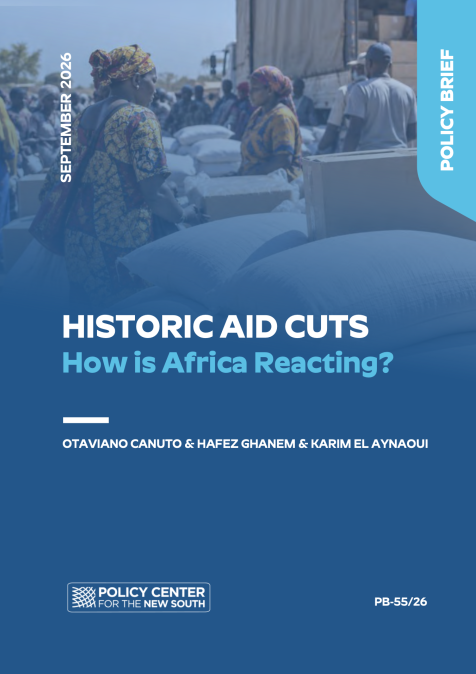 September 28, 2026This paper was initially published in French on the website of the Fondation Jean-Jaurès. There was a historic decline in Official Development Assistance (ODA) in 2025. Foreign aid to developing countries from members of the OECD-DAC fell by some 23%, the largest decline on record and the second consecutive annual decline. Aid to Africa fell by more than 25%. The International Monetary Fund (IMF) described this decline in ODA to Africa as “a shock like no other.” It differ ...
 -
 September 11, 2026Marcus Vinicius de Freitas, Senior Fellow at the Policy Center for the New South, discusses in this podcast his policy brief "Africa, Latin America and Global Governance." He argues that ...
 -
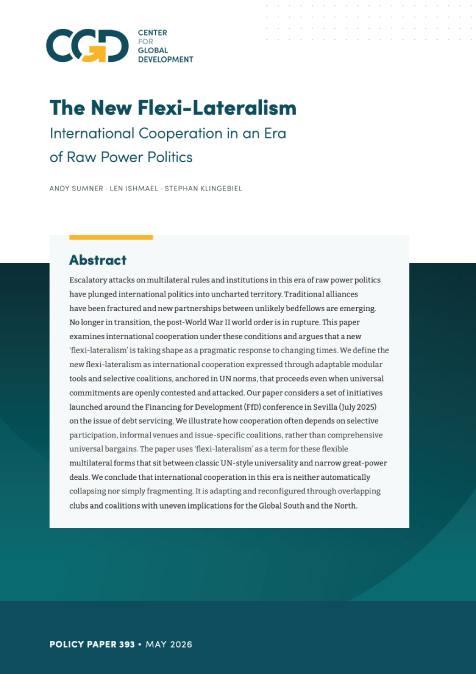 September 4, 2026This Paper was originally published on cgdev.org. Escalatory attacks on multilateral rules and institutions in this era of raw power politics have plunged international politics into uncharted territory. Traditional alliances have been fractured and new partnerships between unlikely bedfellows are emerging. No longer in transition, the post-World War II world order is in rupture. This paper examines international cooperation under these conditions and argues that a new "flexi-l ...
 -
 August 25, 2026The next Secretary-General should begin with an act of institutional rebellion: refuse to become the Secretary-General ofeverything. Over three decades the office's political and administrative reach has spread across sustainable development, climate, health, migration, digital governance, financing, gender, food systems, and a still-growing list of global priorities. These issues are not unimportant; the trouble is that institutional ambition has simply outrun institutional capabil ...
 -
 August 25, 2026Predictions of American decline have become increasingly prevalent. The United States has run persistent trade deficits for decades, but its public debt now exceeds its annual economic output. Meanwhile, and new centers of industrial and technological power continue to emerge across Asia. Yet despite these developments, no country has so far replaced the United States as the main organizing power of the international economy. Conventional explanations explain this in terms of U.S. m ...
 -
 July 10, 2026For much of the post-war period, the Global South was framed as an object of history, defined by dependency, constrained by structural asymmetries, and confined to the margins of global decision-making. That narrative, once empirically grounded, is now no longer adequate. A profound yet uneven transformation is underway. The Global South is no longer only reacting; it is increasingly shaping rules, institutions, and narratives.This Policy Brief argues that the Global South is thus t ...
 -
June 15, 2026As part of the OECD Multilateral Development Finance Week 2026 (MDF Week), the Policy Center for the New South (PCNS) is organizing a webinar entitled “Rethinking Development Finance: African Agency and the Future of Multilateral Development Co-operation after ODA Retrenchment.” The dis...
-
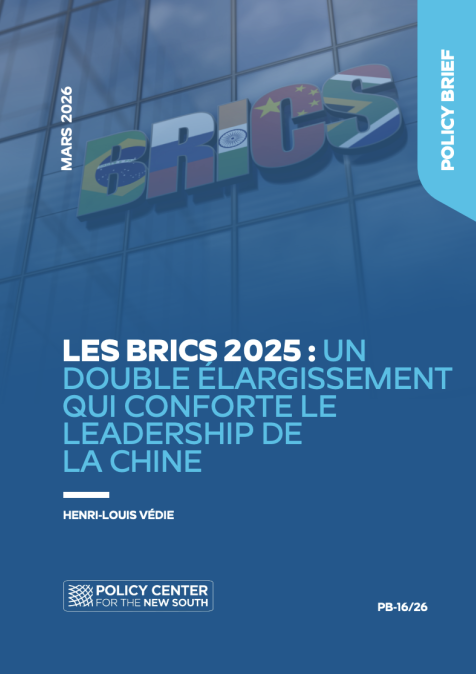 March 18, 2026The first BRICS summit, convened at Russia's initiative in 2009, would be followed by sixteen more, the most recent being the Rio summit held on July 6 and 7, 2025. Until 2022, only one enlargement had taken place — the admission of South Africa, which turned BRIC into BRICS. From 2023 onward, however, three consecutive summits — 2023, 2024 and 2025 — transformed BRICS into BRICS+5, admitting five new member countries and introducing a new “partner country” status that now groups ni ...
 -
March 18, 2026Le premier sommet des BRICS, tenu à l’initiative de la Russie en 2009, sera suivi de 16 autres, le dernier étant celui de Rio dont les travaux se sont déroulés les 6 et 7 juillet 2025. Jusqu’en 2022, un seul élargissement est intervenu, celui accueillant l’Afrique du Sud, transformant les BRIC en BRICS. À partir de 2023, en revanche, trois sommets, ceux de 2023, 2024 et 2025, vont se solder par la transformation des BRICS en BRICS+5, accueillant 5 nouveaux pays membres, en ...

