Publications /
Book / Report

Back
Africa Economic Symposium (AES) 3nd edition - SUMMARY REPORT
Authors
General rapporteur Mahmoud Arbouch
September 2, 2025

The Africa Economic Symposium (AES) has firmly established itself as one of the flagship annual events of the Policy Center for the New South, alongside the Atlantic Dialogues and the African Peace and Security Annual Conference (APSACO). Now in its third edition, AES continues to provide a unique platform for economists, policymakers, and academics from across the continent and beyond to exchange perspectives on the pressing macroeconomic and structural challenges facing Africa. Its mission remains to foster rigorous, evidence-based debates that inform policymaking and support long-term strategies for Africa’s development in an era of uncertainty. 

The 2025 edition, convened under the theme “Bold Moves amid Global Shifts,” explored the difficult policy trade-offs confronting African governments as they navigate a volatile global environment. The continent’s recovery from COVID-19 has been uneven, while debt pressures, supply chain disruptions, and geopolitical tensions weigh heavily on fiscal and economic resilience. Structural challenges such as persistent unemployment, low productivity, and the exclusion of Africa’s youth continue to hinder inclusive growth, even as policymakers are called upon to adapt to deep systemic uncertainty. 

The symposium underscored that many African states are increasingly resorting to short-term stabilization measures—such as accumulating reserves and postponing reforms—that may provide immediate security but risk delaying the structural transformation urgently needed. Against this backdrop, AES 2025 called for a careful balance between fiscal prudence, social investment, and the pursuit of sustainable growth, placing emphasis on reforming governance, improving macroeconomic management, and accelerating structural change. 

The discussions highlighted the urgent need to rethink Africa’s economic strategies in a shifting global order. From debt sustainability and the role of central banks to the promise of financial innovation, digital inclusion, and new instruments such as central bank digital currencies, the symposium emphasized that policy choices must align with long-term transformation goals. The debates also explored the opportunities and challenges of regional integration, trade connectivity, and development finance, all of which are essential levers for Africa’s resilience and prosperity. 

As in previous editions, the Annual Report on African Economies was launched alongside the symposium, offering an in-depth analysis of the continent’s macroeconomic dynamics and structural transformation pathways. More than just a publication, the report reflects the collective intellectual effort of leading scholars and practitioners, providing evidence-based insights to guide decision- makers. Together, the symposium and the report reinforced the Policy Center for the New South’s commitment to fostering forward-looking economic thinking that moves beyond short-term headlines to tackle Africa’s enduring challenges.
RELATED CONTENT

  • February 10, 2025
    Depuis 1956, l’économie égyptienne est en crise. Durant la période entre 1956 et 2024, elle a connu douze dévaluations et huit crises majeures de sa balance des paiements. Avec un déficit récurrent de sa balance courante, le pays est exposé au plus grand des risques : le risque souverain. Ce qui est une première faiblesse. Mais ce pays, qui a toujours réussi à s’épargner ce risque, témoigne aussi de certaines forces, ce qui constitue sa première force. De ce constat est ...
  • Authors
    Paul Isbell
    February 6, 2025
    Pan-Atlantic cooperation is inspired by the opportunity to foster rising, widespread, and sustainable prosperity across Atlantic Basin societies, particularly in Africa and Latin America and the Caribbean (LAC). The key to unlocking this potential lies in deepening the Atlantic Basin’s already high level of intra-regional economic interdependence (when viewed as a single regional entity) and leveraging the untapped complementary opportunities within and across the Southern Atlantic. ...
  • January 30, 2025
    In this episode of Redesigning Global Finance, we explore the evolving landscape of global financial governance, focusing on how institutions like the IMF, World Bank, and regional development banks are adapting to new economic realities and global crises. The episode examines how finan...
  • January 30, 2025
    This Opinion was originally published in Project Syndicate   As the world prepares for COP30 in Belém, Brazil, African countries have an opportunity to advocate for equitable carbon-pricing mechanisms that align climate action with sustainable development. While cutting emissions is important, so, too, is ensuring fairness and equity for the communities most vulnerable to climate change. ...
  • January 29, 2025
    This Opinion was originally published in Project Syndicate   In today's global economy, developing countries must embrace a new policy framework that strengthens their macroeconomic resilience, harnesses technology for productivity growth, and fosters growth and structural transformation. None of this will be possible with an "every country for itself" mentality. ...
  • Authors
    January 27, 2025
    As geopolitical competition among superpowers intensifies, fragmenting the global economy and financial system, the role of middle powers has attracted much attention from policymakers and analysts. While there is no generally agreed list of middle powers, the term is intuitively understandable and has been used widely as referring to countries ranked below a handful of great powers, but significant enough to be able to act in response to external stimuli with some agency and with s ...
  • Authors
    Inácio F. Araújo
    Dina N. Elshahawany
    João Gabriel Sacco
    Maria Carolina Rogelis-Prada
    Antonios Pomonis
    Guillermo Toyos
    Hogeun Park
    January 22, 2025
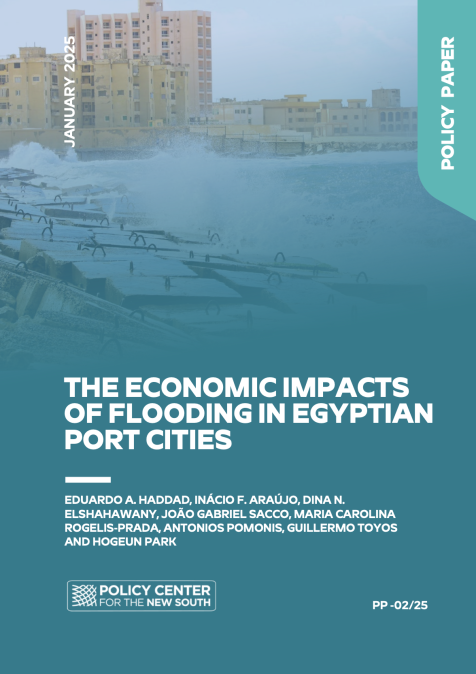
    This study evaluates the economic costs for three Egyptian coastal cities of catastrophic flooding resulting from either sea-level rise or intense rainfall. Using a computable general equilibrium (CGE) framework, we assess the higher-order impacts of physical capital loss on both regional and national economies. Leveraging global flood hazard maps for various scenarios and return periods, and a 100-meter-resolution buildings-exposure model, which estimates the replacement value of r ...
  • Authors
    Arkebe Oqubay
    January 20, 2025
    This paper, included in the report "Urban Sustainable Development: Governance, Finance and Politics.", was originally published on:https://cebri.org/en/doc/356/cebri-and-rio-g20-committee-publish-urban-sustainable-development-governance-finance-and-politics  © Vormittag, Pedro, Marianna Albuquerque & Eugénie Birch (Eds.). 2024. Urban Sustainable Development: Governance, Finance and Politics. Rio de Janeiro: CEBRI.   Sustainable urban development is vital for Africa, ...
  • January 20, 2025
      في هذه الحلقة، تم مناقشة السياسات التعليمية التي تم تنفيذها لتعزيز رأس المال البشري في الدول العربية المنتجة للنفط، وكيفية تقليل الاعتماد على الموارد الطبيعية. كما تم استعراض تأثير تمكين الشباب والنساء على تنويع الاقتصاد في هذه الدول. استضافت الحلقة عبير رشدان، القائم بأعمال نائ...