Publications /
Book / Report

Back
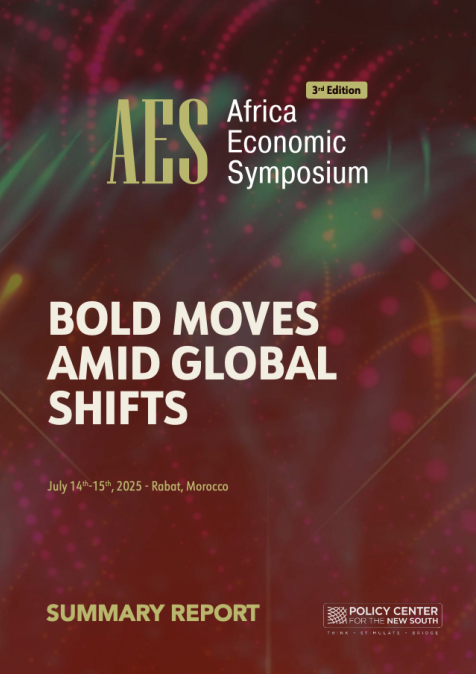
Africa Economic Symposium (AES) 3nd edition - SUMMARY REPORT
Authors
General rapporteur Mahmoud Arbouch
September 2, 2025

The Africa Economic Symposium (AES) has firmly established itself as one of the flagship annual events of the Policy Center for the New South, alongside the Atlantic Dialogues and the African Peace and Security Annual Conference (APSACO). Now in its third edition, AES continues to provide a unique platform for economists, policymakers, and academics from across the continent and beyond to exchange perspectives on the pressing macroeconomic and structural challenges facing Africa. Its mission remains to foster rigorous, evidence-based debates that inform policymaking and support long-term strategies for Africa’s development in an era of uncertainty. 

The 2025 edition, convened under the theme “Bold Moves amid Global Shifts,” explored the difficult policy trade-offs confronting African governments as they navigate a volatile global environment. The continent’s recovery from COVID-19 has been uneven, while debt pressures, supply chain disruptions, and geopolitical tensions weigh heavily on fiscal and economic resilience. Structural challenges such as persistent unemployment, low productivity, and the exclusion of Africa’s youth continue to hinder inclusive growth, even as policymakers are called upon to adapt to deep systemic uncertainty. 

The symposium underscored that many African states are increasingly resorting to short-term stabilization measures—such as accumulating reserves and postponing reforms—that may provide immediate security but risk delaying the structural transformation urgently needed. Against this backdrop, AES 2025 called for a careful balance between fiscal prudence, social investment, and the pursuit of sustainable growth, placing emphasis on reforming governance, improving macroeconomic management, and accelerating structural change. 

The discussions highlighted the urgent need to rethink Africa’s economic strategies in a shifting global order. From debt sustainability and the role of central banks to the promise of financial innovation, digital inclusion, and new instruments such as central bank digital currencies, the symposium emphasized that policy choices must align with long-term transformation goals. The debates also explored the opportunities and challenges of regional integration, trade connectivity, and development finance, all of which are essential levers for Africa’s resilience and prosperity. 

As in previous editions, the Annual Report on African Economies was launched alongside the symposium, offering an in-depth analysis of the continent’s macroeconomic dynamics and structural transformation pathways. More than just a publication, the report reflects the collective intellectual effort of leading scholars and practitioners, providing evidence-based insights to guide decision- makers. Together, the symposium and the report reinforced the Policy Center for the New South’s commitment to fostering forward-looking economic thinking that moves beyond short-term headlines to tackle Africa’s enduring challenges.


RELATED CONTENT

  • December 2, 2024
    This blog was originaly published on orfonline.org.   The maritime industry is the lifeblood of global trade, with ships carrying over 90 percent of all merchandise trade, and the global logistics market accounting for 8-12 percent of global gross domestic product (GDP). The smooth functioning of maritime trade and supply chain logistics is integral to economic development and critical to food security and the distribution of ...
  • Authors
    Soukaina Raoui
    December 2, 2024
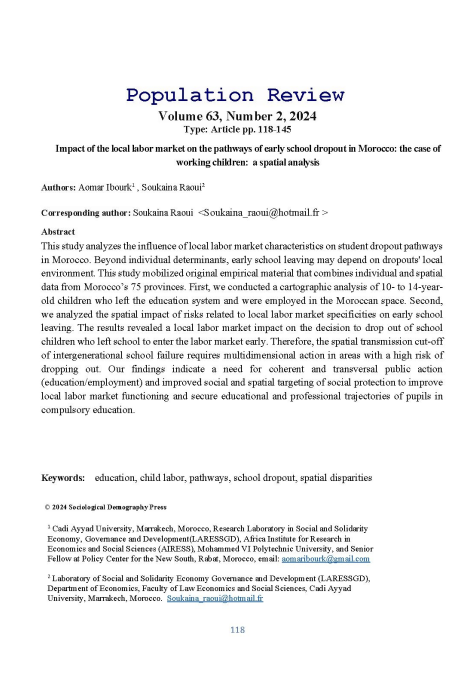
    This paper was originaly published on muse.jhu.edu   This study analyzes the influence of local labor market characteristics on student dropout pathways in Morocco. Beyond individual determinants, early school leaving may depend on dropouts’ local environment. This study mobilized original empirical material that combines individual and spatial data from Morocco’s 75 provinces. First, we conducted a cartographic analysis of 10- to 14-year-old children who left the educat ...
  • November 20, 2024
    This blog was originally published in the book Urban Sustainable Development: Governance, Finance, and Politics, a collaborative effort by the Brazilian Center for International Relations (CEBRI) and the Rio de Janeiro City Hall. The Policy Center for the New South has contributed as a Knowledge Partner to this work.   I belong to a city that has been evolving positively for 20 years. Rabat has one of the world’s highest rates of green space per square meter per capita. ...
  • Authors
    Zakaria Elouaourti
    Mohammed-Ali Bougzime
    November 15, 2024
    This paper was originally published on springer.com Wage subsidy policies’ impact on access to the first job is crucial for workers; however, their influence on job quality holds greater significance for society as a whole. This paper evaluates the impact of the “IDMAJ” wage subsidy program on job quality, extending beyond the traditional focus solely on job placement. Utilizing the complete database from the IDMAJ program survey conducted by the Ministry of Employment, this study ...
  • November 15, 2024
    As COP29 unfolds in Baku, many critical climate issues are discussed and debated. This year’s conference is a pivotal moment for global climate action. Key topics on the agenda include th ...
  • Authors
    November 14, 2024
    At the COP29 climate summit that began on November 11, 2024, in Baku, Azerbaijan, one of the main focuses is Article 6 of the Paris Agreement. Article 6, introduced at COP21 in 2015 and shaped through years of negotiation, enables countries to meet climate targets collaboratively, either through carbon markets or non-market strategies. This section of the Paris Agreement has the potential to unlock significant climate finance, cut the cost of reducing emissions, and foster cooperati ...
  • Authors
    Zakaria Elouaourti
    November 14, 2024
    This paper was originaly published on tandfonline.com   Our study provides an in-depth examination of the relationship between financial development and economic growth in Morocco, revealing key threshold effects through a nonlinear smooth transition model (STAR). Analysis of Moroccan banking and stock market development indexes reveals that the stock market was significantly impacted by the 2008 global financial crisis, showing a decline, while the banking system contin ...