Publications /
Book / Report

Back
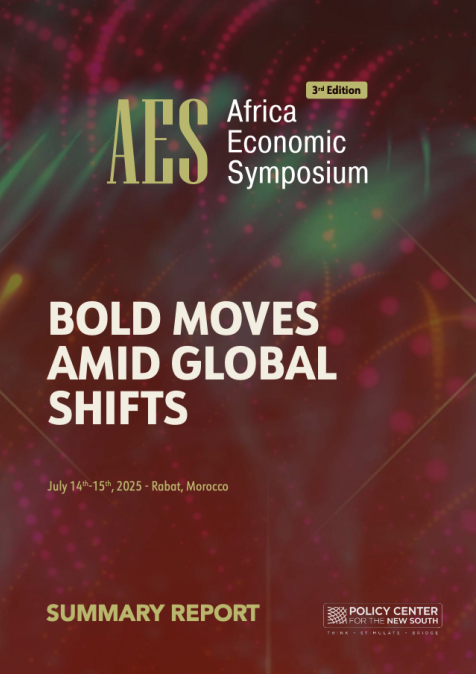
Africa Economic Symposium (AES) 3nd edition - SUMMARY REPORT
Authors
General rapporteur Mahmoud Arbouch
September 2, 2025

The Africa Economic Symposium (AES) has firmly established itself as one of the flagship annual events of the Policy Center for the New South, alongside the Atlantic Dialogues and the African Peace and Security Annual Conference (APSACO). Now in its third edition, AES continues to provide a unique platform for economists, policymakers, and academics from across the continent and beyond to exchange perspectives on the pressing macroeconomic and structural challenges facing Africa. Its mission remains to foster rigorous, evidence-based debates that inform policymaking and support long-term strategies for Africa’s development in an era of uncertainty. 

The 2025 edition, convened under the theme “Bold Moves amid Global Shifts,” explored the difficult policy trade-offs confronting African governments as they navigate a volatile global environment. The continent’s recovery from COVID-19 has been uneven, while debt pressures, supply chain disruptions, and geopolitical tensions weigh heavily on fiscal and economic resilience. Structural challenges such as persistent unemployment, low productivity, and the exclusion of Africa’s youth continue to hinder inclusive growth, even as policymakers are called upon to adapt to deep systemic uncertainty. 

The symposium underscored that many African states are increasingly resorting to short-term stabilization measures—such as accumulating reserves and postponing reforms—that may provide immediate security but risk delaying the structural transformation urgently needed. Against this backdrop, AES 2025 called for a careful balance between fiscal prudence, social investment, and the pursuit of sustainable growth, placing emphasis on reforming governance, improving macroeconomic management, and accelerating structural change. 

The discussions highlighted the urgent need to rethink Africa’s economic strategies in a shifting global order. From debt sustainability and the role of central banks to the promise of financial innovation, digital inclusion, and new instruments such as central bank digital currencies, the symposium emphasized that policy choices must align with long-term transformation goals. The debates also explored the opportunities and challenges of regional integration, trade connectivity, and development finance, all of which are essential levers for Africa’s resilience and prosperity. 

As in previous editions, the Annual Report on African Economies was launched alongside the symposium, offering an in-depth analysis of the continent’s macroeconomic dynamics and structural transformation pathways. More than just a publication, the report reflects the collective intellectual effort of leading scholars and practitioners, providing evidence-based insights to guide decision- makers. Together, the symposium and the report reinforced the Policy Center for the New South’s commitment to fostering forward-looking economic thinking that moves beyond short-term headlines to tackle Africa’s enduring challenges.

RELATED CONTENT

  • Authors
    September 22, 2020
    U.S. stock and corporate bond markets performed extraordinarily well from the March financial shock caused by covid-19 to the end of last month. Then, three consecutive weeks of decline in the three major stock market indexes have been followed this week by a global slump attributed to fears of new lockdowns. A period of disconnect of financial markets with the underlying real economy has culminated in a revelation of the former’s high dependency to Federal Reserve policies. Discon ...
  • September 18, 2020
    On assiste, ces derniers mois, à un rebond des cours de l'or, le portant vers de nouveaux sommets. L'analyse des cours de ce précieux métal depuis deux siècles montre une grande stabilité jusqu'en 1971, date de l'abandon de la convertibilité or /dollar par les Etats-Unis, mais aussi de son mouvement erratique depuis cette date. Soumise aux lois du marché, cette matière première voit son cours dépendre essentiellement de la demande. Evolution qui confirme cet actif comme valeur refug ...
  • Authors
    Youssef El Jai
    September 15, 2020
    Avant l'ère coloniale, l'émission d'argent en Afrique de l'Ouest dépendait de la traite des esclaves. Avec l'avènement du régime colonial, les pièces d'argent ont été importées puis progressivement imposées comme outil de coercition. La trajectoire postcoloniale a été différente pour les anciennes colonies britanniques et françaises. Alors que les premières ont retrouvé leur souveraineté monétaire, les secondes ont conservé une union monétaire sous l’égide de la France. La propositi ...
  • Authors
    Mohammed Al Doghan
    Muhammad Bhatti
    Carlos Braga
    Abdulelah Darandary
    Anabel González
    Niclas Poitiers
    September 15, 2020
    Diversification is important because it is associated with economic growth and reduced volatility. Diversification of exports, which provide foreign exchange and enable imports of critical goods, services, and know-how, is crucial for developing countries. The question we address in this brief is how export diversification is affected by trade policies, including multilateral rules, regional trade agreements, and national measures. The record on diversification is poor across a larg ...
  • Authors
    September 11, 2020
    Latin American and Caribbean economies need help, but organizations like the IDB are also stretched thin. First appeared at Americas Quarterly With Latin America and the Caribbean potentially facing years of difficulties due to the pandemic and related economic crises, attention has shifted to what multilateral institutions like the International Monetary Fund (IMF) might do to help. There’s no doubt they can play a crucial role in preventing another lost decade in the region. But ...
  • Authors
    Mostafa Kheireddine
    September 4, 2020
    L’action publique urbaine dans le monde connait une métamorphose grâce à la montée en puissance du numérique dans la production et la gestion de la ville. Si le Maroc a franchi des étapes importantes dans la dématérialisation de certains services publics (impôts, cadastre, marchés publics, etc.), en revanche, d’autres secteurs peinent à suivre la même voie au moment où l’actuelle crise sanitaire de la Covid-19  vient rappeler l’urgence de la structuration de l’écosystème digita ...
  • Authors
    September 3, 2020
    The “middle income trap” may well characterize the experience of Brazil and most of Latin America since the 1980s. Conversely, South Korea maintained its pace of evolution, reaching a high-income status. Such divergence of economic growth can be related to their distinctive performances of domestic accumulation of technological and organizational capabilities. Their different approaches to global value chains and trade globalization reinforced such discrepancy in domestic accumulati ...
  • September 2, 2020
    The year 2020 is one of the most difficult years for the global automotive industry. The pandemic first appeared in a region of China known for its developed automotive sector. Initially, it was the South Asian manufacturers who first felt the impact of the shutdown in China before the pandemic shifted to Europe and the United States and before the disruption of value chains took on a global dimension. In Morocco, the sector has not remained immune to this turbulent context and its ...
  • Authors
    Tony Addison
    August 24, 2020
    We explore the effects of foreign aid on FDI in a large number of aid-recipient countries using data for the period 1985-2008 and focusing in particular on the impact of the interplay of aid and social cohesion. The preliminary results suggest that the independent effect of aid on FDI is negative in sub-Saharan Africa (SSA) and Latin America (LAC) and positive in other regions, while aid seems to crowd out FDI in countries with high levels of human capital. In addition, we find that ...
  • Authors
    Alioune Sall
    August 17, 2020
    The transformation of the Economic Community of Western African States (ECOWAS) into a « Confederation of States » is sometimes considered, including by the Heads of State of the Community, as a natural next step in the process of deeper integration in West Africa. The purpose of this study is to explore its feasibility and relevance, based on the experience of other continents. A confederation of states can be defined as an association of sovereign states which, by means of an int ...