Publications /
Book / Report

Back
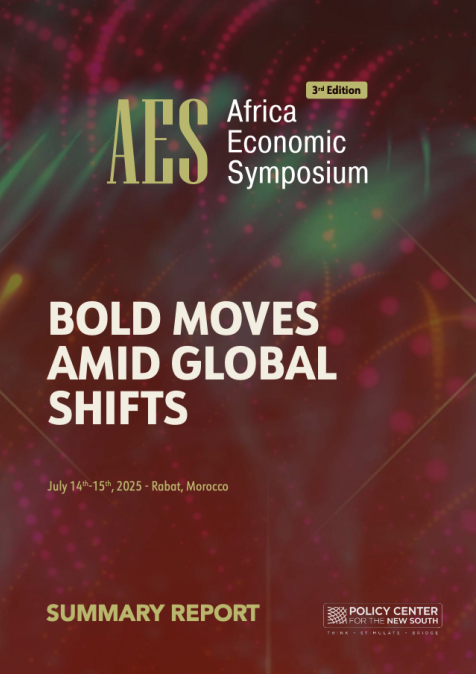
Africa Economic Symposium (AES) 3nd edition - SUMMARY REPORT
Authors
General rapporteur Mahmoud Arbouch
September 2, 2025

The Africa Economic Symposium (AES) has firmly established itself as one of the flagship annual events of the Policy Center for the New South, alongside the Atlantic Dialogues and the African Peace and Security Annual Conference (APSACO). Now in its third edition, AES continues to provide a unique platform for economists, policymakers, and academics from across the continent and beyond to exchange perspectives on the pressing macroeconomic and structural challenges facing Africa. Its mission remains to foster rigorous, evidence-based debates that inform policymaking and support long-term strategies for Africa’s development in an era of uncertainty. 

The 2025 edition, convened under the theme “Bold Moves amid Global Shifts,” explored the difficult policy trade-offs confronting African governments as they navigate a volatile global environment. The continent’s recovery from COVID-19 has been uneven, while debt pressures, supply chain disruptions, and geopolitical tensions weigh heavily on fiscal and economic resilience. Structural challenges such as persistent unemployment, low productivity, and the exclusion of Africa’s youth continue to hinder inclusive growth, even as policymakers are called upon to adapt to deep systemic uncertainty. 

The symposium underscored that many African states are increasingly resorting to short-term stabilization measures—such as accumulating reserves and postponing reforms—that may provide immediate security but risk delaying the structural transformation urgently needed. Against this backdrop, AES 2025 called for a careful balance between fiscal prudence, social investment, and the pursuit of sustainable growth, placing emphasis on reforming governance, improving macroeconomic management, and accelerating structural change. 

The discussions highlighted the urgent need to rethink Africa’s economic strategies in a shifting global order. From debt sustainability and the role of central banks to the promise of financial innovation, digital inclusion, and new instruments such as central bank digital currencies, the symposium emphasized that policy choices must align with long-term transformation goals. The debates also explored the opportunities and challenges of regional integration, trade connectivity, and development finance, all of which are essential levers for Africa’s resilience and prosperity. 

As in previous editions, the Annual Report on African Economies was launched alongside the symposium, offering an in-depth analysis of the continent’s macroeconomic dynamics and structural transformation pathways. More than just a publication, the report reflects the collective intellectual effort of leading scholars and practitioners, providing evidence-based insights to guide decision- makers. Together, the symposium and the report reinforced the Policy Center for the New South’s commitment to fostering forward-looking economic thinking that moves beyond short-term headlines to tackle Africa’s enduring challenges.

RELATED CONTENT

  • July 24, 2020
    Depuis 2018, le Ghana est considéré par le Fonds monétaire international (FMI) comme le bon élève de l'Afrique. Bon élève dans le respect de la démocratie qui lui permet d'attirer de nombreux investisseurs mais, aussi, bon élève de par les résultats économiques obtenus pour réduire son inflation et relancer sa croissance économique, suite à un programme d'ajustement structurel, soutenu par le FMI, mis en place en 2015, et qui s'est achevé en 2019. Ces résultats, le Ghana les doit a ...
  • Authors
    July 20, 2020
    There are signs of recovery in various parts of the global economy, starting in May, after the depressive dip imposed by Covid-19. Such signs emerged after the easing of restrictions on mobility established to flatten out the pandemic curves, and also reflected policies of flattening the recession curve (income transfers to part of the population, credit lines to vulnerable companies and others). Besides remaining far from giving back the GDP lost, in all countries, the r ...
  • Authors
    July 20, 2020
    This article was originally published on Bruegel. The global economy is showing signs of recovery from the economic crisis caused by COVID-19, though the spread of the coronavirus is accelerating in some countries. In this circumstance, policymakers must weigh up the trade-offs involved in dealing with the pandemic while easing lock downs and sustaining economic activity. Differences in age structures, urbanisation rates and other factors will inform decision making in different co ...
  • July 16, 2020
    La femme représente la moitié de la société. Côte à côte avec l’homme, elle a toujours contribué au développement des sociétés lorsque les facteurs de conversion lui ont permis de mettre à l’œuvre ses potentialités pour parler simple. Aujourd’hui, cette catégorie de la société marocaine, et mondiale, subit de manière disproportionnée les répercussions de la crise de la Covid-19, sur plus d’un aspect de la vie en société. Ceci est particulièrement vrai lorsqu’il s’agit des domaines ...
  • Authors
    Abdoul‘ Ganiou Mijiyawa
    July 15, 2020
    We explore the effects of exporting manufactures, primary commodities, and food and agricultural products, and we examine the impact of importing capital and semi-capital goods, on structural transformation in a group of 21 sub-Saharan African countries that were covered by the inaugural African Transformation Report (ACET, 2014). The empirical results suggest that the import of capital and semi-capital goods can be a good predictor of structural transformation, while concentration ...
  • July 10, 2020
    L’Afrique fait face à une crise économique sans précédent qui ne manquerait pas de rebondir sur les équilibres économiques et sociales. Pour apaiser la violence du choc et éviter surtout l’installation permanente de ses répercussions, l’Afrique doit déployer des stratégies de ripostes i...
  • Authors
    Amine Benbernou
    Dorothée Schmid
    July 9, 2020
    Middle Eastern geopolitics is currently undergoing structural changes: the regional order is in transition in the aftermath of the Arab Spring that undermined authoritarian governance, and triggered the competition for power against a backdrop of American withdrawal. This new race for regional domination challenges the traditional hierarchy of powers that is mainly based on military capacity and the interplay of foreign alliances. The economy, which had previously guaranteed the pol ...
  • Authors
    Konrad-Adenauer-Stiftung in partnerships with the Policy Center for the New South and EastWest Institute
    July 3, 2020
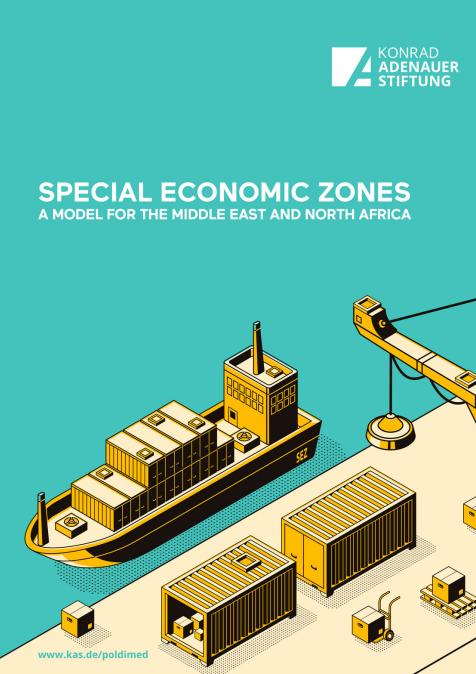
    The Middle East and North Africa (MENA) have enormous economic potential with remarkable natural resources and industrial production capacities. While considerable progress for economic reforms has been reached already, a deeper regional integration and stronger cooperation can provide the needed impetus for facilitated development and upgraded national as well as regional economic structures in the wider region. Special Economic Zones (SEZs) present significant untapped potential, ...
  • Authors
    Alioune Sall
    Moubarack Lo
    July 2, 2020
    La transformation de la Communauté Economique des Etats de l’Afrique de l’Ouest (CEDEAO) en « confédération d’Etats » est parfois évoquée, y compris au niveau des Chefs d’Etat de la Communauté, comme une prochaine étape naturelle du processus d’approfondissement de l’intégration en Afrique de l’Ouest. La présente étude a pour objet d’en explorer la faisabilité et la pertinence, en se fondant sur l’expérience vécue dans d’autres continents. Une Confédération d’Etats peut être défini ...