Publications /
Book / Report

Back
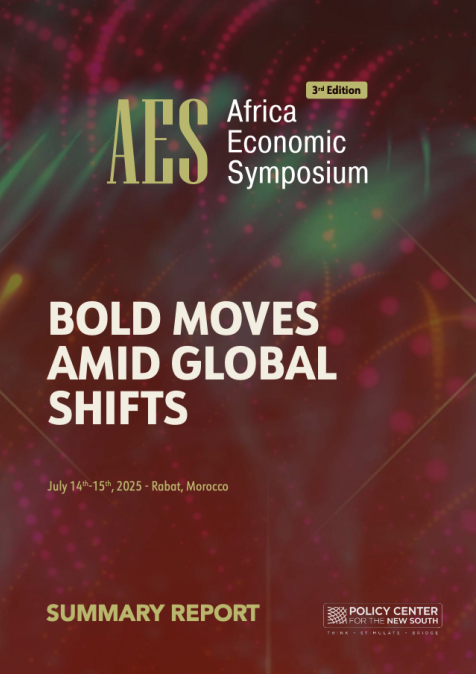
Africa Economic Symposium (AES) 3nd edition - SUMMARY REPORT
Authors
General rapporteur Mahmoud Arbouch
September 2, 2025

The Africa Economic Symposium (AES) has firmly established itself as one of the flagship annual events of the Policy Center for the New South, alongside the Atlantic Dialogues and the African Peace and Security Annual Conference (APSACO). Now in its third edition, AES continues to provide a unique platform for economists, policymakers, and academics from across the continent and beyond to exchange perspectives on the pressing macroeconomic and structural challenges facing Africa. Its mission remains to foster rigorous, evidence-based debates that inform policymaking and support long-term strategies for Africa’s development in an era of uncertainty. 

The 2025 edition, convened under the theme “Bold Moves amid Global Shifts,” explored the difficult policy trade-offs confronting African governments as they navigate a volatile global environment. The continent’s recovery from COVID-19 has been uneven, while debt pressures, supply chain disruptions, and geopolitical tensions weigh heavily on fiscal and economic resilience. Structural challenges such as persistent unemployment, low productivity, and the exclusion of Africa’s youth continue to hinder inclusive growth, even as policymakers are called upon to adapt to deep systemic uncertainty. 

The symposium underscored that many African states are increasingly resorting to short-term stabilization measures—such as accumulating reserves and postponing reforms—that may provide immediate security but risk delaying the structural transformation urgently needed. Against this backdrop, AES 2025 called for a careful balance between fiscal prudence, social investment, and the pursuit of sustainable growth, placing emphasis on reforming governance, improving macroeconomic management, and accelerating structural change. 

The discussions highlighted the urgent need to rethink Africa’s economic strategies in a shifting global order. From debt sustainability and the role of central banks to the promise of financial innovation, digital inclusion, and new instruments such as central bank digital currencies, the symposium emphasized that policy choices must align with long-term transformation goals. The debates also explored the opportunities and challenges of regional integration, trade connectivity, and development finance, all of which are essential levers for Africa’s resilience and prosperity. 

As in previous editions, the Annual Report on African Economies was launched alongside the symposium, offering an in-depth analysis of the continent’s macroeconomic dynamics and structural transformation pathways. More than just a publication, the report reflects the collective intellectual effort of leading scholars and practitioners, providing evidence-based insights to guide decision- makers. Together, the symposium and the report reinforced the Policy Center for the New South’s commitment to fostering forward-looking economic thinking that moves beyond short-term headlines to tackle Africa’s enduring challenges.


RELATED CONTENT

  • Authors
    Adil El Madani
    May 20, 2020
    Despite the global magnitude of the COVID-19 crisis, the response to the pandemic has mainly occurred at national level, with very poor global coordination so far. For Africa, which will provide one in four of the world’s consumers by 2050, coming out of the crisis will cost at least $100 billion. The average ratio of public revenue to GDP in African countries is only 19%, and the debt burden already absorbs 22% of that revenue, giving many African governments limited scop ...
  • Authors
    May 18, 2020
    Alors que commence le déconfinement de l'économie française, la grande inquiétude est de savoir comment éviter une « seconde vague » de l'épidémie. Parmi les nombreuses précautions et mesures à prendre, l’augmentation du nombre de tests et le traçage systématique des contacts sont les plus souvent mis en avant par les épidémiologistes. L'idéal serait de tester fréquemment tous les habitants du pays et ses visiteurs étrangers. Pour cela, il faudrait effectuer bien au-delà d ...
  • Authors
    Benjamin Augé
    May 17, 2020
    The coronavirus epidemic is weakening even further the economies of the Gulf of Guinea, which have already been particularly undermined by an oil sector that has been in crisis for several years. The rapid fall in oil prices will once again put a strain on systems that fail to reinvent and diversify themselves in order to protect themselves from the shortcomings often seen in windfall economies. In addition to the economic impact, it is likely to see the potential security and polit ...
  • Authors
    May 15, 2020
    La crise du Covid-19 a fortement entravé les négociations d'un accord de libre-échange entre le Royaume-Uni et l'Union européenne (UE). Étant condamnée à des obstacles, à la fois temporels et politiques, la perspective de parvenir à un accord avant le départ prévu du Royaume-Uni du marché unique de l'UE le 31 décembre 2020, semble de plus en plus compliquée. Londres et Bruxelles devraient considérer une sortie du Royaume- Uni sans accord comme une conclusion indésirable des négociat ...
  • Authors
    Hynd Bouhia
    May 14, 2020
    Morocco is today cited as an example for its dynamism, its leadership, under the impetus of His Majesty King Mohammed VI, and, above all, its coherence in decision-making and the involvement of the population, through the Covid-19 Special Fund and the media to maintain public confidence. Indeed, the safety of the Moroccans was given priority over all other considerations, which made it possible to speed up the handling of the events and to supervise the management of the contaminate ...
  • Authors
    May 14, 2020
    Confronted with surging unemployment and miles long lines at food banks across the United States, most states have begun reopening the economy. Many of these states are seeing rising numbers of new cases and face a real risk of relapsing into an uncontrolled pandemic. To avoid this outcome, they must adopt a strategy that entails testing, tracing, and isolation of the infected, with priority given to groups and places where the medical impact – reducing infections and saving lives – ...
  • May 11, 2020
    Coronavirus takes down global economic giants (fourth video of the series on the coronavirus crisis) - The impact of COVID-19 on economic activity and on jobs has been deep and strong - The shape of post-coronavirus recovery will depend on the success of containment policies and… - the ...
  • Authors
    May 11, 2020
    Data recently released on the first-quarter global domestic product (GDP) performance of major economies have showed how significant the impact of COVID-19 has been on economic activity and jobs, with large contractions across the board. The ongoing global recession is poised to be worse than the “great recession” after the 2008-09 global financial crisis, especially from the standpoint of emerging market and developing economies. The depth and speed of the GDP decline will rival th ...
  • Authors
    Mohammed Germouni
    May 8, 2020
    An examination, inevitably bound to be broad in scope, of the economic and social implications for a country, in this case Morocco, of a sudden pandemic that has broken out in virtually most parts of the world, can only be a prelude to a broader and more comprehensive study to be undertaken in due course. For obvious reasons, especially as the current crisis induced by the primacy of health, could later evolve into a form of economic depression as various multifaceted aid and suppor ...