Podcasts

Back

U.S. security policy in the East Asian context

07
April 2016
Daniel Twining 

This podcast is performed by Daniel Twining. U.S. Security Policy in the East Asian Context For the United States, some of the main challenges facing the U.S. security policies in East Asia are a mixture of traditional and non-traditional security issues. But the main traditional security challenges for U.S. in East Asia would be the South China Sea issue and North Korea. China continues in the same pace building (and militarizing) artificial islands in the South China Sea which causes anxiety to its neighbours, specifically the Philippines and Vietnam who directly dispute Chinese claims, with the former taking the issue to international arbitration. The U.S. finds itself in a peculiar position since it needs to assure allies in the region and at the same time provide for the freedom of navigation which can be seriously undermined if China takes control of the 9-dash line. The second challenge is North Korea which keeps on provoking, with the latest incident being the 4th nuclear test. Although Missile Defense analysts say that the test does not prove any progress to NK’s nuclear operational capabilities, however it shows how difficult would be to reignite any talks.
RELATED CONTENT

  • January 6, 2026
    La création de l’Alliance des États du Sahel (AES) symbolise une rupture politique et géostratégique majeure, appuyée sur un discours souverainiste et anti-occidental. Deux ans après, Mali, Burkina Faso et Niger peinent à assurer leur intégrité territoriale, à stabiliser leur sécurité intérieure et à bâtir une gouvernance solide. L’intégrité territoriale est un problème commun aux trois États, car dans ces pays, la cohésion de l’État et le contrôle du territoire sont directement men ...
  • Authors
    Niccola Milnes
    December 30, 2025
    Fuel access has become a strategic pressure point across Mali and its neighbors. In 2025, Jama’t Nusrat al Islam wal- Muslimeen (JNIM) shifted from sporadic interdictions to a deliberate fuel-blockade strategy intended to pressure Bamako without holding territory. By selectively constraining movement along the Sikasso–Kayes–Bamako corridor, the group turned fuel scarcity into a tool of coercion, governance, and narrative control—shaping behavior in the capital while remaining largel ...
  • Authors
    December 18, 2025
    The return of President Donald Trump to the White House at the start of 2025 was expected to signal an American retreat from international engagement, especially in regions of traditional security interest, such as southern Europe, North Africa, and the Middle East. To the surprise of many observers around the Mediterranean, and perhaps to the dismay of some in the Trump administration’s ideological orbit, this has not happened. If anything, the second half of 2025 has seen a high d ...
  • Authors
    November 28, 2025
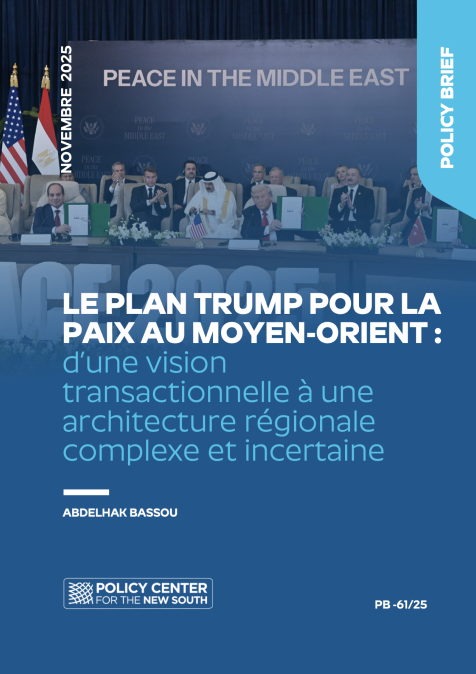
    Le 17 novembre 2025, le Conseil de sécurité de l’Organisation des Nations Unies (ONU) a adopté la résolution 2803 par laquelle il fait sien le Plan d’ensemble du Président Donald Trump ayant pour objectif de mettre fin au conflit à Gaza. Contrairement à ce qu’on pourrait croire, l’initiative américaine ne date pas du 2ème mandat de l’Administration Trump. Elle a vu le jour durant son premier mandat.  Le Plan entériné par la résolution du Conseil de sécurité de l’ONU, surnommé ‘ ...
  • Authors
    November 28, 2025
    On November 17, 2025, the United Nations (UN) Security Council adopted Resolution 2803, endorsing President Donald Trump's Comprehensive Plan to end the conflict in Gaza. Contrary to popular belief, the American initiative does not date from the Trump Administration's 2nd term. It was born during his first term.The plan endorsed by the UN Security Council resolution, dubbed the ''Deal of the Century'', is in fact the heir to the initial plan, which bore the name ''Peace to Prosperit ...
  • November 4, 2025
    Cette tribune a été initialement publiée sur telos-eu.comSi un domaine est supposé devoir échapper à la « démocratie d’opinion », c’est bien la politique étrangère, surtout dans la France de la Ve République. Elle se doit d’être articulée autour d’intérêts à long terme et de calculs savants, sans reculer devant la raison d’Etat. L’opinion des Français à son propos est rarement scrutée.Elle se révèle plus construite qu’on ne croit. Telle est la leçon du sondage Toluna-Louis ...
  • October 23, 2025
    Depuis 2016, le Policy Center for the New South et le Centre de Géopolitique de l’école HEC Paris organisent chaque année deux éditions des « Dialogues Stratégiques ». Cette plateforme d’analyse et d’échange réunit des experts, des chercheurs provenant de différents think-tanks et du mo...
  • Authors
    Niagalé Bagayoko
    Eugène Berg
    Christophe Chabert
    Thierry Garcin
    Alain Oudot de Dainville
    Florent Parmentier
    Anne Sophie Raujol
    Hassan Saoudi
    October 23, 2025
    Les Dialogues Stratégiques, fruit d'une collaboration entre le HEC Center for Geopolitics et le Policy Center for the New South, constituent une plateforme d'échanges biannuelle dédiée à l'analyse des grandes tendances mondiales et des problématiques régionalesqui lient l'Europe et l'Afrique. Réunissant praticiens, décideurs, universitaires et représentants desmédias, cet espace de réflexion permet de décoder les transformations en cours et de proposer des réponses aux défis contemp ...
  • Authors
    April 8, 2025
    The Russia–Ukraine war, while primarily perceived as a European security crisis, has triggered deep structural shocks globally, disproportionately affecting the developing world—the “New South.” This essay explores how historical legacies, global economic dependencies, and shifting geoeconomic paradigms have converged through the war to exacerbate existing vulnerabilities in Africa, Asia, Latin America, and the Middle East. It critically examines the war’s impact through four interc ...