Podcasts

Back

La diplomatie énergétique de la Chine

Ce podcast est présenté par Mme. Gabrielle Desarnaud, chercheur au Centre Energie de l’IFRI. Un peu plus de trois ans se sont écoulés depuis le lancement des routes de la soie par le Président chinois Xi Jinping. L’énergie faisait partie des secteurs porteurs de cette initiative, qui se veut inclusive et porteuse de coopération internationale. Pourtant, la logique des investissements chinois dans ce secteur ne semble pas avoir particulièrement évolué, ni même les montants engagés. Mme Desarnaud analysera dans ce podcast les tenants énergétiques de cette initiative diplomatique et commerciale, afin de déterminer quels ont été réellement les changements engagés.
RELATED CONTENT

  • Authors
    July 17, 2026
    The close relationship between energy and geopolitics is well established. The same holds true for several armed conflicts. In recent years, however, the conflict most closely intertwined with energy has been the 2026 Iran War, which began on February 28. A ceasefire has been in effect since April 8, and a Memorandum of Understanding (MoU) was signed by Iran and the United States on June 17. Nevertheless, as demonstrated by Iran's attacks on commercial vessels and recent U.S. strike ...
  • Authors
    July 17, 2026
    Les relations, très étroites, entre l’énergie et la géopolitique sont bien connues. Cela vaut aussi pour plusieurs conflits armés. Mais, dans la période récente, le conflit le plus lié à l’énergie est la guerre d’Iran de 2026, qui a débuté le 28 février. Un cessez-le-feu est en vigueur depuis le 8 avril et un protocole d’accord a été signé le 17 juin par l’Iran et les États-Unis. Mais, comme le montrent les attaques de l’Iran contre des navires et les frappes américaines de ces dern ...
  • June 5, 2026
    Driven by its mission to reflect on and analyze the major geopolitical, economic, and societal transformations shaping the contemporary world, and with a view to contributing to knowledge-sharing and disseminating the main outcomes of its research program, the Policy Center for the New South regularly publishes collective volumes addressing issues of particular importance to Morocco, Africa, and the broader Global/New South. In this spirit, the Center has recently released two volum ...
  • April 10, 2023
    This policy paper examines India’s growing engagement in North Africa, focusing on five countries: Morocco, Algeria, Tunisia, Libya, and Egypt. Despite lacking a distinct regional policy for North Africa, India has amplified its bilateral engagement with these countries, underpinned by a steadfast commitment to the principle of South-South cooperation. Through its strategic moves in North Africa, India has established a powerful southern-west axis for its foreign policy that stretch ...
  • Authors
    November 4, 2022
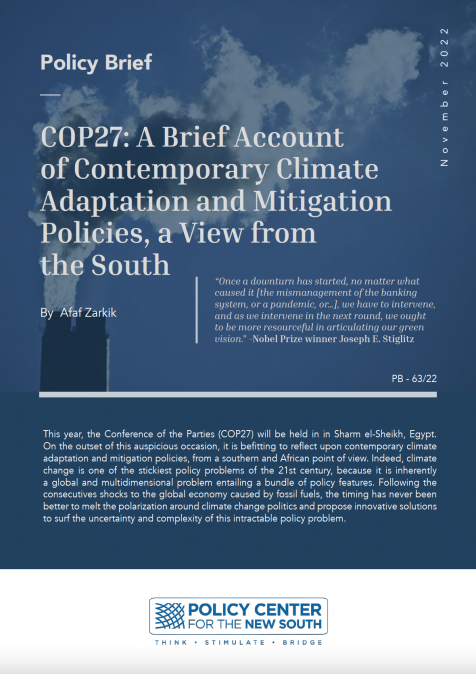
    This year, the Conference of the Parties (COP27) will be held in in Sharm el-Sheikh, Egypt. On the outset of this auspicious occasion, it is befitting to reflect upon contemporary climate adaptation and mitigation policies, from a southern and African point of view. Indeed, climate change is one of the stickiest policy problems of the 21st century, because it is inherently a global and multidimensional problem entailing a bundle of policy features. Following the consecutives shocks ...
  • Authors
    March 16, 2022
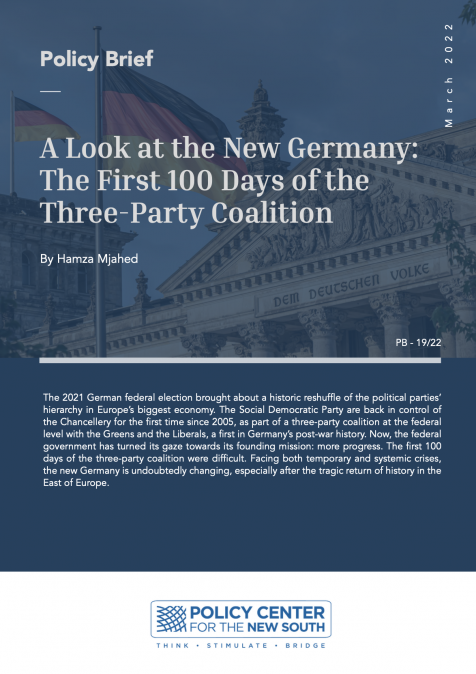
    The 2021 German federal election brought about a historic reshuffle of the political parties’ hierarchy in Europe’s biggest economy. The Social Democratic Party are back in control of the Chancellery for the first time since 2005, as part of a three-party coalition at the federal level with the Greens and the Liberals, a first in Germany’s post-war history. Now, the federal government has turned its gaze towards its founding mission: more progress. The first 100 days of the three-pa ...
  • May 16, 2017
    Ce podcast est présenté par Mme. Gabrielle Desarnaud, chercheur au Centre Energie de l’IFRI. Un peu plus de trois ans se sont écoulés depuis le lancement des routes de la soie par le Prés ...