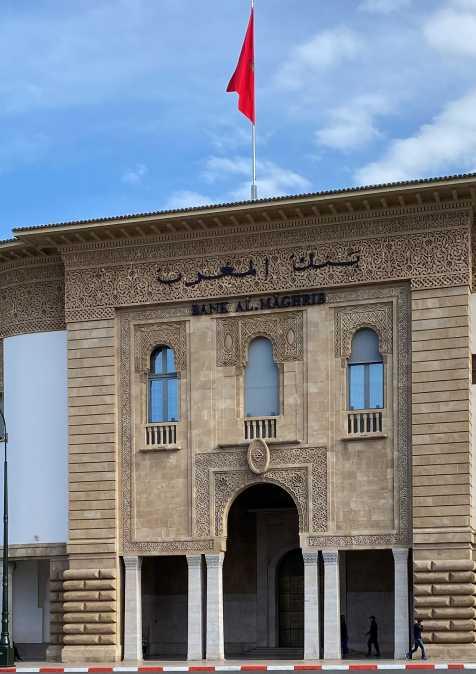
Marchés de capitaux et marchés financiers : quels leviers de développement au Maroc ?

May 11, 2026

Cet épisode interroge la capacité du Maroc à atteindre ses ambitions économiques avec un système de financement encore largement dominé par les banques. Dans un contexte de besoins croissants en investissement et de transformation du tissu productif, les marchés de capitaux apparaissent comme un levier stratégique pour mobiliser l’épargne, soutenir les entreprises et diversifier les sources de financement. À travers l’analyse de Mohammed Benmoussa, l’épisode met en lumière les réformes et dynamiques nécessaires pour faire des marchés de capitaux un moteur durable de croissance et de compétitivité pour le Maroc.

Speakers

Ahmed Ouhnini
Economist, Policy Center for the New South
Ahmed Ouhnini is an Economist at the Policy Center for the New South. His research area covers agricultural economics, human and social development. Previously, he has worked as a researcher at the Paris School of Economics (PSE) and has also a record of working in consulting services in Morocco. Ahmed holds an engineering Diploma in Agriculture and Rural Development from the National School of Agriculture of Meknes and a Master’s Degree in Law, Economics and Management from the Paris 1 Pantheon Sorbonne Institute of Development. ...

Mohammed Benmoussa
Affiliate Professor, Mohammed VI Polytechnic University, Rabat
Mohammed Benmoussa is a Moroccan economist and senior consultant in economic policy, taxation, and public finance, as well as a former banker and capital market practitioner. He is Professor of Corporate and Market Finance at Mohammed VI Polytechnic University. In December 2019, he was appointed by HM King Mohammed VI to the Special Commission on the New Development Model. He is also President of the Forum of Progressive Economists, President of the Damir Movement and the La Samir Front. He previously served as President of the Brokerage Firms Association and Vice-President of the Casablanca Stock Exchange. ...

RELATED CONTENT

  • Authors
    June 24, 2022
    In its May 15th meeting, the Federal Open Market Committee of the U.S. Federal Reserve (Fed) lifted its benchmark policy rate by 0.75% to 1.50%–1.75%, the biggest increase since 1994. The central bank also signaled an additional increase of 0.75% ahead. FOMC members also raised the median projection for the Fed funds rate to a range between 3.25% and 3.50% next year. In addition to hikes in basic interest rates, liquidity conditions in the US economy will also be affected by the sh ...
  • Authors
    Rishita Mehra
    June 24, 2022
    For today’s middle-income countries in Africa, innovation is essential to sustain growth and promote the transition to high-income status. This paper begins by providing an in-depth review of the region’s innovation performance during the last three decades. A distinction is made between residents and non-residents, and outcomes at different income levels. Using cross-country regressions, we then study the determinants of innovation and assess the impact of innovation on growth in t ...
  • Authors
    Moubarack Lo
    Mohamed Ben Omar NDIAYE
    June 15, 2022
    La question de la mise en œuvre du projet de monnaie unique de la CEDEAO a encore été au centre des discussions entre les chefs d’État de la CEDEAO lors de leur 57ème session ordinaire, tenue à Niamey le 7 septembre 2020, et lors de laquelle ils ont décidé pour diverses raisons un nouveau report à une date ultérieure, après ceux de 2003, 2005, 2009 et 2015. Les chefs d’État ont aussi évoqué l’élaboration d’une « nouvelle feuille de route », sans toutefois déterminer u ...
  • June 10, 2022
    The latest IMF projections indicate that global growth will be 4.4% in 2022 after 5.9% in 2021. These projections make us very optimistic for the future, but they certainly cannot heal th ...
  • June 7, 2022
    يعتبر التضخم مقياسا اقتصاديا يعنى بتطور الأسعار في أسواق السلع والخدمات كما انه يرصد القدرة الشرائيّة. وقد شهد معدل التضخم مؤخرا ارتفاعات غير مسبوقة في بقاع عدة، قارن بعض الخبراء الاقتصاديين بينها وبين مرحلة الركود التضخمي في سبعينيات القرن الماضي، اخذين كمنطلق مجموعة من ...
  • May 20, 2022
    Traders have worried that the war involving Russia and Ukraine could stoke inflation, further disrupt supply chains and derail the global economic recovery. Scarcity of food has led ...
  • Authors
    May 18, 2022
    The world food price index collected for the last 60 years by the United Nations Food and Agriculture Organization (FAO) hit its highest record in March, declining gently in April. Pandemic, war and death in Ukraine, and droughts in the last 2 years… Such a combination looks apocalyptical. Now it is adding global hunger risks, because of the food price crisis. The rise in global food prices started in mid-2020 because supply chain disruptions triggered food stockpiling. Mobility r ...
  • April 29, 2022
    Following on the heels of the COVID-19 pandemic and severe drought in North Africa, the Russian invasion of Ukraine – large exporters of food and, in the case of Russia, energy— may inflict increased hunger on the food insecure in Morocco – despite mitigating measures by the government. Morocco is so far successfully shielding its large poor and vulnerable population by subsidizing essential commodities. With memories of the violent protests during the 2007/08 food and fuel crisis ...
  • Authors
    April 22, 2022
    Emerging market and developing economies (EMDE) face a common set of external shocks: rising energy and food prices; tightening in global financial conditions caused by the prospect of sharper interest rate hikes and anticipation of "quantitative tightening"; and return of restrictions on mobility in China, on account of the Covid zero policy, leading to slumping in growth and weakening one of the primary growth drivers for the other EMDE. However, the impacts of those common shocks ...
  • Authors
    March 15, 2022
    The war in Ukraine is bringing substantial financial, commodity price, and supply chain shocks to the global economy. Sanctions on Russia are already having a significant impact on its financial system and its economy. Price shocks will have a global impact. Energy and commodity prices—including wheat and other grains—have risen, intensifying inflationary pressures from supply chain disruptions and the recovery from the pandemic. The push toward relative deglobalization received fro ...