This podcast features Ingmar Juergens, CEO and co-founder of Climate & Company, discussing the challenges and opportunities of sustainability transitions and cross-regional cooperatio ...
The episode discusses the High Seas Treaty as a major step for global ocean governance and marine biodiversity protection. Rear Admiral Nuno Bragança highlights its importance for African countries, particularly in terms of cooperation, capacity-building, technology transfer, and marine...
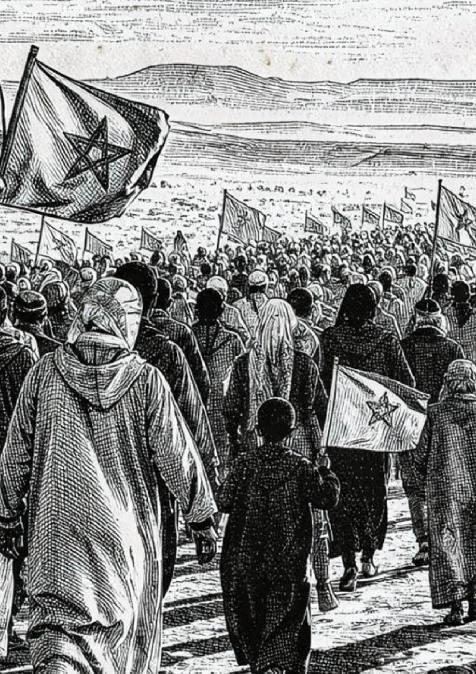
The Green March cannot be regarded merely as a historical event confined to a particular time and place—a completed undertaking. Rather, it should be understood as an ongoing process with far-reaching consequences that continue to unfold and shape the present.
...
La Marche Verte ne peut être perçue seulement comme un événement daté, historiquement situé, une action accomplie et achevée. L’événement n’a pas fini d’apparaitre comme un processus aux prolongements très variés, aux conséquences multiples, étalés sur le temps et déployant leurs effets jusqu'à aujourd’hui.
...
Geopolitical rivalries, and especially the competition for access to critical minerals, could be an opportunity for Africa. The objective of African mineral exporters is to diversify their partners and increase processing and value addition on the continent in order to create jobs and enhance export revenues.[1] To succeed, African exporters of critical minerals need to strengthen their coordination and develop joint infrastructure projects and regional value chains. The creation of ...
As part of the OECD Multilateral Development Finance Week 2026 (MDF Week), the Policy Center for the New South (PCNS) is organizing a webinar entitled “Rethinking Development Finance: African Agency and the Future of Multilateral Development Co-operation after ODA Retrenchment.” The dis...
Ce papier a été initialement publié dans la revue Carrefours de l'éducation n°61 L’écart entre les sexes en matière de réussite éducative demeure une préoccupation majeure au Maroc. Cette étude analyse les disparités de genre en lecture et en mathématiques aux niveaux national, urbain et rural, en exploitant des données individuelles issues de l’évaluation PIRLS 2021 (7 017 élèves) et de TIMSS 2019 (13 536 élèves), toutes deux menées auprès d’élèves de 4e année du primaire. En ...
Le rapport annuel sur la géopolitique de l’Afrique est cette année à sa dixième édition, cela fait donc dix ans que le Policy Center for the New South consacre à l’Afrique une tribune par laquelle les africains tentent de récupérer le narratif sur leur continent. Ce chiffre 10 n'est pas anodin : il marque la maturité d'un projet éditorial fondé sur une conviction simple mais exigeante : l'Afrique doit se penser elle-même, depuis elle-même, avec les instruments analytiques ...
L’édition 2026 du Rapport annuel sur la Géopolitique de l’Afrique (RAGA) du Policy Center for the New South analyse un continent africain saisi par une double transformation : celle du système international, plus fragmenté, plus conflictuel et plus transactionnel ; et celle des environn...
The energy shock caused by the war between the United States and Israel and Iran has highlighted the need for Africa to refine more of its own crude oil. Africa is a net hydrocarbon exporter, but remains stuck in the old colonial economic model: it mostly exports raw materials and imports refined products. Africa exports about 2.6 billion barrels of crude oil every year, and imports about 1.4 billion barrels of refined products. This is a problem for two reasons. First, Africa ...