Publications /
Policy Brief
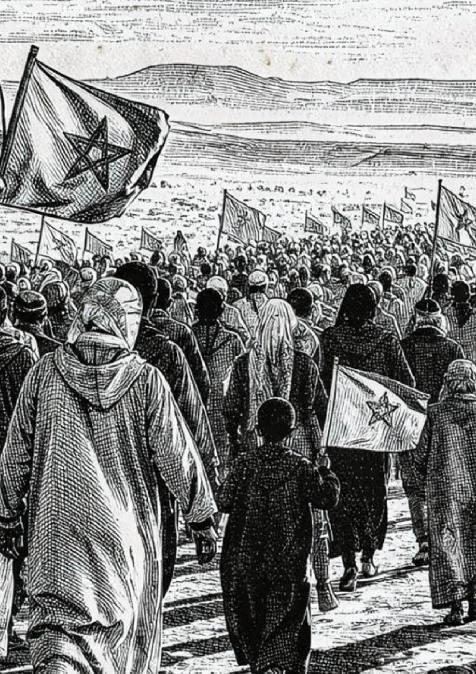
The Green March cannot be regarded merely as a historical event confined to a particular time and place—a completed undertaking. Rather, it should be understood as an ongoing process with far-reaching consequences that continue to unfold and shape the present.
A Crucial Period
Declassified documents dating from Henry Kissinger’s tenure as U.S. Secretary of State have already shed light on the early developments of the Sahara issue, through records of his diplomatic exchanges and visits across the region’s capitals and his communications with their leaders. The recent declassification of additional confidential documents provides further details regarding the years following the Green March, during the Jimmy Carter administration (1977–1981).
This was a crucial period for Morocco, marked by significant threats and uncertainty. The declassified documents shed new light on the period’s political and security context and the constraints confronting Morocco, the sequence of events and the broader significance of this pivotal phase in the Sahara issue.
1. Of the 89 declassified documents, 48 concern the Sahara. Taken together, highlight the sustained diplomatic and political efforts undertaken by the late King Hassan II in the years following the Green March.
Reading the declassified documents provides valuable insight into the period between 1977 and 1980. They include minutes and summaries of meetings between U.S. officials and representatives of countries in the region, diplomatic telegrams, circulars sent by the U.S. administration to its ambassadors, reports prepared for the Pentagon or the National Security Council, and letters sent directly to President Jimmy Carter. Their contents encompass instructions, intelligence briefings, follow-up assessments, warnings, alerts, and policy recommendations.
This was a particularly sensitive period, shaped by a succession of major developments: Morocco’s military successes and setbacks; its security vulnerabilities amid intense guerrilla warfare; visits by U.S. officials to the region and by regional leaders to Washington, notably King Hassan II’s meeting with President Carter; the death of Algerian President Houari Boumediene; the 1978 coup d’état in Mauritania and the country’s subsequent withdrawal from the portion of the territory it had administered as Tiris al-Gharbiyya; and Morocco’s subsequent assumption of control over the territory previously administered by Mauritania. The period was also marked by the expansion of Soviet influence in Africa, accompanied by an expanding Cuban presence on the continent, changes in the U.S. position on Morocco’s security needs, and the gradual emergence of a new U.S. strategic outlook toward the region.
Reading these previously classified documents provides valuable insight into the period from 1977 to 1980. These documents include minutes, meeting summaries of discussions between U.S. officials and officials from countries in the region, telegrams, circulars sent by the U.S. Administration to its ambassadors, reports intended for the Pentagon or the National Security Council and even letters sent directly to President Jimmy Carter, in the form of instructions, intelligence briefings, follow-ups, warnings, alerts, and advice…
It should be noted that this was a highly sensitive period due to the events that marked it, the military successes and setbacks for Morocco, security vulnerabilities in the face of a fierce guerrilla war, visits by U.S. officials to the region and by regional leaders to Washington (notably the meeting between Hassan II and Jimmy Carter), the death of Algerian President Boumediene, the coup d’état in Mauritania and that country’s withdrawal from Rio de Oro, Morocco’s subsequent takeover of the region, Soviet advances in Africa, supported by a stronger Cuban presence on the continent; the evolution of the U.S. position on Morocco’s security; and the evolving political vision that the United States is developing in this part of the world.
Key Players Behind the Scenes
The declassified documents reveal the names of several key figures. On the Moroccan side, those involved include the late King Hassan II; M’hamed Boucetta, then minister of foreign affairs; Ali Benjelloun, then Morocco’s ambassador to the United States; and Ahmed Osman, then prime minister of Morocco. On the U.S. side, those mentioned include President Jimmy Carter, Vice President Walter Mondale, Secretary of State Cyrus Vance, William Quandt, Gary Sick, Ambassador Richard B. Parker and several members of Congress, including Stevens, Representative Stephen Solarz and Senator Dick Clark.
These documents outline Morocco’s overall strategy, as presented by the late King Hassan II in a document dated November 18, 1978. They also shed light on the initial policy of neutrality adopted by the Carter administration toward the Sahara issue at a time when the U.S.–Soviet rivalry was intensifying and competing superpower influences were becoming increasingly pronounced across Africa.
Two main themes emerge from these documents:
a. The U.S. position was initially grounded in political, legal, and technical arguments, as well as, at times, economic considerations. Although officially neutral at first, the U.S. position gradually shifted away from its initial neutrality in response to the geopolitical changes then taking place in Africa.
b. Cooperation between Moroccan and U.S. officials eventually enabled Morocco to secure approval for its repeated requests to purchase arms.
Soviet and Cuban Pressure on Africa
2. Initially, Moroccan and U.S. assessments of the regional situation differed. Nevertheless, both sides characterized the regional environment as marked by the expansion of Soviet and Cuban influence in Africa, which they regarded as a threat. Moroccan officials sought to portray Algeria as aligned with the Soviet bloc, although Algeria maintained relations with both Cold War blocs.
According to the late King Hassan II’s assessment, the Sahara issue unfolded during this period against a backdrop of expanding Soviet and Cuban influence in Africa. Morocco sought to maintain close relations with the United States, which it regarded as serving the interests of both countries and as reflecting the values and perspectives they shared on a range of issues. In the King’s view, Africa and the Middle East were experiencing a period of profound instability.
Moroccans Dissatisfied with the West's Attitude
Within this geopolitical context, the late King Hassan II was convinced that Morocco served as a model for countries of what was then termed the “Third World.” The comparison he drew with Algeria’s position on the international stage illustrates his perception of the asymmetry between the two countries’ alliances. Algeria, which he viewed as aligned with the Soviet bloc, benefited from the advantages associated with that alignment, including diplomatic support, propaganda assistance, military aid, and arms. By contrast, Morocco, as an ally of the Western bloc, encountered reservations, hesitation and a degree of distance from its allies. He noted what he perceived as Western countries’ reluctance to support Morocco’s position on the Sahara and considered this alliance dynamic perplexing. The late King Hassan II therefore expressed his dissatisfaction with the West’s stance.
The declassified documents show that U.S. officials instructed their diplomats to encourage Morocco to pursue a negotiated settlement with the parties to the dispute. The diplomats were instructed to avoid specifying the contours of a final settlement, refrain from contacting the Polisario Front until a credible framework for a settlement had been developed, and prepare for a possible mediation role, potentially with the support of Saudi Arabia, France, and Spain.
The Delicate Issue of Armaments: The documents also reveal another central concern: armaments. The United States sought to align its arms policy with its diplomatic objectives. This alignment was particularly important because many officials within the U.S. administration, as well as several members of Congress, particularly members of the House of Representatives, took it upon themselves to distinguish publicly between those areas of the Sahara over which the Kingdom’s sovereignty is fully exercised and those that, in their view, are merely under its “administrative control,” a distinction firmly rejected by Morocco as incompatible with its sovereignty over the Sahara.
In support of this distinction, U.S. officials cited an additional argument based on the 1960 Convention between the United States and Morocco, which they interpreted as permitting the use of U.S. weapons only in territories recognized by the United States. To override these provisions, the terms of the Convention would have to be amended, according to the Moroccan negotiators’ U.S. counterparts.
Several declassified documents refer to this interpretation, which Moroccan officials disputed. The U.S. administration thus cited opposition among many members of Congress. This allowed the administration to argue that it could not consider asking Congress to approve the sale of arms to Morocco. Together, these considerations were invoked to justify the U.S. decision not to sell weapons that could be used in the Sahara, when Morocco desperately needed such weapons on the battlefield.
The challenges faced in the Sahara in the late 1970s prompted Morocco to seek to improve the capabilities and firepower of its arsenal in the face of well-armed adversaries. It faced opposition from the Carter administration and from many members of the U.S. Congress at a critical juncture.
Among the most revealing documents is a telegram sent by U.S. Secretary of State Cyrus Vance (1977–1980) to the U.S. Embassy in Rabat on March 7, 1978. It contained detailed instructions directing the ambassador to explain to Moroccan officials how difficult it would be for U.S. institutions to approve an arms deal involving weapons whose use would not be limited solely to territories over which Moroccan sovereignty is recognized by the United States. This central point of the letter was supported by a series of arguments intended to assist U.S. diplomats in responding to Moroccan objections.
3. This rigidity in the U.S. position can be partly attributed to opposition from influential members of Congress, including Stephen Solarz and Dick Clark. The declassified documents shed light on their efforts to resist Morocco’s demands. Among these documents is a letter addressed directly to President Carter and signed by Solarz and other members of Congress, illustrating the strength of this opposition.
Following a tour of the countries in the region, during which he met with King Hassan II and President Chadli Bendjedid, Solarz presented President Carter with a carefully constructed argument. The letter demonstrates the extent to which Solarz opposed the sale of arms to Morocco, warning the Carter administration that approving the Kingdom’s requests could provoke a confrontation with Congress. Solarz not only called for the use of U.S. weapons to be limited to areas outside the southern provinces, a stance implying non-recognition of Morocco’s sovereignty over the Sahara, but also urged the Carter administration to establish contact with the Polisario Front, which he appeared to support fully. The letter indicates that he regarded it as “a genuine national liberation movement.” He openly expressed the view that the sale of weapons to Morocco and their use in the Sahara ran counter to U.S. interests and values.
Solarz went even further in this document by highlighting the advantages of an independent state in the Sahara that he believed would not be hostile to the United States. “Based on my discussions with them,” he wrote to the president, “they do not support Marxism or the Soviet Union.” He openly advocated support for the Polisario Front and full backing for Algeria.
Solarz argued that, from a U.S. perspective, Algeria appeared more important than Morocco. At the time, Algeria accounted for 9% of U.S. crude oil imports, while U.S. companies had secured approximately $6 billion in construction contracts since the early 1970s. From a broader strategic perspective, Solarz emphasized that Algeria was of greater strategic importance, particularly in terms of the diplomatic support it could provide to the United States. In this regard, he cited Algeria’s joint efforts with Yugoslavia to prevent Cuba from mobilizing the Non-Aligned Movement in support of the Soviet Union, in addition to its opposition to Soviet and Cuban policies in Cambodia, Ethiopia, and Uganda. In retrospect, these arguments appear reductive, as other motivations also shaped Algeria’s diplomatic conduct. In the same letter, Solarz informed President Carter of Algerian President Bendjedid’s desire to visit Washington but made no mention of his own meeting with the late King Hassan II.
Morocco Expresses Concern Over the Security Situation in Mauritania
4. Declassified documents from the Carter administration pertaining to the Maghreb highlight another significant event of that period: the coup d’état of July 10, 1978, and its implications for the Sahara issue.
A memorandum from the National Security Council dated July 27, 1978, summarizes a discussion between King Hassan II and Richard “Dick” Sanders on July 15 in Rabat concerning the situation in Mauritania, a few days after the coup. During this meeting, the Moroccan monarch shared with his U.S. interlocutor his concerns about the new political situation in Mauritania. He foresaw that Mauritania would cede to the Polisario Front the part of the Sahara it had previously administered under the Madrid Agreement, a development Morocco would not accept. The U.S. National Security Council appeared to discount this possibility. This development nevertheless occurred twelve months later. Only later did U.S. officials appear to obtain information supporting this assessment.
Later, as the relinquishment of Río de Oro drew near, Mauritanian officials informed Morocco of Mauritania’s decision to withdraw from the conflict and relinquish Río de Oro. Mauritania did so on August 14, 1979. King Hassan II reacted swiftly. Moroccan authorities immediately deployed the Moroccan army throughout the province; local leaders declared their allegiance to the King; the Ministry of the Interior issued a decree formally establishing the territory of Dakhla; and a ceremony was held during the Throne Day celebrations in Dakhla, at which residents of these provinces pledged their allegiance. The recovery of Dakhla significantly advanced negotiations over an agreement for U.S. arms sales to Morocco.
A memorable event
From the outset, there had been discussions about Morocco acquiring ten OV aircraft, helicopters, and F-5s. Following arduous negotiations led by King Hassan II and subject to the conditions outlined below, Morocco eventually acquired CH-4.7 fighter jets. This was the most significant outcome of the U.S.-Moroccan relationship during this period.
5. U.S. officials insisted that the weapons supplied to Morocco be used only to defend the part of the country recognized by the United States as being under Moroccan sovereignty.
Following his meeting with King Hassan II on November 18, 1978, Cyrus Vance offered the following explanation: “We have a political problem in Congress; we have no other choice.” To overcome congressional opposition, he requested, at a minimum, that the prospective agreement between the two parties specify where the weapons might be used. He asserted that U.S. officials would have no objection if a written agreement specified that the weapons would be used only in the north. Alternatively, it would be sufficient to specify that they were intended to counter an act of aggression. The Moroccan ambassador to the United States then told U.S. Ambassador Parker in Rabat that the United States should show greater understanding of Morocco’s needs. U.S. officials nevertheless maintained their objections.
At this point, the Sovereign asked the ambassador to propose to U.S. officials what he called “the Kosygin formula.” This formula originated in earlier Moroccan-Soviet negotiations. At the time, the late King Hassan II had sent Morocco’s then prime minister, Ahmed Osman, to Moscow to prepare for the negotiation of two agreements: one concerning phosphates, which was concluded quickly and without difficulty, and another concerning fisheries, which was initially welcomed by Soviet officials. However, they subsequently grew more reluctant because of the status of the Saharan coast. In discussions with the Soviet negotiators, led by Kosygin, the Moroccan delegation, headed by Ahmed Osman, suggested to its counterparts that the Soviet reluctance could only be understood as “the result of Algerian pressure.” Kosygin reacted angrily, responding that the Soviet Union was an independent state and was not subject to external pressure. He left the negotiations, and the Moroccan delegation believed that the fisheries negotiations had ended. A few moments later, to everyone’s surprise, Kosygin returned with a formulation that was acceptable to both sides: “Fishing will take place along the entire Moroccan coast.” In his discussions with U.S. officials, Hassan II referred to this formulation as “the Kosygin clause” and asked the Moroccan ambassador to propose this sufficiently broad wording, which could accommodate both parties. King Hassan II sought to incorporate this wording into the U.S. arms agreement. Negotiations between the ambassadors therefore focused on this wording.
Ambassador Parker first proposed a text stipulating that U.S. weapons would be used solely for the defense of Morocco and could under no circumstances be used outside Moroccan territory. Moroccan officials understood “Moroccan territory” to include the Sahara. Although they did not distinguish between the Sahara and the rest of Morocco, they emphasized that they did not wish to place U.S. officials in a difficult position.
Ultimately, both sides agreed that, in accordance with the 1960 U.S.-Moroccan Military Assistance Agreement, the weapons could be used to defend the territorial integrity of the Kingdom of Morocco, including in the event of a major attack on the Moroccan armed forces by a foreign military. The Polisario attacks, the broader geopolitical context in Africa, the Kosygin formula, and the King’s tenacity, flexibility, and skill helped bring about the reversal of the U.S. decision following consultations with the Senate and the House of Representatives.
In short, the Carter administration placed significant constraints on Morocco during a period of acute insecurity, but the late King Hassan II succeeded in achieving his objective.