Africafé : Crise énergétique mondiale : quels risques pour les économies africaines ?

June 4, 2026

La guerre contre l’Iran et le blocage du détroit d’Hormuz ont déclenché une crise énergétique mondiale qui perturbe les marchés du pétrole et du gaz. Dans cet épisode d’Africafé, Francis Perrin analyse les conséquences de cette situation sur les économies africaines, en distinguant les défis des pays importateurs et les opportunités pour certains producteurs. Il revient également sur les enjeux du raffinage, de la sécurité énergétique et de la coopération régionale pour renforcer la résilience du continent face aux chocs futurs.

Speakers

Francis Perrin
Senior Fellow
Francis Perrin is a Senior Fellow at the Policy Center for the New South who focuses on energy.  Following studies in economics and political science at the University Pierre Mendès France (UPMF – today University Grenoble Alpes) at Grenoble (France), Francis Perrin worked for several years as a journalist and freelance consultant on energy and mining resources before joining in 1991 the Paris-based Arab Petroleum Research Center (APRC). He was editor in chief of Arab Oil & Gas (AOG) and Pétrole et Gaz Arabes (PGA) between 1991 and 2000 and editorial manager of the publications of the APRC from 2001 to the end of 2011. Francis Perrin set up at the beginning of 2012 Stratégies et Politiques Energétiques (SPE) and later Energy Industries Strategies Information (EISI).& ...

Fatim Zohra Azouzou
Junior Analyst - International Relations - Policy Center for the New South
...

RELATED CONTENT

  • November 19, 2021
    This Podcast is based on a Policy Brief by Rim Berahab and Uri Dadush. It examines how Morocco progresses on the mitigation component of its Nationally Determined Contribution (NDC) targe ...
  • November 9, 2021
     As COP 26 unfolds, more attention is likely to be paid to big emitters such as China and the United States than to the situation of small developing countries, even though they are more exposed to the consequences of climate change. Morocco falls into this category. This Policy Brief examines Morocco's mitigation objectives under its NDCs and its performance to date before exploring the needed measures to achieve the 2030 mid- term goal. Although Morocco has made significant p ...
  • November 9, 2021
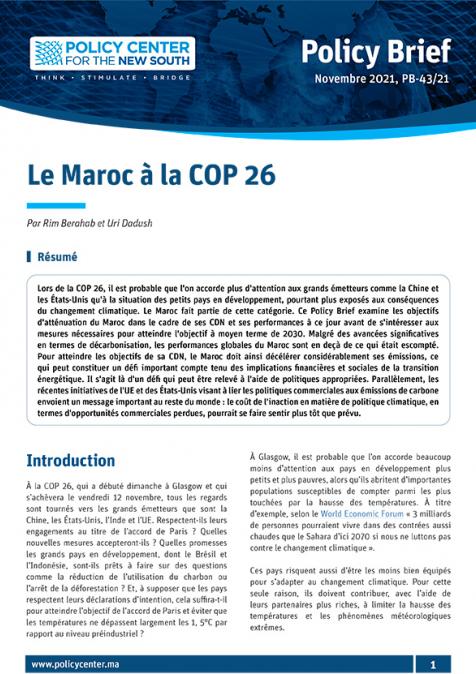
     Lors de la COP 26, il est probable que l'on accorde plus d'attention aux grands émetteurs comme la Chine et les États-Unis qu'à la situation des petits pays en développement, pourtant plus exposés aux conséquences du changement climatique. Le Maroc fait partie de cette catégorie. Ce Policy Brief examine les objectifs d'atténuation du Maroc dans le cadre de ses CDN et ses performances à ce jour avant de s'intéresser aux mesures nécessaires pour atteindre l'objectif à moyen term ...
  • Authors
    November 2, 2021
    Quelques jours avant le début de la COP 26 à Glasgow, en Ecosse, la Commission africaine de l’énergie (AFREC) (a) a voulu souligner que le gaz naturel pouvait jouer un rôle important dans le paysage énergétique africain. Le 25 octobre, l’AFREC a publié un communiqué de presse pour mettre en valeur une ‘’note d’orientation politique sur l’énergie’’ qui avait été achevée en juillet 2021. Le changement climatique est largement causé par la production et la consommation massive des éne ...
  • Authors
    Sous la direction de : Philippe Chalmin
    October 25, 2021
    Fruit d’une collaboration étroite entre CyclOpe et le Policy Center for the New South (PCNS), le rapport Arcadia – pour Annual Report on Commodity Analytics and Dynamics In Africa – se fonde sur une réalité bien connue : les matières premières fa- çonnent et façonneront une large part de la physionomie des économies africaines et doivent, en raison de cette dimension stratégique, faire l’objet d’analyses dédiées. À cet égard, ce rapport est probablement unique. Il offre en effet un ...
  • October 15, 2021
    The European Commission recently presented several legislative proposals as part of its “Fit for 55” initiative, designed to accelerate the reduction of greenhouse gas emissions and achieve carbon neutrality by 2050. A Carbon Border Adjustment Mechanism (CBAM) has been proposed as part of this initiative. The CBAM would be complementary to the EU’s Emission Trading Scheme (ETS), involving CBAM certificates issued to importers based on the integrated emissions intensity of the produc ...
  • Authors
    October 1, 2021
    Africa is often overlooked in international policy conversations about climate change, but the continent has not been spared extreme weather events. On the eve of COP26, in Glasgow, United Kingdom, in October 2021, and as the African Union formulates a climate strategy for the continent, it is worth recalling how global warming is affecting different parts of Africa and how the continent fits into policy conversations on climate change. ...