Publications /
Policy Brief
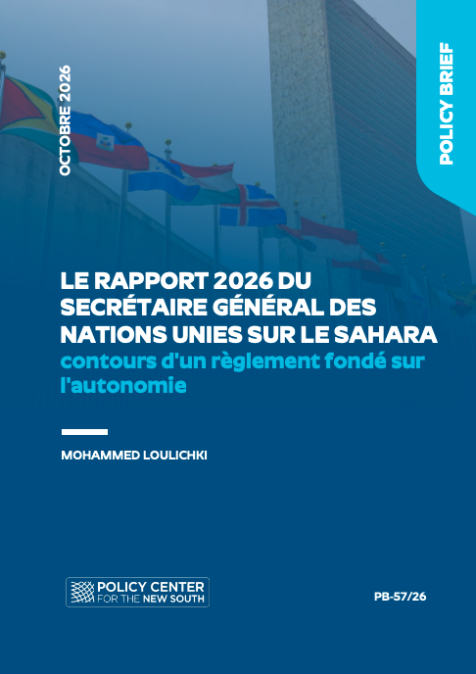
The UN Secretary-General’s report of October 1, 2026 marks an important stage in the evolution of the political process concerning the Moroccan Sahara. As the first report issued since the adoption of Resolution 2797 (2025), it highlights renewed diplomatic momentum, marked by the resumption of substantive four-party negotiations led by the United States with United Nations support.
This development reflects a gradual shift in a debate long focused on the territory’s final status towards the practical arrangements for a negotiated settlement based on Morocco’s Autonomy Initiative.
Four dimensions shape this emerging approach: the central role of autonomy; the possible establishment of a transitional period overseen by a Transitional Council; constitutional, institutional, and international guarantees to ensure that the autonomy regime is stable, effective, and lasting; and the gradual adaptation of MINURSO’s mandate.
Two major ambiguities remain unresolved: the arrangements for what the report calls “meaningful consultation” of the populations of the Sahara, and Mauritania’s request for “consensual clarification of the definitive and permanent international borders of the disputed territory.”
Despite progress in examining certain aspects of autonomy, fundamental differences persist over sovereignty, self-determination, and guarantees for implementing any agreement.
The next Security Council resolution could play a decisive role in sustaining this momentum and clarifying the political and institutional framework for a final settlement by unequivocally identifying a negotiated autonomy status as both the sole starting point and the ultimate outcome of the process to resolve this dispute.
The UN Secretary-General’s new report on the Sahara, submitted to Security Council members on October 1, 2026, is particularly significant for several reasons.[1]
First, it is the first report issued since the adoption of Security Council Resolution 2797 (2025), which gave fresh impetus to the search for a negotiated political solution.
Second, the report documents the launch of a new process led by the United States with United Nations support, in which the four parties—Morocco, Algeria, Mauritania, and the Polisario Front—have, for the first time, engaged in substantive, detailed discussions on Morocco’s autonomy proposal and the arrangements for negotiating and implementing it.
Finally, the document has particular institutional significance: it is António Guterres’s final report on the Sahara before his term of office ends. His legacy could thus include the revival of a process long marked by stagnation, although a successful outcome to the discussions cannot be taken for granted.
The report records three rounds of discussions held in the first quarter of 2026, involving Morocco, the Polisario Front, Algeria, and Mauritania, under a facilitation framework bringing together the United Nations and the United States. Morocco’s autonomy proposal forms the basis of the discussions, but several essential issues remain contentious, particularly sovereignty, self-determination, and the conditions under which the populations concerned would endorse a settlement.
Four main themes emerge: the central place of autonomy in the negotiations; consideration of a possible transitional institutional framework; the pursuit of domestic and international guarantees; and the possibility of adapting MINURSO’s mandate over time as the political process evolves. It is nevertheless essential to distinguish options under discussion from decisions actually taken: neither the Transitional Council nor the framework agreement can, at this stage, be presented as an established feature of the process.
I. The Transitional Period and Transitional Council
Paragraphs 8–10 and 13 of the report refer to discussions on a Transitional Council and a framework agreement that could govern the period between the conclusion of a compromise and its implementation. Such a body would help prepare the institutions of autonomy, coordinate the various actors, and develop arrangements for consulting the populations. It would replace neither the parties nor the negotiating mechanisms, but could provide an additional forum for dialogue and confidence-building.
The idea of a transitional council is not entirely new. Paragraph 32 of Morocco’s initiative of April 11, 2007 already envisaged, following agreement between the parties, a body composed of their representatives, tasked, among other things, with assisting repatriation and disarmament, demobilization, and reintegration. The current debate therefore appears to concern less the principle itself than the council’s composition, powers, safeguards, and relationship with the new negotiating mechanisms.[2]
Subject to agreement, the Council could include representatives of the Moroccan government, the Polisario Front, and the populations concerned, under arrangements yet to be defined. The United Nations and the United States could play a facilitating or supporting role; neither membership nor guarantor status should, however, be assumed without an explicit decision.
The Council’s possible functions could include supporting the gradual transfer of powers, facilitating voluntary return and the reintegration of displaced persons, and assisting disarmament, demobilization, and reconciliation.
International practice shows that transitional periods can serve very different purposes. In Bosnia and Herzegovina, implementation mechanisms supported the execution of a peace agreement; in Kosovo, the UN performed interim administrative functions; and in Bougainville, autonomy arrangements were linked to a consultation on political status. These experiences offer points of comparison rather than directly transferable models.
These precedents demonstrate that transition is an adaptable instrument whose substance depends on the political objective pursued. In the Sahara, it represents a negotiated phase intended to turn an autonomy-based political settlement gradually into an institutional reality, while building the trust, guarantees of cooperation, and conditions for participation needed to sustain it.
II. Guarantees for the Integrity and Durability of the Autonomy Regime
The parties have discussed guarantees as integral components of the transitional period. The issue is no longer simply what autonomy would entail, but also how to ensure its effective implementation, stability, irreversibility, and long-term durability.
International practice and United Nations work expressly identify constitutional and international guarantees, monitoring arrangements, and dispute settlement mechanisms as instruments for preserving the viability and durability of territorial or institutional agreements.
From this perspective, the guarantees would be structured around four levels:
The first concerns the substance of the negotiated autonomy statute itself, particularly compliance in good faith with the autonomy agreement, the division of powers, and the establishment of dialogue mechanisms and judicial bodies responsible for ensuring compliance with the statute.
The second involves incorporating the autonomy statute into Morocco’s constitutional order, so that its existence, core powers, and institutional architecture cannot be altered by ordinary legislation or administrative decision alone. Indeed, paragraph 29 of Morocco’s April 2007 initiative provides that “the Moroccan Constitution shall be amended and the autonomy Statute incorporated into it, in order to guarantee its sustainability and reflect its special place in the country’s national juridical architecture.” In Morocco’s case, this constitutional entrenchment is reinforced by the preamble to the 2011 Constitution, which recognizes the primacy of the Kingdom’s international commitments over domestic law.
The third requires an express provision that no substantive amendment to the statute’s essential elements may be made without the parties’ explicit agreement, thereby ruling out any unilateral change.
The fourth and final level concerns the settlement of disputes over the interpretation or application of the statute.
These domestic safeguards could be supplemented by an international guarantee, a principle that now appears to be among the issues under discussion. If the parties accept such a guarantee, it is reasonable to envisage that the two co-chairs who have led the new process might offer to serve as international guarantors of the future autonomy statute.
International practice recognizes that third states can act as guarantors of a peace agreement and help monitor and uphold its provisions. Examples include the Belfast Agreement, also known as the Good Friday Agreement, concluded on April 10, 1998 and guaranteed by the governments of the United Kingdom and Ireland,[3] and the 2012 agreement between Colombia and the FARC, for which Cuba and Norway acted as guarantors.[4]
The Baker I and II plans offer instructive precedents on guarantees. The first, presented in 2001, envisaged guarantees by the United States and France to ensure that the parties fulfilled their obligations under the agreement.[5]
In the second plan, dating from 2003, the United States and France were no longer designated as guarantor parties. The United Nations assumed that function, particularly through the roles of the Secretary-General, his Special Representative, and MINURSO.
III. MINURSO: An “A” for Adapting Its Mandate
During closed consultations held by the Security Council on April 23, 2026, Asif Khan, an official in the Department of Political and Peacebuilding Affairs, delivered a briefing in which he “cautioned against any premature change to the Mission’s structure or mandate while negotiations were ongoing.”
He reportedly outlined various options for adjusting the Mission’s tasks in the event of a political agreement, including monitoring, observing, and reporting on a ceasefire; facilitating the return of refugees; and supporting a disarmament, demobilization, and reintegration (DDR) process—areas in which the UN has extensive experience.
Security Council members, the Secretariat departments involved in the mediation efforts of the Secretary-General and his Personal Envoy, and their various interlocutors continue to regard MINURSO’s role in preventing escalation, monitoring developments, and maintaining liaison between the parties as valuable and irreplaceable.
Against this backdrop, the Secretary-General’s recommendation to extend MINURSO’s mandate by one year, until October 31, 2027, while taking account of developments in the political process, was foreseeable. It also dispelled rumors of a six-month mandate intended to pressure the parties into engaging more intensively in negotiations.
At the same time, the report indicates that a strategic review of the mandate’s future is underway, informed by the evolution of the negotiations. This is particularly significant: the Mission could gradually become an integral component of the settlement rather than solely a mechanism for monitoring the ceasefire.
Changes to the mandate should not be considered separately from the transitional period, as the two are closely interdependent. Since the transition is conceived as the implementation of a negotiated autonomy agreement, the mandate would change accordingly, turning the Mission into an instrument supporting the implementation of the negotiated autonomy regime. In addition to observing the ceasefire, the Mission could facilitate refugee returns and contribute United Nations support and expertise to the DDR process.
This transformation should be understood as an adjustment to the new momentum and objectives of the ongoing negotiations, rather than a concession to Morocco. In light of this possible evolution, the Mission’s acronym could change from MINURSO to MINUARSO, reflecting the proposed French name Mission des Nations Unies pour l’accompagnement du règlement au Sahara occidental (United Nations Mission to Support the Settlement in Western Sahara).
For now, aside from questions that other aspects of the report may raise, several ambiguities warrant closer examination.
IV. Ambiguities Requiring Clarification
For decades, the search for a solution to the dispute over the Moroccan Sahara stalled over the question of final status. Resolution 2797 and the new report issued pursuant to it point to a different paradigm, grounded in realism and compromise: how to build an acceptable political settlement based on autonomy under Moroccan sovereignty, and how to organize, implement, and stabilize it.
In other words, autonomy now provides the framework for negotiation, and the debate is increasingly focused exclusively on the practical arrangements for its implementation and on securing support among the territory’s population for the negotiated autonomy settlement.
Four conditions would need to be met: Algeria’s willingness to contribute constructively to the negotiations and cease obstructing the prospect of a successful outcome; Morocco’s readiness to develop its proposal further so as to make it “genuine” and consistent with the “highest international standards”; continued United States engagement and pressure for meaningful progress to prevent the process from stalling; and the consent of the other Security Council members, particularly the permanent members, to support this approach.
Two ambiguities in the report require particular attention: consultation of the populations and Mauritania’s request during the negotiations concerning the Sahara’s borders.
1. Consultation of the Populations of the Sahara
On the first issue, the Secretary-General’s latest report states: “I wish to stress that any proposal must undergo a process of meaningful consultation with the people of Western Sahara, enabling them to choose freely and voluntarily whether to accept or reject it. This consultation process is essential to ensure that the people of Western Sahara are not further deprived of their inalienable right to self-determination” (para. 61).
The expression “meaningful consultation” must be interpreted in the context of the ongoing negotiations, on the basis of Resolution 2797, and in light of the evolution of international efforts over the past thirty years. Those efforts have gradually shifted towards a political approach aimed at overcoming the impasses of the referendum process, in contrast to the approach advocated by Algeria and the Polisario Front, and in favor of a realistic, pragmatic political compromise. Within this perspective, the discussions have established Morocco’s proposed autonomy regime as the negotiating framework for a final political settlement of the Sahara issue.
Accordingly, the Personal Envoy’s emphasis on this expression cannot entail a return to a conventional referendum on self-determination. It introduces a participatory dimension into the understanding of self-determination, something already guaranteed by two provisions of Morocco’s Autonomy Initiative, proposed in 2007 and further developed in 2025. This is a strategic variable whose implications will need careful assessment to avoid any reversal of the momentum generated by Resolution 2797.
Three unresolved questions will determine the scope of this concept: the definition of the electorate to be consulted, which requires a credible, transparent, and inclusive identification process; the form of the consultation and the substance and wording of the question to be put to participants; and the relationship between consultation and the implementation of autonomy. The answers will largely determine whether consultation is compatible with a negotiated political solution and whether the gains achieved through the process can be protected against reversal.
The proposal by the Office of the United Nations High Commissioner for Refugees (UNHCR) to organize individual, voluntary “go-and-see visits,” allowing Sahrawi refugees to travel to Laayoune and Dakhla to learn more about conditions in the Sahara and the details of Morocco’s autonomy proposal (para. 49), offers a practical means of involving them in the process. Such visits would allow them to form their own views in light of the socioeconomic realities observed on the ground, and to compare the information available to them with a firsthand assessment, free from preconceptions and propaganda.
Finally, the emphasis on compromise, mutual acceptance, negotiation, guarantees, and consultation of the populations concerned should be accompanied by an unequivocal commitment by the parties to act in good faith, with integrity and transparency, and to refrain from ambiguous strategies that could undermine the process.
It would indeed be difficult to envisage a negotiating process underway for almost half a century, and now seemingly moving towards a settlement, being derailed by the very populations whose aspirations are meant to inform it throughout. Their representatives would therefore be responsible for ensuring their support for the envisaged settlement.
2. Mauritania’s Request
The Secretary-General’s report states that “during the second round (Madrid, February 8–9, 2026) and subsequent sessions, Mauritania emphasized the need to establish a commission tasked with clarifying, by consensus, the definitive and permanent international borders of the disputed territory” (para. 8). This passage calls for several observations:
Mauritania’s decision to raise the request at the Madrid session and subsequent meetings indicates the importance it attaches to the issue and its wish to see it given serious consideration.
Its proposal to establish a commission to examine the issue further underscores that importance.
According to Mauritania, the request seeks only “clarification,” to be reached “by consensus.”
It concerns “definitive and permanent international borders,” a particularly deliberate and precise formulation.
The wording clearly rules out any assertion or claim of sovereignty and appears to point instead to political, security, or economic guarantees that Mauritania may wish to obtain from Morocco, which alone would exercise sovereign powers, including the protection and defense of the Kingdom’s borders. This follows from Mauritania’s withdrawal from the southern part of the Sahara in 1979, after concluding an agreement with the Polisario Front on August 5 of that year.[6]
Following the agreement, Mohamed Khouna Ould Haidalla, former President of Mauritania (1980–1984), reportedly traveled to Rabat to inform King Hassan II of his country’s decision “to end the war definitively and withdraw from the region … regardless of who occupies the region after us, there remains one location that we will relinquish only at the end of the conflict, namely the Lagouira area.”[7]
Moreover, unlike Morocco, Mauritania is among the African states that accepted the principle of the inviolability of borders inherited from colonial rule. The borders of the “former Spanish Sahara” also appear on maps deposited with the United Nations that clearly delineate the territory.
Since the report contains neither an explicit indication nor an implicit reference that might explain the motivations behind this request, any explanation must necessarily remain a hypothesis.
The first hypothesis that comes to mind concerns the situation of Lagouira. It is supported by numerous Mauritanian press articles that consistently place Lagouira’s current status and future, in the context of a final settlement of the Sahara issue, at the heart of Mauritania’s request.
During the colonial period, the line separating Spanish Sahara from French Mauritania crossed the Ras Nouadhibou (Cap Blanc) peninsula, dividing it into two distinct parts. To the south, Nouadhibou fell within Mauritania; to the north, La Güera belonged to Spanish Sahara, under the boundaries established by the Franco-Spanish conventions of 1900 and 1904, as supplemented by specific provisions concerning Cap Blanc.
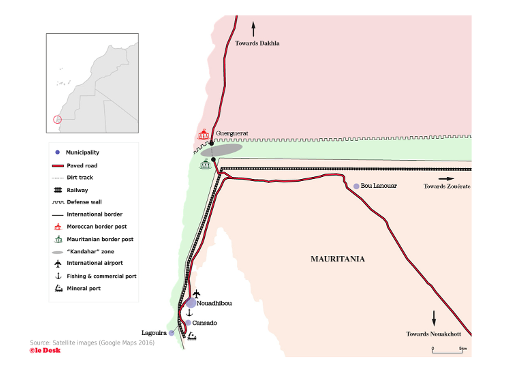
In this context, it is worth recalling that the only instrument delimiting the Morocco–Mauritania border remains the Convention concerning the State frontier line, signed in Rabat on April 14, 1976 and entering into force on November 10, 1976. It allocated the southern part of the Sahara to Mauritania, which withdrew from it in 1979. Morocco subsequently recovered that territory, rendering the Convention obsolete.
Once the Sahara Region’s autonomy statute has been approved and entered into force, Morocco will, for the first time, need to demarcate its newly shared land and maritime boundaries with Mauritania.
The reconfiguration of the land border will affect the starting point and course of maritime delimitation between the two countries, while also requiring consideration of any claims Spain may advance in relation to the Canary Islands. Geographic proximity, the potential overlap of claims to exclusive economic zones and continental shelves, and the interests associated with fisheries, energy, and mineral resources could make a coordinated approach necessary between Morocco, Mauritania, and Spain, all parties to the 1982 United Nations Convention on the Law of the Sea.
Given the sensitivity and complexity of border issues, the requested clarifications could have awaited a final settlement before being discussed and resolved bilaterally between Morocco and Mauritania. Nouakchott has instead chosen, for reasons of its own, to raise the matter at this stage of the negotiations.
Primarily economic considerations appear to underpin Mauritania’s initiative, without excluding legitimate underlying concerns about security, stability in border areas, and the preservation of regional balances.
For Nouakchott, Lagouira’s proximity to Nouadhibou—around fifteen kilometers away—and the risk of uneven competition between the region’s ports and trade corridors could explain the concerns expressed, particularly the fear that new regional economic dynamics centered on the future port of Dakhla might marginalize the port of Nouadhibou.[8]
Beyond these considerations, the initiative could reflect Mauritania’s determination to avoid being left out of major projects capable of reshaping trade and logistics in the area. Rather than an effort to freeze the status quo, it may primarily seek to secure Mauritania’s place in any cross-border regional cooperation initiative. The aim would then be less to challenge developments already underway than to turn a regional transformation imposed on Mauritania into one shaped jointly.
This reading is consistent with the approach advocated by a Mauritanian analyst in an article published in March 2026, which calls for the issue to be understood in light of history, human ties, and the complementarity between two neighboring states. Reflecting on the area’s historical openness, he observes that “it is precisely because this area was long a crossroads rather than a barrier that it continues, even today, to defy simplification … and that the solution may lie not in entrenching antagonisms, but in overcoming them through a coordinated approach based on mutual interests and the pursuit of regional synergies.”[9]
Morocco, which has consistently sought to build a partnership with Mauritania grounded in good neighborliness, mutual trust, and cooperation based on solidarity, will see a final settlement of this issue at the international level as a fresh opportunity to strengthen this privileged relationship. It would allow the two countries to pursue a more ambitious partnership, consolidating a stable and peaceful neighborhood and deepening economic integration in the interests of both countries and the wider region.
Conclusion
In his October 2026 report on the Moroccan Sahara, the UN Secretary-General notes encouraging developments in the political process, despite a persistent and profound lack of trust between the parties and fundamental differences over sovereignty and self-determination. He observes, in particular, that “the Personal Envoy’s interlocutors assured him of their commitment to the process and emphasized the historic nature of the progress achieved. They stressed that the consensus-building process needed to be given the opportunity to succeed” (para. 12).
This assessment is particularly significant because it reflects a marked departure from the stalemate that long characterized efforts to address the dispute. The resumption of four-party negotiations is itself a substantial step forward. More significantly, the discussions have addressed practical aspects of a possible settlement, including the scope and modalities of autonomy, transitional institutional arrangements, international guarantees for implementation, and issues of security, reconciliation, and disarmament.
The new process is still at an early stage and faces major political obstacles. Nevertheless, several factors now warrant cautious optimism: the resumption of high-level political dialogue; substantive discussions on the autonomy statute; the drafting of a framework agreement for a possible transitional period; and, above all, the consolidation of international support for a negotiated solution based on Morocco’s Autonomy Initiative, in accordance with Security Council Resolution 2797 (2025). Together, these developments point to renewed momentum.
The content of the next resolution, and what it may add to the momentum generated by the 2025 resolution, remain to be seen. Its contribution could lie in aligning the operative provisions of Resolution 2797 with its preamble, thereby establishing autonomy under Moroccan sovereignty, as further developed and detailed, as both the sole basis and the ultimate objective of the negotiations, while removing any ambiguity about the scope of the popular consultation intended to endorse their outcome.
Notes
[1] Report of the Secretary-General to the Security Council on the Sahara, S/2026/781, October 1, 2026.
[2] Text of the Autonomy Initiative annexed to report S/2007/202, April 13, 2007.
[3] Government of the United Kingdom, The Belfast Agreement, April 10, 1998, Cm. 3883: https://www.gov.uk/government/publications/.
[4] Norwegian Ministry of Foreign Affairs, “The peace process in Colombia”: https://www.regjeringen.nor.
[5] Annexes to the report of the UN Secretary-General S/2001/613, June 20, 2001 (Baker I), and document S/2003/565, May 23, 2003 (Baker II).
[6] General Assembly document A/34/427 and Security Council document S/13503, August 20, 1979.
[7] Interview published on the Mauritanian website Aqlame, August 9, 2021.
[8] Fadoua Ammari and Rida Lyammouri, “L’initiative atlantique et les relations Maroc–Mauritanie” [The Atlantic Initiative and Morocco–Mauritania Relations], Research Paper RP-09/25, Policy Center for the New South, August 28, 2025.
[9] Mohamed Ould Chriv Chriv, “La Güera et le Sahara occidental : histoire longue d’un territoire disputé” [La Güera and Western Sahara: The Long History of a Disputed Territory], Rapide Info, March 10, 2026.