Podcasts

Back

Why Local Expertise Matters for Africa's Development

In this Episode, Arup Banerji discusses why local expertise—not just international advice—should be intentionally embedded in African development policy. He cites cash transfer programs as an example: the core design came from abroad, but successful adaptation (like dropping conditionalities) relied on local research and context. He also introduces NIA, a new World Bank partnership with African think tanks to turn local research into real policy influence.

RELATED CONTENT

  • Authors
    March 8, 2022
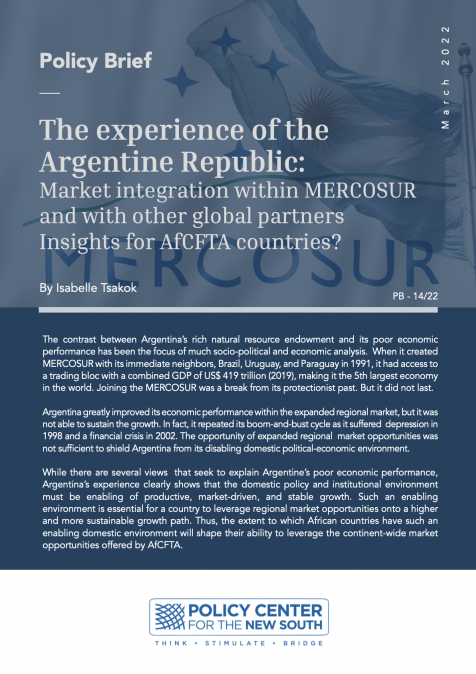
    The contrast between Argentina’s rich natural resource endowment and its poor economic performance has been the focus of much socio-political and economic analysis. When it created MERCOSUR with its immediate neighbors, Brazil, Uruguay, and Paraguay in 1991, it had access to a trading bloc with a combined GDP of US$ 419 trillion (2019), making it the 5th largest economy in the world. Joining the MERCOSUR was a break from its protectionist past. But it did not last. Argentina greatl ...
  • March 1, 2022
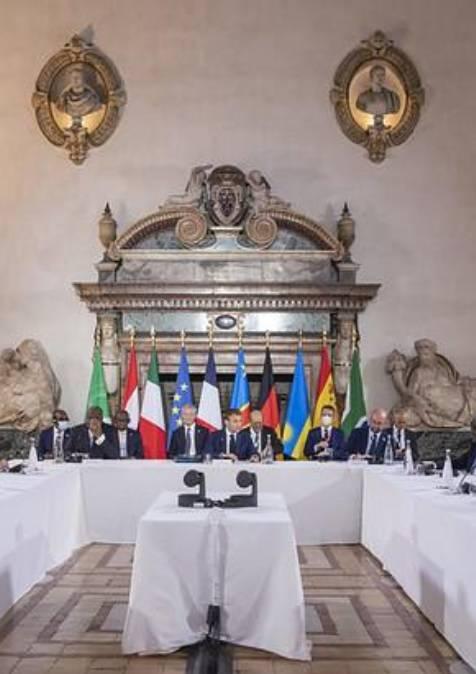
    يخصص مركز السياسات من أجل الجنوب الجديد حلقة برنامجه الأسبوعي "حديث الثلاثاء" لتقييم مخرجات القمة الاوروبية الافريقية ونموذج الشراكة الجديدة بين الطرفين، مع محمد لوليشكي، باحث بارز لدى مركز السياسات من أجل الجنوب الجديد. خلال القمة السادسة التي جمعت الاتحاديين في بروكسل ...
  • Authors
    Patricia Ahanda
    February 23, 2022
    Le Sommet Union européenne (UE) - Union africaine (UA), qui s’est tenu à Bruxelles les 17 et 18 février 2022, entend marquer un tournant dans les relations entre les deux continents. L’agenda européen pour l’année 2022 met au centre de ses priorités les relations Europe - Afrique. Celles-ci sont aussi l'un des principaux axes défendus par la Présidence française du Conseil de l’Union européenne (PFUE) et le Président français Emmanuel Macron dans de son discours inaugur ...
  • Authors
    Policy Center
    ACET
    ECDPM
    February 15, 2022
    The African Union (AU) and the European Union (EU) have never struggled to list common areas of interest or set up thematic partnerships and joint initiatives. The persistent challenge however is translating these partnerships into impact for both blocs of nations, particularly where interests diverge, such as those related to migration and green transition. Fifteen years since the critical Lisbon summit and the Joint Africa-EU Strategy, the time to move is now. To make the partne ...
  • Authors
    December 6, 2021
    Between January 2020 and June 2021, the world spent about US $16.5 trillion (18% of world GDP) to fight COVID-19, and this amount does not even include the most important losses such as deaths, mental health effects, restrictions on human freedom, and other nonmonetary suffering. Nearly 90% of this amount was spent by developed economies; the rest by emerging market and developing economies. Low-income countries spent just US $12.5 billion, or less than 0.0001% of the total. Moreove ...
  • Authors
    Pascal Chaigneau
    Eugène Berg
    Rodolphe Monnet
    Jacques Gravereau
    Jérémy Ghez
    Olivier Tramond
    Niagalé Bagayoko
    Alain Oudot de Dainville
    Jérôme Evrard
    Coordination de l’ouvrage: Imane Lahrich
    Fatine Cherkaoui
    October 28, 2021
    Depuis l’accession au trône du Roi Mohammed VI, l’Afrique s’est transformée en priorité de la diplomatie marocaine. Sur le plan économique, l’Afrique est devenue le prolongement naturel du Maroc en termes d’investissements et d’implantations. Pascal Chaigneau s’attarde sur les relations affaiblies Europe-Afrique, l’ambitieuse relation Chine-Afrique ainsi que les relations entre la Russie, les Etats-Unis, la Turquie ou encore les pays du Golf et l’Afrique. Ce chapitre traite égalemen ...
  • July 16, 2021
    Over 25 years after the launch of the Euro-Mediterranean Partnership (EMP) in the 1995 Barcelona Conference, the Mediterranean geographical area continues to be subject to the reflection and conceptualisation of the European Union (EU) with the aim of firmly establishing this strategic neighbourhood relationship and addressing the progress of the inherent challenges. Since then, several initiatives have marked the Euro-Mediterranean framework as stages on the pat ...
  • Authors
    Christophe Bertossi
    Matthieu Tardis
    February 26, 2021
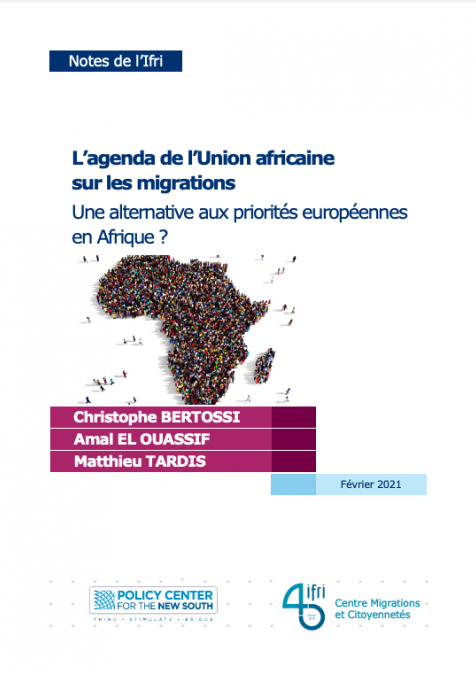
    Si les migrations en provenance d’Afrique constituent la priorité des politiques européennes de contrôle des frontières extérieures de l’Union européenne (UE), les dynamiques migratoires africaines sont pourtant avant tout régionales. Les migrations subsahariennes sont très peu connectées aux flux transcontinentaux : plus de 70 % restent en Afrique. Si l’on observe le continent dans son ensemble, en y ajoutant les pays du Maghreb et l’Afrique du Sud (deux régions mieux connectées a ...