Publications /
Policy Brief

Back
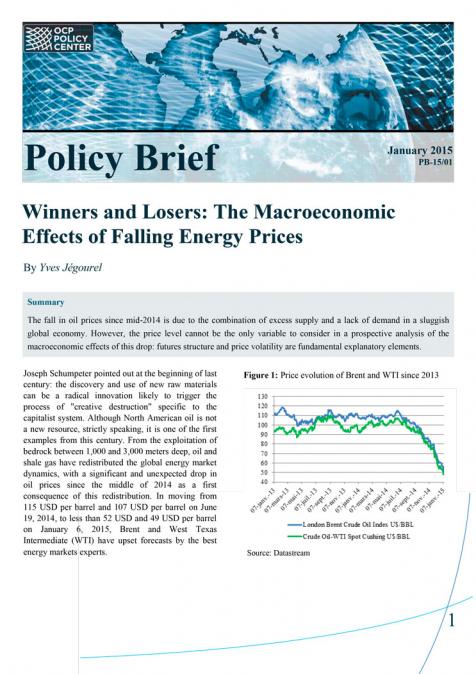
Winners and Losers: The Macroeconomic Effects of Falling Energy Prices
Authors
January 10, 2015

The fall in oil prices since mid-2014 is due to the combination of excess supply and a lack of demand in a sluggish global economy. However, the price level cannot be the only variable to consider in a prospective analysis of the macroeconomic effects of this drop: futures structure and price volatility are fundamental explanatory elements.
RELATED CONTENT

  • Authors
    Christos Daoulas
    August 22, 2019
    This note approaches the relationship between natural wealth and economic growth, using the case of Sub-Sahara African economies as an illustration. Delving into recent World Bank reports, it highlights how a sustained positive correlation between natural capital and GDP growth happens through the transformation of the former into other forms of assets: produced capital, human capital and other intangible assets. Governance features and the quality of macroeconomic policies are of t ...
  • Authors
    Sous la direction de
    Philippe Chalmin
    April 9, 2019
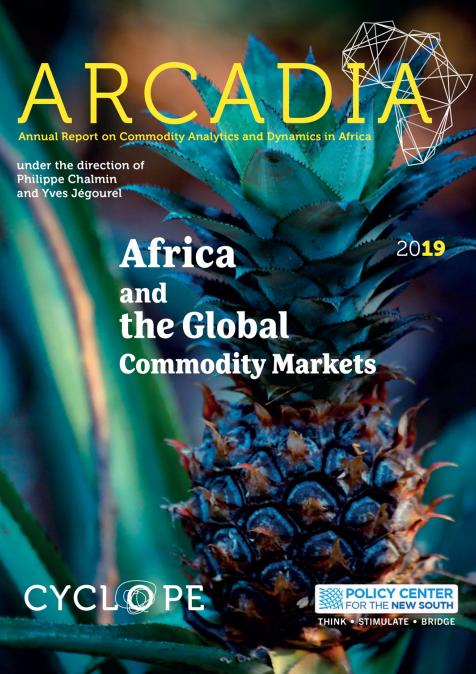
    Les cours des matières premières ont, une fois encore, été marqués par une importante volatilité en 2017 et 2018. Si de nombreux facteurs économiques permettent de l’expliquer, la raison politique fut également bien présente. Les Annual Report tensions commerciales entre la Chine et les États-Unis on Commodity et, plus globalement, la montée des incertitudes ont pesé Analytics and sur les perspectives macroéconomiques mondiales et sur Dynamics « le dynamisme des marchés ». Comptant ...
  • Authors
    Ahmed Rachid El-Khattabi
    March 22, 2019
    The author of this blog, Ahmed Rachid El Khattabi, is an alumnus of the 2018 Atlantic Dialogues Emerging Leaders program Rapid urbanization and climate change are two of the biggest challenges for cities. As much of the world is urbanizing, cities are growing thirstier, constantly seeking out new water supplies to keep up with demand. These challenges are especially significant for many growing cities that, due to historical reasons, are not located near water resources. Climate ch ...
  • Authors
    Philippe Chalmin
    February 27, 2019
    Rarement, autant qu’en 2018, les marchés mondiaux de matières premières et de commodités auront été lle jouet non pas des tendances des « fondamentaux » (offre/demande et leur évolution), mais bien des convulsions d’une situation géopolitique mondiale qui, sous la houlette quelque peu déréglée des États-Unis de Donald Trump, a été particulièrement imprévisible. En effet, si 2018 restera dans les annales des marchés, c’est bien parce que les matières premières se sont retrouvées au p ...
  • Authors
    August 13, 2018
    Depuis la fin de l’année 2017, le président Donald Trump mène plusieurs batailles commerciales, contre différents partenaires, sous prétextes de sauver des emplois industriels américains et de réduire le déficit commercial des États-Unis. S’il est difficile de se prononcer sur les effets des combats commerciaux amorcés par le président Trump, l’importance des opposants et des échanges pour l’économie mondiale en fait une source de risque pour la croissance, les emplois et les prix à ...
  • Authors
    June 9, 2017
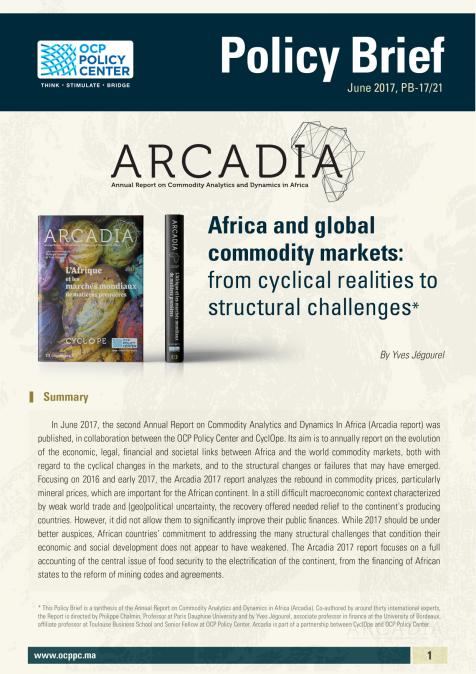
    In June 2017, the second Annual Report on Commodity Analytics and Dynamics In Africa (Arcadia report) was published, in collaboration between the OCP Policy Center and CyclOpe. Its aim is to annually report on the evolution of the economic, legal, financial and societal links between Africa and the world commodity markets, both with regard to the cyclical changes in the markets, and to the structural changes or failures that may have emerged. Focusing on 2016 and early 2017, the Arc ...
  • Authors
    Under the Supervision of
    Philippe Chalmin
    July 4, 2016
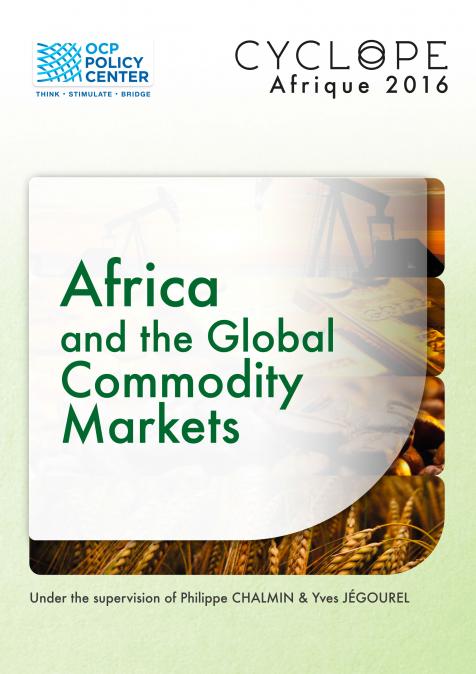
    Guinea’s bauxite, Moroccan phosphates, Nigerian Bonny Light, Zambian copper, Côte d'Ivoire’s cocoa, Ethiopian coffee or Madagascar’s vanilla: all are examples demonstrating that raw materials have a dimension that is as global as it is local. Global by the markets on which they are traded, local by their quality, a key element of their price, and their macroeconomic impact, particularly for Africa. In line with the 2016 CyclOpe report, which celebrates three decades of existence thi ...