Publications /
Book / Report

Back
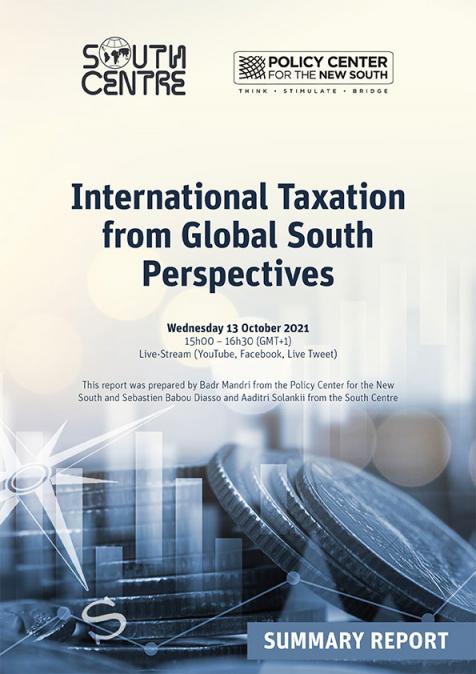
Summary Report - International Taxation from Global South Perspectives
Authors
Babou Diasso
Aaditri Solankii
November 4, 2021

South Centre (SC) in collaboration with the Policy Center for the New South (PCNS) organized on October 13, 2021, a webinar on the issue of International Taxation from the Global South perspectives.
Tax revenue mobilization plays a key role in financing the economic and social development of countries. When well designed and implemented, tax policy can help developing countries raise revenue and increase their spending, especially in the social sector. Indeed, tax revenue as a share of GDP represent only 15% to 20% in low and middle-income countries, because of obstacles such as the imbalanced and complex international standards designed for developed countries, and the difficulties in collecting taxes in developing countries.
This webinar addressed keys questions such as:
• What reforms to international standards are needed that can strengthen the capacities of governments to raise revenue from multinational enterprises (MNEs) without discouraging economic activity?
• What is the cost of tax havens for developing countries and what role can international cooperation play in dealing with this issue?
• What might the future of tax reform look like in the post-COVID-19 era, given the growing digitalization of the economy?

RELATED CONTENT

  • May 12, 2021
    Leonardo Da Vinci’s mechanical knight was a humanoid automaton, designed and possibly constructed by da Vinci around 1495. When a version of the mechanical knight was brought into existence several hundred years later, it could stand, sit, raise its visor, and independently maneuver its arms, operated by a series of pulleys and cables. Today, of course, robots have escaped da Vinci’s fantasies. Today they land on Mars, help nurses treat COVID-19 patients, and slave in car manufactur ...
  • May 6, 2021
    The Policy Center for the New South recently partnered with the Atlantic Council’s Africa Center on a pair of reports exploring the theme of technology and its impact on Africa’s political and economic future. In its report, The Impact of New Technologies on Employment and the Workforce...
  • April 26, 2021
    La Tunisie a fêté récemment le 10ème anniversaire de la révolution qui a mis fin à l’ancien régime bénalien et défini les principes de la IIème République. Ayant pour principales doléances la croissance économique et la justice sociale, la révolution tunisienne était exclusivement sociale. Or, l’appropriation de la révolution par l’Assemblée nationale constituante (ANC) et le quartet du dialogue national qui ont privilégié le chantier des réformes démocratiques au détriment des réfo ...
  • April 13, 2021
    Technologies and Big Data in Shaping African Public Services: Towards Efficient Digital Solutions for Africa Social Good Can technology and digitalization improve and enhance the value we get from public services? Data can change the experience that individuals get from a public service...
  • Authors
    March 24, 2021
    This report is part of a partnership between the Policy Center for the New South and the Atlantic Council’s Africa Center.   New technologies, such as automation, artificial intelligence and industrial robots, are often seen as a real danger for existing jobs and also for future job-creation prospects. There is a perception that they will make work redundant and lead to massive job destruction. However, others believe that automation, like previous technological waves , ...
  • Authors
    Fernando S. Perobelli
    Inácio F. Araújo
    Tomaz P. Dentinho
    March 16, 2021
    Angola’s prospects for reconstruction and development of its poor connectivity infrastructure are heavily dependent upon the export performance of its oil sector. Using an interregional inputoutput table for Angola, we estimate comprehensive measures of trade in value added revealing different hierarchies of interregional and international trade integration, with implications for regional inequality in the country. By encompassing the subnational perspective in the case study of an ...
  • March 3, 2021
    Brazil, an oil-exporting nation, was still struggling to recover from the depression which started around 2014/15 when it was hit by a quick succession of shocks: the COVID-19 pandemic and the oil price collapse. The global pandemic triggered major economic dislocations and contractions in foreign and domestic markets, which further exacerbated the fall in demand for oil, sending world prices tumbling further. Poverty was already widespread in Brazil pre-pandemic. And despite recen ...