Technologies and Big Data in Shaping African Public Services

April 13, 2021

Technologies and Big Data in Shaping African Public Services: Towards Efficient Digital Solutions for Africa Social Good Can technology and digitalization improve and enhance the value we get from public services? Data can change the experience that individuals get from a public service across all its characteristics (e.g., policy design, implementation, customization and so on). The Covid-19 pandemic has proven that technology has the potential to solve some of the most pressing challenges that impact Africa and drive growth and development in core sectors (health, agriculture, education and financial services). The purpose of this joint panel is to shed the light on the opportunities and the challenges of using technology and data in shaping public services. To this end, the discussion will be structured around following points: How governments are delivering better public services to citizens using cloud-based technology? Digital technology is now an integrated part of government modernization strategies to create public value. The potential and the challenges of digital transformation in Africa and its impact on governance Does digital transformation represent a leapfrog opportunity for Africa? 14:00 – 14:05 Introduction to the panel Akram Zaoui, International Relations Specialist, Policy Center for the New South 14:10 – 14:45 Debate: Digital Transformation from a Northern Perspective Alex Holmes, Senior Manager Government Transformation, Amazon Web Services Digital Transformation from a Southern Perspective Amir Abdul Reda, Assistant Professor in Computational Political Science, Mohammed 6 Polytechnic University 14:00 – 15:10 Q&A


Speakers
Akram Zaoui
Chargé de Mission to the Executive President
Akram Zaoui is a Senior International Relations Specialist and Chargé de Mission to the Executive President at the Policy Center for the New South (PCNS). Prior to this, he was Manager of Research Support and the Public Policy Lab at the PCNS. His main area of interest is the geopolitical economy of the Extended Middle East and North Africa (MENA) region. From 2018 to 2020, Zaoui was the coordinator of a network of 70+ civil society organizations (CSOs) across France, working with foundations, government, local communities, and the private sector. Zaoui holds a dual degree in corporate and public management from HEC Paris and Sciences Po, as well as a bachelor's degree (licence) in history from Université Paris 1 Panthéon-Sorbonne. He audited courses in Iranian and Shia Stud ...
Alex Holmes
Senior Manager Government Transformation, Amazon Web Services
...
Amir Abdul Reda
Professeur assistant à l’Université Mohammed VI Polytechnique
...

RELATED CONTENT

  • Authors
    June 8, 2026
    The energy shock caused by the war between the United States and Israel and Iran has highlighted the need for Africa to refine more of its own crude oil. Africa is a net hydrocarbon exporter, but remains stuck in the old colonial economic model: it mostly exports raw materials and imports refined products. Africa exports about 2.6 billion barrels of crude oil every year, and imports about 1.4 billion barrels of refined products. This is a problem for two reasons. First, Africa ...
  • Authors
    Karim El Mokri
    Idriss El Abbassi
    June 8, 2026
    Bientôt disponible en vente sur amazon et Livremoi. Le monde du travail est engagé dans un processus de mutation sans précédent. La quatrième révolution industrielle, portée par l’intelligence artificielle (IA) et la robotisation, a été le point de commencement d’une ère nouvelle où les repères économiques et sociaux se redéfinissent à une vitesse inédite. Ces technologies suscitent un engouement légitime et offrent des perspectives prometteuses, mais requièrent une vigilance a ...
  • June 1, 2026
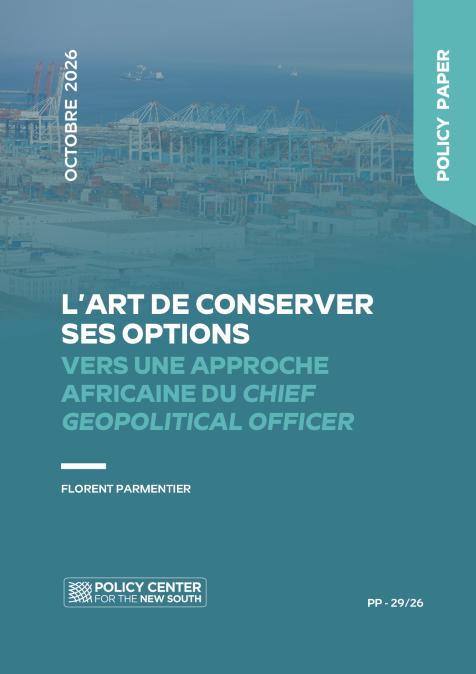
    Cette interview met en lumière le rôle central du secteur textile et de l’habillement dans l’économie marocaine, tant en matière d’emploi que d’exportations. Notre économiste, Mr. Fahd Azeroual revient sur son évolution historique, ses principaux défis, notamment la dépendance aux impor...
  • Authors
    May 22, 2026
    This paper, the fourth in a research series on services-led growth in the Global South, examines Egypt’s potential for growth and economic transformation through the integration of services into Global Value Chains (GVCs). It employs a new taxonomy that classifies services into Knowledge Services (KS), Enabling Services (ES), and Local Services (LS) and applies OECD 2025 Trade in Value-Added (TiVA), Trade in Employment (TiM), and input-output databases to benchmark Egypt against Mor ...
  • Authors
    May 15, 2026
    This paper is the third in a series of country and comparative studies that together comprise a research program on services as drivers of economic growth and structural transformation in the Global South. The paper analyzes the pattern of Tunisia's services-led economic growth from 2012- 2022 using a specialized three-category framework: knowledge services (KS), enabling services (ES), and local services (LS). Using data from the OECD Trade in Value Added (TiVA), Trade in Employmen ...
  • May 15, 2026
    In this podcast recorded during the Growth Summit, Naomi Kengurungu, Director of Marketing and Communication at the African Management Institute, discusses the key conditions needed for h ...
  • May 14, 2026
    In this episode of Africafé, Neema CHUSSI discusses the opportunities and challenges artificial intelligence presents for Africa. She highlights the need for the continent to develop its own AI governance approach, rooted in African democratic values, while addressing critical issues su...
  • May 6, 2026
    Dans cette interview, l’évolution de la politique industrielle marocaine est analysée : planification étatique (1960–1980), libéralisation (1980–1990), puis intégration dans les chaînes de valeur mondiales (à partir des années 2000). Aujourd’hui, face au protectionnisme et au nearshorin...
  • April 14, 2026
    Cet épisode met en avant les industries automobile et aéronautique du Maroc en tant que moteurs de transformation industrielle, portées par le Pacte pour l’Émergence et le Plan d’Accélération Industrielle. Un écosystème solide composé de donneurs d’ordre, de fabricants internationaux et...
  • April 13, 2026
    Résumé exécutif stratégiqueLe Maroc s’est engagé avec détermination dans une trajectoire de modernisation fondée sur la transition numérique, la transition verte et l’innovation. Ces dynamiques sont devenues des leviers stratégiques pour la compétitivité, l’attractivité et la création d’emplois à forte valeur ajoutée. Pourtant, l’analyse des données microéconomiques récentes révèle un paradoxe préoccupant : les entreprises les plus modernisées, moteurs de la croissance de demain, re ...