Publications /
Opinion
On the day he formally took power in Nigeria, 29 May, President Bola Tinubu put an end to fuel subsidies. It was a bold and politically difficult decision, but long overdue. Nigeria is a leading oil producer and yet its citizens struggle to put gas in their tanks. It exports crude oil but imports refined fuels. For years, the government capped the gasoline price and paid importers the difference between the higher landed cost of petrol and diesel and the lower price at the pump. That allowed consumers to buy at subsidized rates.
This fuel subsidy cost the country $600 million per month but did not benefit the ordinary citizens. The price distortion resulted in fuel shortages and created a smuggling racket that made a cabal of politicians and petrol traders very rich. However, it was a financial burden Nigeria could no longer afford to bear. So, when the subsidy was scrapped, the market cheered. The NGX All Share Index jumped to levels last seen in 2008. The stock market has risen more than 20% since President Tinubu was inaugurated. Nonetheless, it still is a small step on a long road ahead for Nigeria as it tries to revive its economic prospect.
Navigating a perfect storm
Africa’s largest economy is confronting a perfect storm of slow growth, population explosion, shrinking revenues, endemic corruption, and the breakdown of security. More Nigerians are slipping into poverty than escaping it[1]. Manufacturing has all but stopped, and the kinds of jobs that do exist are not enough to provide meaningful employment to the approximately two million people entering the workforce every year. Gas prices have more than tripled and the pace of annual Nigerian food inflation is running above 25%[2]. Business confidence has been hit badly and borrowing on international markets has become costlier.
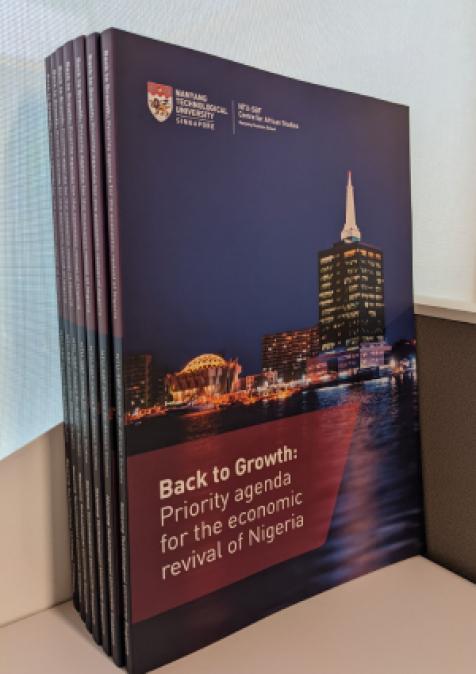
In this context, a report by the NTU-SBF Centre for African Studies in Singapore, titled ‘Back to Growth: Priority Agenda for the Economic Revival of Nigeria’, is arguably the most comprehensive policy recommendation report produced by a Singapore-based think tank for any African state. It identifies the most serious problems facing the Nigerian economy and presents a 10-year roadmap that could put it back on a path of sustained growth.
The Nigerian economy has been sputtering at an average growth rate of 2.1% since 2015[3]. The biggest challenge confronting President Tinubu is excessive reliance on fossil fuel. Oil and gas accounts for just 5% of Nigeria’s GDP, but makes up more than 80% of government revenues. Dependence on crude oil exports has left the country vulnerable to boom and bust cycles, and has also corroded governance by creating ample rent-seeking opportunities for those in power. Meanwhile, inflation is chipping away the income of Nigerians. This is driving up poverty at an alarming pace. Ninety-five million Nigerians are now considered ‘extremely poor’.
It is a cruel irony that despite its remarkable natural wealth, Nigeria remains one of the poorest countries in the world. Unemployment is at a record high. It has multiplied fourfold since 2015 and now stands at 33%[4]. The multiple exchange rate regime is hurting business and inadvertently created a thriving black market for foreign currency. The US dollar trades at almost twice the official rate in the black market and the national currency, the naira, has fallen almost 40% against the dollar since June. As reserves continue to shrink, access to hard currency has become difficult. Only one in ten local firms has access to finance. Poor infrastructure has rendered manufacturing uncompetitive. Street vendors in Lagos run diesel generators pretty much all day long. On a good day, the grid provides power for no more than five hours. Erratic power supply costs Nigeria $28 billion per year. Large parts of the countryside are inaccessible because there are few motorable roads, and armed gangs have made kidnapping-for-ransom a cottage industry. Farmers waste 40% of agricultural produce because of lack of access to markets and fields. Productivity at the workplace is hit because workers are caught in traffic jams on gridlocked roads. Ships remain idle for days because ports are congested, ill-equipped and inefficient. Faith in public institutions has been eroded as a result of years of corruption and mismanagement. To put it bluntly, Nigeria is in dire straits.
It was not always like this. In the early years of independence, Nigeria invested heavily in health, education, and infrastructure. The founding fathers adopted an industrial policy that prioritized manufacturing and provided incentives for entrepreneurs to start new ventures and create jobs. Then came the discovery of oil and with that a rush of easy money. Petrodollars made it cheap to import finished goods. Agriculture and manufacturing were neglected, and jobs disappeared. In 1960, Nigerian GDP per capita was almost as much as that of Malaysia. Today it is less than a fifth. The population of Nigeria in 1960 was 45 million. Today it is over 200 million. At 5.4 children per woman, the fertility rate in Nigeria is among the highest in the world. But economic growth is simply not keeping pace with the rate of population expansion. If nothing is done to reverse this trend, Nigeria faces an imminent catastrophe.
A proposed path to growth and through reforms
What we have presented in Back to Growth is a set of progressive reforms that if carried out sequentially could put Nigeria back on the path to sustained growth. Over the next two years, the Tinubu administration could achieve stability by ending the fuel subsidy, migrating to a flexible unified exchange rate regime, and curbing oil theft. That should stop the bad financial situation from getting worse. The new government has started out by taking the right steps, but what matters is not losing momentum.
Once stabilization is achieved, the priority should shift towards structural transformation. The objective should be to revive growth by reducing dependence on oil and diversifying the economy by enhancing the competitiveness of agriculture, manufacturing, and service sectors. That would require dismantling the many barriers that hobble private enterprise. Priority should be given to ending the power shortage. The fiscal space acquired in the first two years of reforms should provide adequate capital to crowd in private investments to fix the power infrastructure. The annual budget of the government is approximately $50 billion, but most of it is used for administrative expenses. Over the next five years, Nigeria should rein in wasteful public spending and re-prioritize expenditure on health, education, and social protection as more reforms are carried out.
Once growth is revived, policy priorities will need to shift towards ensuring that growth is sustained. If the report’s recommendations are carried out, Nigeria could probably achieve an annual GDP growth rate of 7% or more. But sustaining such growth will depend on three essential conditions. First, if international trade and the financial markets remain favorable to Nigeria, it would be able to borrow at concessional rates. Second, Nigeria’s demographic dividend will not be felt unless the working-age population has the right skills to exploit opportunities in a changing world. Third, and perhaps most important, is governance. Good governance is critical to ensuring durable economic growth. It would help improve the business climate and repair the social contract between citizens and the state that has been damaged over the years. This report is our attempt to show the direction that Nigeria should take if it wants to become one of the top 20 economies in the world over the next decade.
(Amit Jain is the author of Back to Growth: Priority agenda for the economic revival of Nigeria and the Director of the NTU-SBF Centre for African Studies at the Nanyang Business School in Singapore. The report will be launched on 18 Aug 2023)
[1] https://guardian.ng/opinion/why-are-more-nigerians-getting-poor/
[2] https://businessday.ng/news/article/nigerias-food-inflation-hit-26-9-in-july/
[3] https://data.worldbank.org/indicator/NY.GDP.MKTP.KD.ZG?locations=NG
[4] https://punchng.com/nigerian-unemployment-rate-to-hit-41-in-2023-kpmg/