Publications /
Paper in Academic Journals
Back
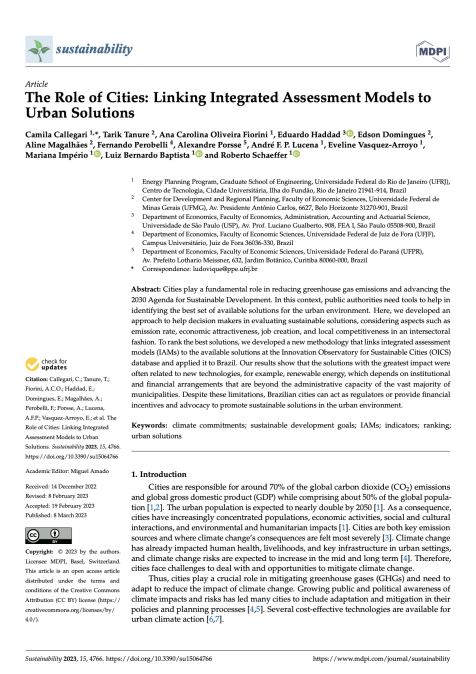
The Role of Cities: Linking Integrated Assessment Models to Urban Solutions
Authors
Camila Callegari
Tarik Tanure
Ana Carolina Oliveira Fiorini
Edson Domingues
Aline Magalhães
Fernando Perobelli
Alexandre Porsse
André F. P. Lucena
Eveline Vasquez-Arroyo
Mariana Império
Luiz Bernardo Baptista
Roberto Schaeffer
March 20, 2023

This Paper was originally published on mdpi.com


Cities play a fundamental role in reducing greenhouse gas emissions and advancing the 2030 Agenda for Sustainable Development. In this context, public authorities need tools to help in identifying the best set of available solutions for the urban environment. Here, we developed an approach to help decision makers in evaluating sustainable solutions, considering aspects such as emission rate, economic attractiveness, job creation, and local competitiveness in an intersectoral fashion. To rank the best solutions, we developed a new methodology that links integrated assessment models (IAMs) to the available solutions at the Innovation Observatory for Sustainable Cities (OICS) database and applied it to Brazil. Our results show that the solutions with the greatest impact were often related to new technologies, for example, renewable energy, which depends on institutional and financial arrangements that are beyond the administrative capacity of the vast majority of municipalities. Despite these limitations, Brazilian cities can act as regulators or provide financial incentives and advocacy to promote sustainable solutions in the urban environment.

RELATED CONTENT

  • Authors
    Georges Ali Benyahia
    November 20, 2026
    This paper was originaly published on sciencedirect.com Ammonia and methanol feature in a growing share of announced low-emissions hydrogen projects; evidence on their progression to a final investment decision (FID) remains aggregate. We follow 2098 pre-FID projects, classified by output product, across six releases (2021–2026) of the International Energy Agency hydrogen projects database and estimate discrete-time cause-specific hazard models of progression to FID and ex ...
  • From

    17
    9:00 am November 2026
    Industrialization in North Africa is entering a new phase shaped by global megatrends, the green and digital transitions, evolving value chains, and the growing need for resilient and competitive production systems.Against this backdrop, the Policy Center for the New South and the United Nations Industrial Development Organization (UNIDO) are convening The Future of Industrialization: Building Future-Ready Industries in North Africa on November 17, 2026, at the Policy Center for the New South in Rabat.The event will present key insights from the Industrial Development Report 2026 (IDR26) and bring together policymakers, industry leaders and experts to discuss the region’s industrial opportunities, constraints and policy priorities. The exchanges will focus on pathways toward s ...
  • October 15, 2026
    The Policy Center for the New South, in partnership with The Asian Network, is organizing a webinar titled “Emerging Powers and the Remaking of Global Order” to examine the growing role of emerging powers and the Global South at a time of profound transformation in the international sys...
  • Authors
    September 21, 2026
    Aircraft carriers are massive and menacing, carrying dozens of aircraft and thousands of naval personnel, supported by an escort of warships and supply vessels. Ships such as the USS Gerald R. Ford are formidable symbols of military power. Yet even these giants can be surpassed in length by the largest cruise ships, including Royal Caribbean’s Legend of the Seas, introduced in 2026. The 365-meter Legend is approximately 32 meters longer than the Gerald R. Ford and can accommoda ...
  • Authors
    July 31, 2026
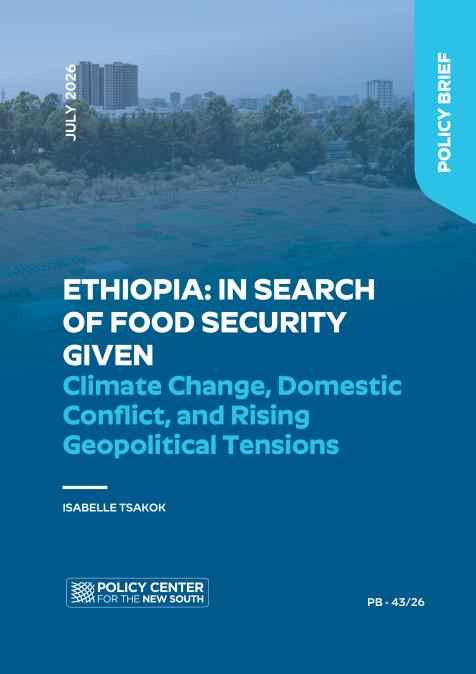
    Ethiopia continues to struggle to lay the economic foundations of food security for all, more than 30 years after first adopting the East Asian Developmental State Model (EADS) under Zenawi (1911-2012), continued under Hailemariam Desalegn (2012-April 2018), and later shifting toward a neo-liberal, Washington consensus-oriented approach under Abiy Ahmed (2018-present). The achievements recorded under the EADS approach—particularly double-digit annual growth, substantial poverty ...
  • Authors
    July 2, 2026
    Africa is facing a massive electricity deficit that is impacting its economic and social development, and its ability to catch up with the rest of the world. It is imperative that the continent increase its electricity production to connect the 600 million people who are currently without access and to improve the quality of service for the millions who are suffering from frequent blackouts and load-shedding. Economic development in the 21st century will crucially depend on the digi ...
  • June 24, 2026
    Africa, Latin America, and the Caribbean have both the potential and the desire to transform their people's lives through Green Industrial Policy. Yet they have long been constrained by structural obstacles embedded in the international system. The current rupture in that system, which ...
  • June 3, 2026
    Cet épisode met en lumière les défis et perspectives du secteur halieutique marocain à travers l’analyse du Pr. Abdelkabir Kamili. Il souligne que la durabilité des ressources marines n’est pas un frein à la croissance économique, mais une condition essentielle pour garantir la performa...
  • May 29, 2026
    This Paper was originally published on tandfonline.com This paper examines how reductions in transportation costs reshape regional economic and environmental outcomes in Morocco. We simulate a reduction in delivered (purchasers’) costs via a transport-margin efficiency improvement – implemented as a margin-saving technical change in the transport sector – within a province-level Spatial Computable General Equilibrium (SCGE) framework. Simulating a 1% decline in transport costs, ...
  • Authors
    Jorge Arbache
    May 14, 2026
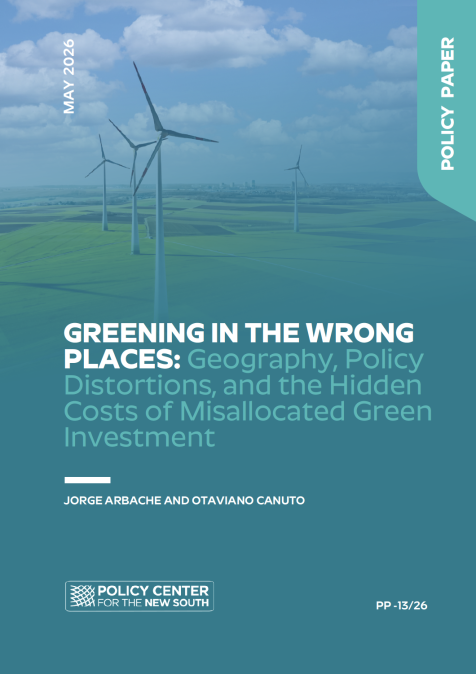
    Decarbonization is reconfiguring global relative prices. As clean energy, natural capital, and location-specific assets become dominant industrial inputs, the relative cost of producing low-carbon goods is increasingly determined by geography. Two systematic distortions explain why the expected reallocation of investment toward renewable-rich economies remains incomplete. First, industrial policy interventions, including subsidies, trade barriers, and certification systems, disconne ...