Publications /
Paper in Academic Journals
Back
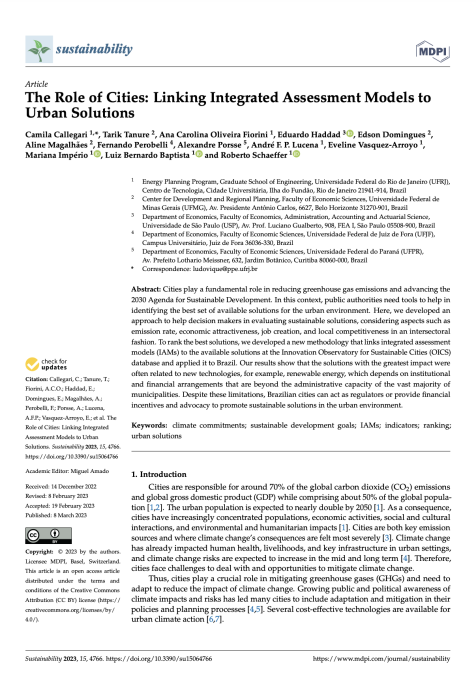
The Role of Cities: Linking Integrated Assessment Models to Urban Solutions
Authors
Camila Callegari
Tarik Tanure
Ana Carolina Oliveira Fiorini
Edson Domingues
Aline Magalhães
Fernando Perobelli
Alexandre Porsse
André F. P. Lucena
Eveline Vasquez-Arroyo
Mariana Império
Luiz Bernardo Baptista
Roberto Schaeffer
March 20, 2023

This Paper was originally published on mdpi.com


Cities play a fundamental role in reducing greenhouse gas emissions and advancing the 2030 Agenda for Sustainable Development. In this context, public authorities need tools to help in identifying the best set of available solutions for the urban environment. Here, we developed an approach to help decision makers in evaluating sustainable solutions, considering aspects such as emission rate, economic attractiveness, job creation, and local competitiveness in an intersectoral fashion. To rank the best solutions, we developed a new methodology that links integrated assessment models (IAMs) to the available solutions at the Innovation Observatory for Sustainable Cities (OICS) database and applied it to Brazil. Our results show that the solutions with the greatest impact were often related to new technologies, for example, renewable energy, which depends on institutional and financial arrangements that are beyond the administrative capacity of the vast majority of municipalities. Despite these limitations, Brazilian cities can act as regulators or provide financial incentives and advocacy to promote sustainable solutions in the urban environment.
RELATED CONTENT

  • Authors
    February 9, 2022
    Energy markets have experienced significant disruptions since the outbreak of COVID-19. In late 2021, soaring natural gas prices triggered a new crisis, leading to risks of energy supply shortages worldwide and propelling the issue of energy security to the forefront. Africa will not be spared the repercussions of this crisis, which could further increase energy inequality, which is in turn linked to other forms of inequality. Indeed, in a context of persistent inflation, the lack o ...
  • Authors
    Morten Seja
    Hadley Hilgenhurst
    Charlie Knight
    January 25, 2022
    Why Green Finance Taxonomies? The increasing effort to mitigate climate change has caused more and more individuals, governments, and companies to shift away from traditional financial investments and activities, and towards more environmentally-friendly alternatives. However, until recently, there has been a lack of consensus on what green finance and its environmental impact is. Thus, green finance taxonomies are needed to provide classification systems that identify how environm ...
  • Authors
    January 13, 2022
    “This opinion was prepared within the framework of the Jean Monnet Atlantic Network 2.0. The European Commission's support for the production of this publication does not constitute an endorsement of the contents, which reflect the views only of the authors, and the Commission cannot be held responsible for any use which may be made of the information contained therein.”   As part of the lengthy fight against climate change, the European Union (EU) has introduced a Border Car ...
  • Authors
    Morten Seja
    December 20, 2021
    A Case for Regulators to Green Financial Inclusion Financial Inclusion is an Excellent Tool for Combating Poverty It is well known that supporting financial inclusion is a relevant tool in lifting people out of poverty. There is plenty of empirical evidence showing that financial inclusion significantly reduces poverty and income inequality in developing countries. Concerted efforts to support financial inclusion globally have existed since the United Nations Capital Development ...
  • Authors
    December 10, 2021
     Accelerating the transition toward low or net-zero carbon emissions is necessary to keep global warming at theoretically safe levels. That will likely bring price shocks associated with rising metal prices, energy costs, and carbon taxes – what has been called “greenflation”. Greening the economy will also require public spending and redistributive policies. ...
  • October 01, 2021
    The climate crisis is a latent threat that has been brewing for several years. Its repercussions affect both individuals and economies. Since the Paris Agreement, progress has stalled in ...
  • Authors
    Chami Abdelilah
    Derj Atar
    Hammi Ibtissem
    Morazzo Mariano
    Naciri Yassine
    with the technical support of AFRY
    July 29, 2021
    As decarbonization is a long-term process and requires significant investments, specific financial and non- financial measures will need to be implemented, both in the short and long term, to facilitate this transition. In Part II of Morocco’s decarbonization pathway Policy Brief series, an update of the decarbonization scenarios was presented. It revealed that the Increased Ambition and Green Development scenarios achieve higher decarbonization targets than current policy. It showe ...
  • Authors
    Chami Abdelilah
    Derj Atar
    Hammi Ibtissem
    Morazzo Mariano
    Naciri Yassine
    with the technical support of AFRY
    July 23, 2021
    La décarbonisation est un processus à long terme qui nécessite des investissements importants. Ainsi, des mesures financières et non financières spécifiques devront être mises en œuvre, à la fois à court et à long termes, pour faciliter cette transition. Dans la deuxième partie de la série de Policy Briefs sur la trajectoire de décarbonisation du Maroc, une mise à jour des scénarios de décarbonisation a été présentée. Elle révèle que les scénarios « Ambition accélérée » et « Dévelop ...
  • Authors
    Chami Abdelilah
    Derj Atar
    Hammi Ibtissem
    Morazzo Mariano
    Naciri Yassine
    with the technical support of AFRY
    July 19, 2021
    Morocco's significant renewable energy resources offer an unprecedented opportunity to anchor the country’s economic and political choices in the energy transition, and to turn the transition into an essential lever for economic development. This is all the more relevant as the costs of renewable energies have dropped over the past 10 years2, and now offer strong potential, not only for creating green jobs but for ensuring a dynamic and resilient economic growth as well. In 2020, ne ...