
Publications /
Paper in Academic Journals
This Paper was originally published on mdpi.com
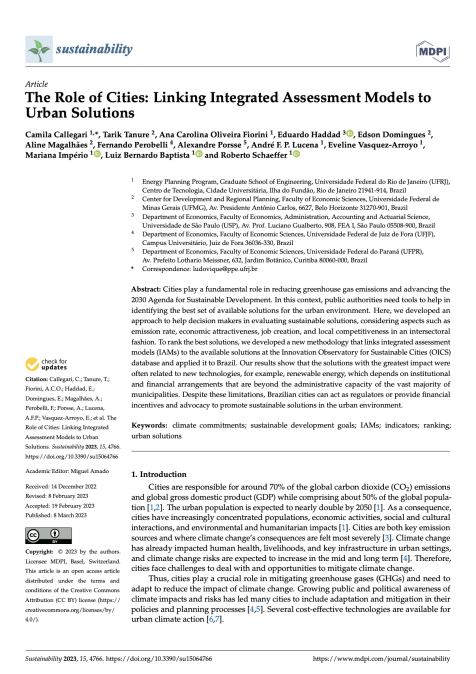
Cities play a fundamental role in reducing greenhouse gas emissions and advancing the 2030 Agenda for Sustainable Development. In this context, public authorities need tools to help in identifying the best set of available solutions for the urban environment. Here, we developed an approach to help decision makers in evaluating sustainable solutions, considering aspects such as emission rate, economic attractiveness, job creation, and local competitiveness in an intersectoral fashion. To rank the best solutions, we developed a new methodology that links integrated assessment models (IAMs) to the available solutions at the Innovation Observatory for Sustainable Cities (OICS) database and applied it to Brazil. Our results show that the solutions with the greatest impact were often related to new technologies, for example, renewable energy, which depends on institutional and financial arrangements that are beyond the administrative capacity of the vast majority of municipalities. Despite these limitations, Brazilian cities can act as regulators or provide financial incentives and advocacy to promote sustainable solutions in the urban environment.

