Publications /
Paper in Academic Journals
Back
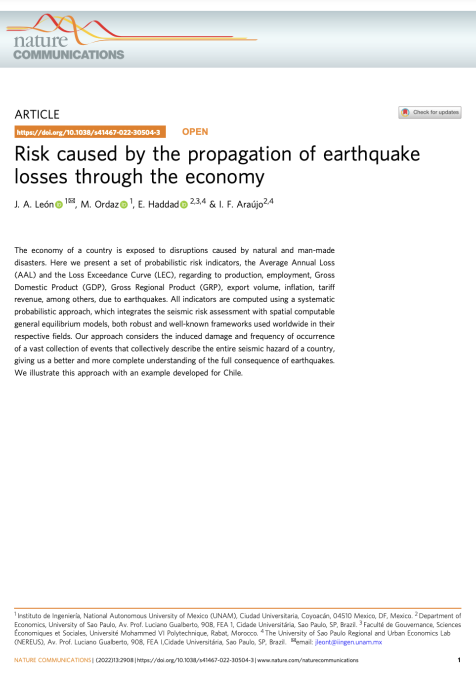
Risk caused by the propagation of earthquake losses through the economy
Authors
J. A. León
M. Ordaz
I. F. Araújo
May 30, 2022

This Paper was originally published on nature.com


The economy of a country is exposed to disruptions caused by natural and man-made disasters. Here we present a set of probabilistic risk indicators, the Average Annual Loss (AAL) and the Loss Exceedance Curve (LEC), regarding to production, employment, Gross Domestic Product (GDP), Gross Regional Product (GRP), export volume, inflation, tariff revenue, among others, due to earthquakes. All indicators are computed using a systematic probabilistic approach, which integrates the seismic risk assessment with spatial computable general equilibrium models, both robust and well-known frameworks used worldwide in their respective fields. Our approach considers the induced damage and frequency of occurrence of a vast collection of events that collectively describe the entire seismic hazard of a country, giving us a better and more complete understanding of the full consequence of earthquakes. We illustrate this approach with an example developed for Chile.
RELATED CONTENT

  • October 17, 2025
    Jodie Keane, Principal Research Fellow at the International Economic Development Group, discusses how green trade measures are transforming African economies, stressing the need for faire ...
  • October 15, 2025
    Depuis que l’économie a été reconnue par les Nobel, en1969, c’est à cette discipline qu’il revient de clore les cérémonies annuelles d’attribution des Prix aux lauréats. Pour cette année 2025, c’est le 13 octobre que  l’Américano-Israélien, Joel Mokyr, le Français, Philippe   Aghion, et le Canadien, Peter Howitt, ont été consacrés Prix Nobel de l’Économie. ...
  • October 10, 2025
    This episode of the Policy Center for the New South Podcast features Dr. Hung Q.Tran, Senior Fellow, discussing the tokenization of money and its impact on the global financial system. He ...
  • Authors
    Jorge Arbache
    October 9, 2025
    Conventional wisdom holds that the United States has undergone massive deindustrialization in recent decades, with the country's manufacturing sector supposedly withering as it lost ground to China. This narrative has fueled debates about industrial policy, economic nationalism, and the reshoring of manufacturing production. But what if this story is only partially true? What if, instead of disappearing, American industry simply changed its address?  ...
  • Authors
    October 7, 2025
    Africa's development depends on the mobilization of catalytic levers capable of accelerating growth momentum, with wider benefits for the African people. The digital, energy and demographic transitions are all major challenges, but at the same time they present the continent with new opportunities for transformation. In this context, Atlantic Africa appears to be a strategic and promising area, thanks to the richness and diversity of its natural resources, its geographical position ...
  • October 7, 2025
    Global economic growth has been more resilient than expected, as the artificial intelligence-led growth seems to be compensating for the negative impacts of trade conflicts. Overstretched asset values and slowing jobs growth may be signaling that the balanced crossing of those two paths...
  • October 3, 2025
    This policy paper examines digital colonialism as a defining structural challenge of the twenty-first century and argues for the urgent pursuit of digital sovereignty in the Global South. While digitalization holds immense potential to foster inclusion and bridge development gaps, current dynamics reproduce historical patterns of dependency: data is extracted from Southern populations, routed through infrastructures owned by Northern corporations, processed by algorithms trained on ...
  • Authors
    October 3, 2025
    Global economic growth has been more resilient than expected, as the artificial intelligence-led growth seems to be compensating for the negative impacts of trade conflicts. Overstretched asset values and slowing jobs growth may be signaling that the balanced crossing of those two paths will be challenged. ...
  • October 3, 2025
    In this episode, we explore Africa’s industrial challenges and opportunities, showing how AfCFTA-driven integration, green sectors, and inclusive policies for women, youth, and SMEs can foster sustainable growth, resilience, and domestic value capture. ...