Publications /
Paper in Academic Journals
Back
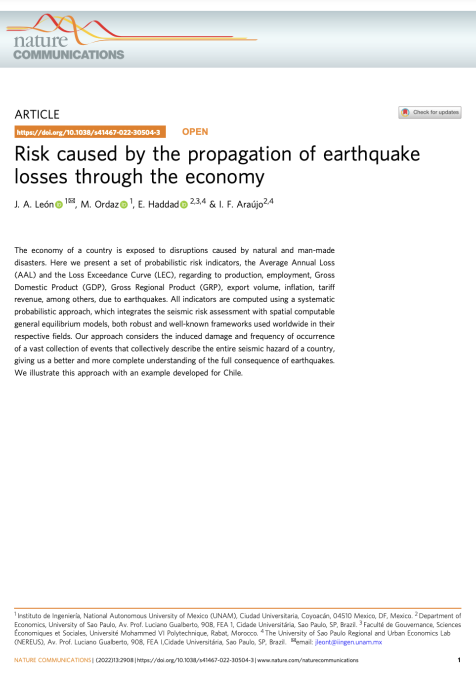
Risk caused by the propagation of earthquake losses through the economy
Authors
J. A. León
M. Ordaz
I. F. Araújo
May 30, 2022

This Paper was originally published on nature.com


The economy of a country is exposed to disruptions caused by natural and man-made disasters. Here we present a set of probabilistic risk indicators, the Average Annual Loss (AAL) and the Loss Exceedance Curve (LEC), regarding to production, employment, Gross Domestic Product (GDP), Gross Regional Product (GRP), export volume, inflation, tariff revenue, among others, due to earthquakes. All indicators are computed using a systematic probabilistic approach, which integrates the seismic risk assessment with spatial computable general equilibrium models, both robust and well-known frameworks used worldwide in their respective fields. Our approach considers the induced damage and frequency of occurrence of a vast collection of events that collectively describe the entire seismic hazard of a country, giving us a better and more complete understanding of the full consequence of earthquakes. We illustrate this approach with an example developed for Chile.

RELATED CONTENT

  • Authors
    Markus Goldstein
    Chema Triki
    Charley Ward
    April 16, 2026
    This blog was originally published on cgdev.org We recently wrapped up the second edition of the Growth Summit, organized by our three organizations and hosted by the Policy Center for the New South. The event was filled with eclectic voices. To give you a sense of the discussions, we’ve tried to capture some of the key messages from the 12 sessions (with no direct attribution).Overall, the eclecticism of the debate points to an uncomfortable truth: there is today no shared pla ...
  • April 14, 2026
    Cet épisode met en avant les industries automobile et aéronautique du Maroc en tant que moteurs de transformation industrielle, portées par le Pacte pour l’Émergence et le Plan d’Accélération Industrielle. Un écosystème solide composé de donneurs d’ordre, de fabricants internationaux et...
  • April 13, 2026
    This episode delves into Morocco’s healthcare system, tracing strides in maternal and child health, vaccination, and the quest for universal coverage. Morocco’s COVID-19 response, alongside initiatives like TADAMON and telemedicine, showcases innovation and resilience. Yet, gaps remain,...
  • April 13, 2026
    Résumé exécutif stratégiqueLe Maroc s’est engagé avec détermination dans une trajectoire de modernisation fondée sur la transition numérique, la transition verte et l’innovation. Ces dynamiques sont devenues des leviers stratégiques pour la compétitivité, l’attractivité et la création d’emplois à forte valeur ajoutée. Pourtant, l’analyse des données microéconomiques récentes révèle un paradoxe préoccupant : les entreprises les plus modernisées, moteurs de la croissance de demain, re ...
  • April 10, 2026
    تتتبع هذه الحلقة التاريخ الاقتصادي للمغرب منذ تهميشه في القرن التاسع عشر تحت ضغط القوى الأوروبية، مرورًا بالثنائية الاستعمارية والتنمية التي قادها الدولة بعد الاستقلال، وصولًا إلى برامج التكيف الهيكلي في الثمانينيات. وقد عززت الإصلاحات الأخيرة مرونة الاقتصاد، مع مساهمة قطاعات الزراعة،...
  • April 9, 2026
    This episode explores Morocco’s economic diplomacy, from 1980s liberalization to its rise in global value chains in automotive and aerospace. Strategic reforms and infrastructure projects have attracted investment and expanded ties across Africa, yet trade deficits linger. While Europea...
  • Authors
    April 8, 2026
    This report was originally published on the website of the Middle East Institute ( mei.edu) The following study discusses the role of Lebanon’s gold reserves in the establishment of a currency board and evaluates four policy options: a true currency board, constrained central bank reform, full dollarization, and a unified managed float. Gold reserves are relevant under all four. The conclusion is consistent across them: no monetary framework, however carefully designed and howe ...