Publications /
Policy Paper

Back
Retrospective Analysis of the 2024 European Elections: The European Parliament Renews Itself in a Europe Facing Significant Transitions
July 12, 2024

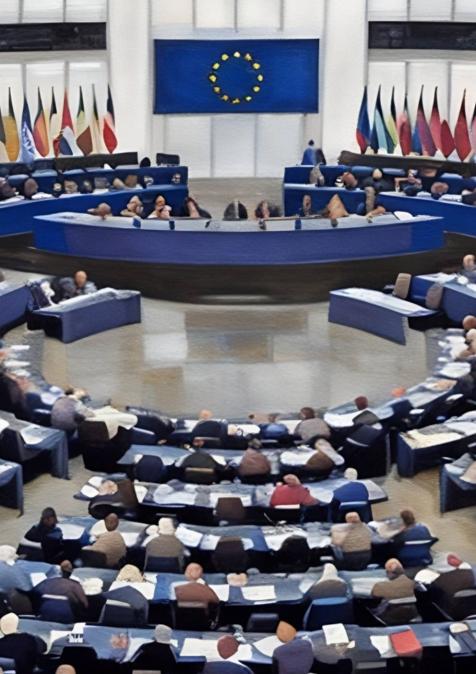
The European Elections of 2024 were marked by a significant surge in sovereigntist parties at the expense of liberals and greens, while moderate right and left-wing parties also made notable gains. Despite the substantial wins and losses during this election, no single bloc emerged with the overall majority of 361 seats in the European Parliament. The impression from the new political balances emerging from the 2024 elections is that the European People's Party, which won the electoral contest, will turn to the social democrats and liberals in Brussels to form a majority, amid significant transitions that are shaping the future of European integration and the place of the EU in the world.

RELATED CONTENT

  • Authors
    August 13, 2026
    The Resolution adopted by an overwhelming majority of elected European officials in Strasbourg on June 10, 2021, on "the violation of the UN Convention on the Rights of the Child and the exploitation of minors by the authorities in the migration crisis in Ceuta" (2021/2747/RSP), could not fail to leave its mark.Decoding the ResolutionThe Resolution shocked Moroccans to such an extent that it was quickly set aside at the time, as if there were a wish to forget it as fast as possible. ...
  • Authors
    July 27, 2026
    Is Europe Prepared for War?European public opinion is moving from treating a major conflict as unthinkable to regarding it as a possibility for which governments must prepare. Attention is increasingly focused on Russian hybrid operations, vulnerabilities in critical infrastructure and the risk of fragmentation within NATO. European defence policy is consequently undergoing a rapid transition from post-Cold War complacency towards preparations for high-intensity warfare. Recent ...
  • Authors
    July 15, 2026
    We Are Watching You In April 2026, the UK Ministry of Defence revealed that it had tracked a covert Russian submarine operation apparently intended to map critical undersea cables and pipelines in the North Atlantic and the North Sea. A Russian attack submarine and two specialised intelligence vessels operated by the Main Directorate of Deep-Sea Research, commonly known as GUGI, were reportedly monitored for four weeks by the Royal Navy, including HMS St Albans and P-8 Poseidon ...
  • Authors
    Gabriela Keseberg Dávalos
    January 26, 2026
    This Opinion was originally published by the Hanns Seidel Stiftung on January 19th, 2026. The author of this opinion, Gabriela Keseberg Dávalos, is a 2013 alumna of the Atlantic Dialogues Emerging Leaders Program. The signing of the EU–Mercosur agreement is a small geopolitical miracle. Signed on 17 January 2026 in Paraguay, it arrives at a moment when Europe is unmistakably being cast aside by the United States. Meanwhile Latin America, and with it, the Mer ...
  • Authors
    December 18, 2025
    The return of President Donald Trump to the White House at the start of 2025 was expected to signal an American retreat from international engagement, especially in regions of traditional security interest, such as southern Europe, North Africa, and the Middle East. To the surprise of many observers around the Mediterranean, and perhaps to the dismay of some in the Trump administration’s ideological orbit, this has not happened. If anything, the second half of 2025 has seen a high d ...
  • November 4, 2025
    Cette tribune a été initialement publiée sur telos-eu.comSi un domaine est supposé devoir échapper à la « démocratie d’opinion », c’est bien la politique étrangère, surtout dans la France de la Ve République. Elle se doit d’être articulée autour d’intérêts à long terme et de calculs savants, sans reculer devant la raison d’Etat. L’opinion des Français à son propos est rarement scrutée.Elle se révèle plus construite qu’on ne croit. Telle est la leçon du sondage Toluna-Louis ...
  • Authors
    November 29, 2024
    Following the European Parliament’s approval of the 26 candidates proposed by Member States to form the new European Commission (2024-2029), the new European super-ministers will take office on 1 December. Notably, for the first time, the core of “Europe’s government” includes two representatives from the far-right: Italian Raffaele Fitto, nominated by the Meloni Government as Vice-President for Cohesion and Reforms, overseeing structural funds, and Hungarian Olivér Várhelyi, appoin ...
  • Authors
    November 29, 2024
    After the European Parliament cleared the 26 candidates proposed by Member States to form the European Commission for 2024-2029, the new European super-ministers will take up their functions on 1 December, with a revised portfolio structure. Where does Africa fit into this new organizational chart of the European Commission? Jozef Síkela, a Czech banker with a professional career in Austria, Slovenia and Ukraine, lately serving as his country’s Ministry of Industry, has been appoin ...
  • July 12, 2024
    The European Elections of 2024 were marked by a significant surge in sovereigntist parties at the expense of liberals and greens, while moderate right and left-wing parties also made notable gains. Despite the substantial wins and losses during this election, no single bloc emerged with the overall majority of 361 seats in the European Parliament. The impression from the new political balances emerging from the 2024 elections is that the European People's Party, which won the electo ...