Publications /
Policy Brief

Back
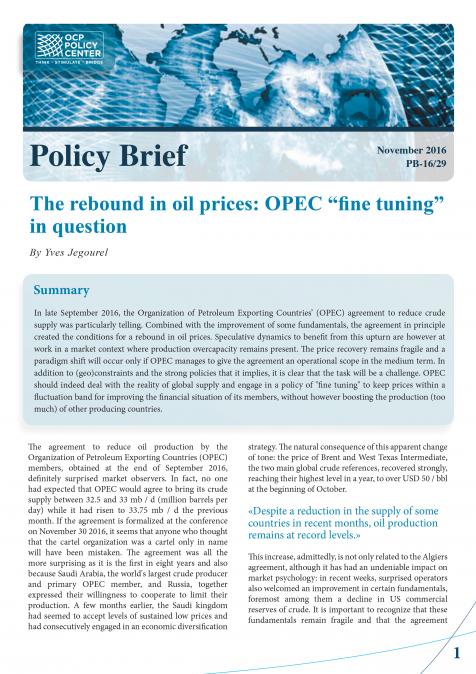
The rebound in oil prices: OPEC “fine tuning” in question
Authors
November 21, 2016

In late September 2016, the Organization of Petroleum Exporting Countries’ (OPEC) agreement to reduce crude supply was particularly telling. Combined with the improvement of some fundamentals, the agreement in principle created the conditions for a rebound in oil prices. Speculative dynamics to benefit from this upturn are however at work in a market context where production overcapacity remains present. The price recovery remains fragile and a paradigm shift will occur only if OPEC manages to give the agreement an operational scope in the medium term. In addition to (geo)constraints and the strong policies that it implies, it is clear that the task will be a challenge. OPEC should indeed deal with the reality of global supply and engage in a policy of "fine tuning" to keep prices within a fluctuation band for improving the financial situation of its members, without however boosting the production (too much) of other producing countries.
RELATED CONTENT

  • Authors
    March 3, 2026
    Sur les marchés mondiaux de matières premières, l’année 2025 s’est inscrite dans le sillage de 2024 : une hausse record des cours des métaux précieux dans le contexte d’incertitudes, toujours plus marquées, et des métaux de base dont la performance a, une fois encore, été largement déterminée par les niveaux de l’offre minière. Du côté des ‘’ softs’’, cacao et café se sont repliés après les records de prix passés, tandis que le marché des céréales a connu une relative stab ...
  • Authors
    Fatima Ezzahra Mengoub
    February 20, 2026
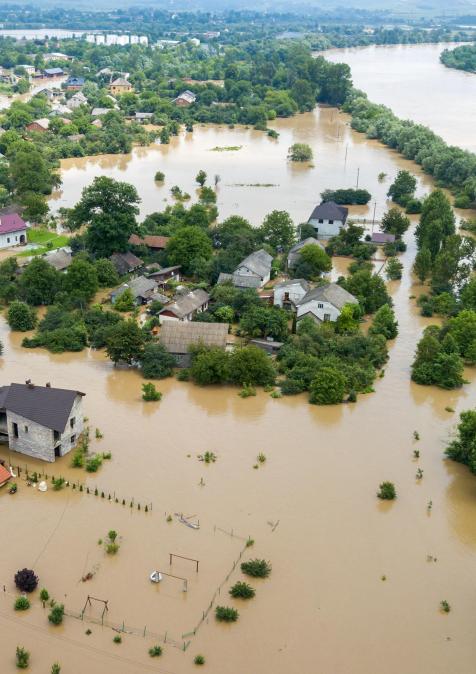
    After more than seven years of drought, Morocco experienced exceptionally abundant rainfall during the winter of 2025-2026, reflecting increasingly marked water variability. This rapid alternation between chronic deficits and occasional excesses reveals the country's water paradox: a system historically centered on scarcity must now manage concentrated and intense extreme episodes.Hydraulic infrastructures helped limit human and economic impacts and ensured significant replenishment ...
  • Authors
    Fatima Ezzahra Mengoub
    February 20, 2026
    Après plus de sept années de sécheresse, le Maroc a connu durant l’hiver 2025–2026 des précipitations exceptionnellement abondantes, témoignant d’une variabilité hydrique de plus en plus marquée. Cette alternance rapide entre déficit chronique et excès ponctuels révèle le paradoxe hydrique national : un système historiquement centré sur la rareté doit désormais gérer des épisodes extrêmes concentrés et intenses.Les infrastructures hydrauliques ont limité les impacts humains et écono ...
  • Authors
    February 11, 2026
    The U.S.–China technological rivalry has become a central axis of global economic and geopolitical competition. While the United States continues to lead in frontier innovation—most notably in advanced semiconductors and artificial intelligence (AI)—China has consolidated strengths in large-scale implementation, manufacturing capacity, and control over critical segments of global supply chains. These advantages are especially visible in clean energy technologies and in the processin ...
  • February 10, 2026
    تناقش هذه الحلقة إشكالية الفيضانات في المغرب في ظل التغيرات المناخية وتزايد حدّة الظواهر القصوى، وتسلّط الضوء على تحديات إدارة الموارد المائية بين الوقاية من المخاطر وضمان الأمن المائي، كما تستعرض السياسات العمومية وآليات التدبير الاستباقي والبنية التحتية المرتبطة بالمياه، وتفتح النقاش ...
  • Authors
    February 9, 2026
    L’arrestation du président vénézuélien Nicolàs Maduro a suscité la sidération internationale en interrogeant sur le respect du droit international ; puis, fort logiquement, cette opération a conduit à maintes analyses tant sur les arguments politiques, sécuritaires et géostratégiques avancés par Washington que sur les ambitions sous-jacentes ayant présidé à cette décision sans réel précédent dans l’histoire récente. Outre la lutte contre le narcotrafic, c’est bien évidemment la ...
  • Authors
    February 9, 2026
    The arrest of Venezuelan President Nicolàs Maduro caused international astonishment, raising questions about respect for international law. And, quite logically, the operation led to numerous analyses, both of the political, security and geostrategic arguments put forward by Washington, and of the underlying ambitions behind this decision, which has no real precedent in recent history. In addition to the fight against narco-trafficking, it was of course the oil issue that came first ...