Publications /
Policy Brief

Back
The New South: breaking with the past - West-South engagement in a changing world
Authors
July 26, 2024

This paper was originally published in idos-research.de


The early 1960s can be regarded as the “Big Bang” for international cooperation and development policy. The US was pushing an international system to support developing countries, and in 1961, it established the US Agency for International Development (USAID). The same year saw the Organisation for Economic Co-operation and Development (OECD) set up its Development Assistance Committee (DAC). Germany’s post-WWII engagement in international development cooperation took an institutional shape with the founding of the Federal Ministry for Economic Cooperation and Development (BMZ) also in 1961. Shortly after, in March 1964, the German Institute of Development and Sustainability (IDOS, formerly German Development Institute / Deutsches Institut für Entwicklungspolitik (DIE)) was created with the mandate to train practitioners and post-graduates to work in the new field of development policy and offer research-based advice to the field of international cooperation.

Today, 60 years later, we look back at six decades of research, policy advice, training, knowledge, cooperation and joint learning, with the constant aim of finding innovative and implementation-oriented solutions to current development challenges. The focus of our work is on the interdependence of “development” and “sustainability” and the system of international cooperation itself, in the context of geopolitical shifts. Decent living worldwide and for all social groups is only possible today and in the future if planetary boundaries are adhered to, that is, if political, economic and social development is accompanied by the protection of biodiversity, soils, water and oceans and a radical reduction of climate-damaging emissions is achieved. This requires the climate-stabilizing transformation of production systems and consumption behavior in countries of all income groups, but with targeted support for low- and middle-income countries. It is about envisioning, designing and implementing pathways into sustainable futures around the globe. A reformed, rule-based international order needs to address double-standards and ensure that rules of the game apply to all. Such an order must be based on the recognition of human rights and international law and constructive multilateral cooperation in a multipolar world.

Len Ishmael, in her keynote at IDOS’ 60th anniversary event, addresses these challenges of shaping futures by reflecting on the state of our world and world order today, determining how and by whom futures are being negotiated. She argues that our world is standing at a crossroads. The “New South” is re-considering its identity, aware of its increasing agency, and pursuing alliances that support the New South’s “emergence”. Her assessment is clear: the “Old North” must boost its attractiveness to countries in what she calls the New South if it wants to be considered an important player in upcoming future-making. This seeking of alliances with the New South is not about giving up “Northern” interests or values; instead, it is about shaping reciprocal, trusted partnerships in areas of joint interest and respecting one another’s differences.

Len Ishmael’s keynote “The New South: Breaking with Past: West-South Engagement in a Changing World” is a must-read for all those reflecting on the state of the world today and with the ambition to co-shape its future in a collaborative and constructive manner. (Foreword by Anna-Katharina Hornidge)

RELATED CONTENT

  • Authors
    July 15, 2026
    We Are Watching You In April 2026, the UK Ministry of Defence revealed that it had tracked a covert Russian submarine operation apparently intended to map critical undersea cables and pipelines in the North Atlantic and the North Sea. A Russian attack submarine and two specialised intelligence vessels operated by the Main Directorate of Deep-Sea Research, commonly known as GUGI, were reportedly monitored for four weeks by the Royal Navy, including HMS St Albans and P-8 Poseidon ...
  • Authors
    July 14, 2026
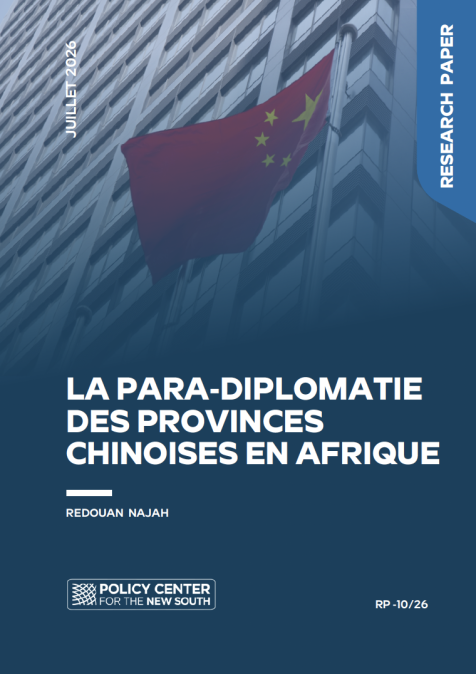
    Avec la capitale Pékin comme acteur principal de la politique étrangère chinoise, l’engagement de la Chine en Afrique ne peut plus être appréhendé à travers le seul prisme de l’État central. Suite aux réformes de décentralisation engagées en 1978, les gouvernements provinciaux de l’Empire du Milieu jouent un rôle de plus en plus visible et structurant, en s’affirmant en tant qu’acteurs à part entière de la coopération internationale. Ils interviennent, entre autres domaines, dans le ...
  • Authors
    July 13, 2026
    On “marinetraffic.com”, thousands of triangles fill a map of the world’s ports and oceans, each representing the active location and destination of a ship, reported the “McGill International Review” (April 16, 2026) adding,” suspicious tankers are plentiful among them.” One of these vessels, marked by a red triangle, appears, zoomed, as “Monique”, a twenty-year-old vessel, aka Tokyo, Phuket and Elysia. Its old age and the frequent name change, suspects reporter Julnar Alzuki, “indic ...
  • July 10, 2026
    For much of the post-war period, the Global South was framed as an object of history, defined by dependency, constrained by structural asymmetries, and confined to the margins of global decision-making. That narrative, once empirically grounded, is now no longer adequate. A profound yet uneven transformation is underway. The Global South is no longer only reacting; it is increasingly shaping rules, institutions, and narratives.This Policy Brief argues that the Global South is thus t ...
  • Authors
    July 9, 2026
    Cet essai analyse la guerre Iran–États-Unis–Israël de 2026 comme un révélateur de la transformation profonde de l’ordre international. À travers le prisme du droit de la mer, du détroit d’Ormuz, des alliances fragmentées, des câbles sous-marins et des flux énergétiques, il montre que le pouvoir mondial se déplace progressivement du contrôle des territoires vers la maîtrise des infrastructures de circulation. Loin de disparaître, la mondialisation entre dans une phase de connectivité ...
  • Authors
    July 7, 2026
    The Green March is one of those seminal moments that have never ceased to influence the course of political events in Morocco, because of its long-term significance from the outset, the context in which it unfolded, the logic of interactions in which it was embedded through its causes and effects, and as one of the striking figures in the national narrative. ...
  • Authors
    July 6, 2026
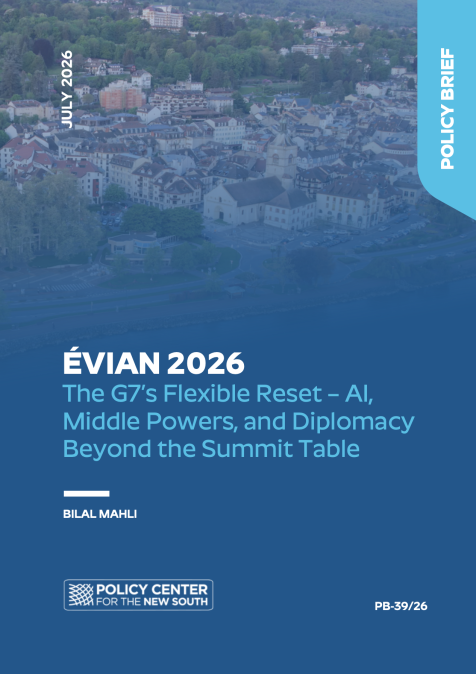
    We take the 2026 G7 Summit in Évian-les-Bains as a case study for understanding how a leading existing multilateral organisation adapts to a more fragmented, technologically inflected, and multipolar world. We argue that the significance of Évian lies less in the summit agreements themselves than in what the summit reveals: a qualitative shift in governance away from exclusive summit diplomacy and towards more selective coalition-building, broader engagement with non-state actors, a ...