Publications /
Opinion
This Blog was originally published on cgdev.org.
The OECD Conference on the Future of International Development Co-operation (which is set to take place in Paris on 11-12 May 2026) comes at a moment of acute strain. OECD Development Assistance Committee (DAC) countries' official development assistance fell by almost a quarter in 2025, and is projected to fall further in 2026. The US has withdrawn from or defunded dozens of multilateral bodies. Development cooperation, long predicated on a stable Western-led institutional order, is now operating in conditions marked by contested policy norms and shrinking public finance. The question confronting delegates in Paris is not whether cooperation is changing. It is how any new configuration will work in practice.
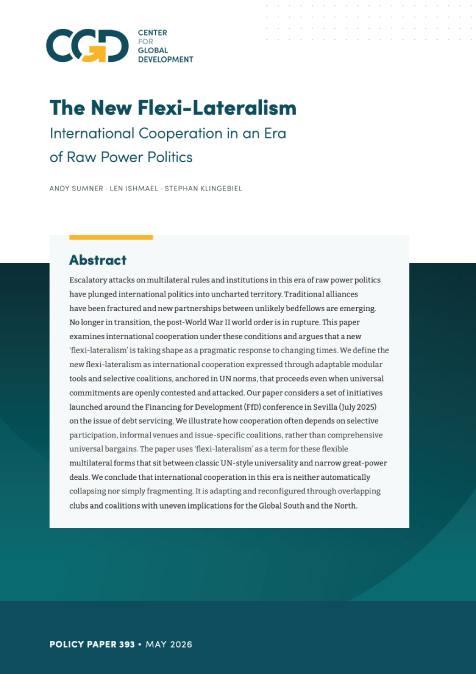
In a new CGD policy paper, we argue that a “new flexi-lateralism” is emerging as a pragmatic response to these conditions. We define this new flexi-lateralism as international cooperation—which happens through flexible, practical tools and selective coalitions, anchored in UN norms—that proceeds even when universal commitments are openly contested and attacked.
We draw from evidence of debt-servicing initiatives launched at the Fourth International Conference on Financing for Development (FfD4) in Sevilla in July 2025. Sevilla is instructive because the US did not participate. What happened thus tells us something important about how cooperation proceeds when a superpower is absent.
Defining the new flexi-lateralism
Our paper identifies five defining characteristics of the new flexi-lateralism evident in the Sevilla initiatives. Each speaks to the agenda in Paris:
1. Selective participation with pathways for others to join
Classic multilateralism typically aims for universal membership. The Sevilla debt initiatives took a different route:
The Borrowers' Forum convened debtor countries under UNCTAD (meaning there is a collective voice for countries that owe debt, allowing them to coordinate positions and negotiate with creditors jointly).
The Global Hub for Debt Swaps centred on the World Bank, Spain and a subset of creditors. It acts as a clearing house, facilitating arrangements in which a portion of a country’s debt is cancelled in exchange for committed domestic investment in development or climate goals.
The Debt Pause Clause Alliance is a coalition committed to inserting clauses into loan contracts that automatically suspend repayment obligations when a borrower country is struck by a severe economic or climate shock. The alliance brought together creditors, multilateral development banks and selected private investors.
In each case, coalitions of willing actors moved ahead while leaving structured pathways for others to join later. The trade-off is that selectivity gains speed and feasibility at the cost of breadth.
2. UN-anchoring with extra-UN operation
None of the three Sevilla initiatives we study abandoned universal norms. The Borrowers' Forum sits under a UN mandate. The Hub and Alliance were launched at a UN conference and frame their work with the language of the UN’s Sustainable Development Goals. Legitimacy is drawn from the universal system. Execution, though, shifts to multilateral development banks, expert groups and operational platforms outside the classic Bretton Woods architecture. This separation of legitimacy from delivery is a defining feature of the new configuration.
3. Modular instruments
The Sevilla cases moved cooperation from declaratory texts to operational tools. Swap templates, contractual pause clauses, debt registries and coordination platforms replaced the pursuit of a single grand deal. These instruments can be revised through pilots and monitoring without reopening a full-scale negotiation.
4. Orchestration across intermediaries
In each case, an international organisation steered cooperation indirectly rather than issuing binding commands. UNCTAD enabled the Forum. The World Bank orchestrated the Hub. Multilateral development banks coordinated the Alliance. This pattern fits orchestration theory of governance without hierarchy, achieved by mobilising intermediaries rather than mandating compliance.
5. Iteration and learning
The Hub and Alliance are structured around pilots, standard-setting, monitoring and revision cycles. The Forum supplies a standing venue for collective learning on negotiation strategy. This experimentalist logic assumes that cooperation under contestation cannot be settled once and for all. It proceeds through iterative adjustment.
Implications for the future of development cooperation
These five characteristics describe a mode of multilateralism that is institutionally connected to universal bodies, yet flexible in its participation rules, venue choice and relies on modular instruments rather than all-encompassing bargains.
The concept is not a replacement for universal multilateralism. It is a description of what cooperation looks like when universal bargains stall and a superpower withdraws.
The risks are numerous. Selectivity can erode inclusiveness. Non-participating creditors, including China and major private bondholders, can free ride on macroeconomic stability gains generated by swaps or pause clauses without offering comparable terms. Voluntary commitments may lack enforceability. Accountability mechanisms remain weak. Without transparency, open accession and meaningful participation by weaker actors, club-based arrangements risk deepening fragmentation.
The OECD conference “will focus on action, connecting geopolitical realities with development priorities and translating vision into practical strategic directions.”
So how does the flexi-lateralism framework help? We argue that cooperation is reconfiguring into selective coalitions using discrete modular instruments, orchestrated through intermediaries, connected to universal norms but no longer dependent on universal participation. Whether this configuration can maintain legitimacy while delivering speed and adaptation is an open question.
Delegates in Paris could look at the design principles we set out that distinguish workable flexi-lateral arrangements from fragmentation, namely, transparency, open accession pathways, and normative alignment with agreed development goals. These are the features that differentiate new forms of cooperation.