Publications /
Policy Brief
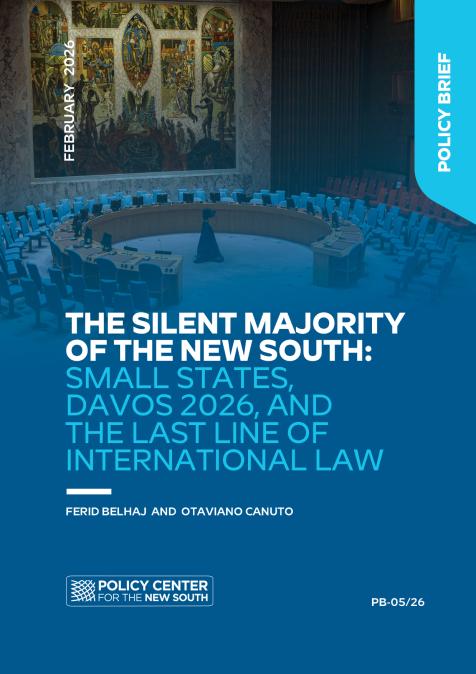
This article examines the quiet but profound implications of the erosion of U.S.-led hegemony for small and vulnerable states of the New South. While the post-1945 international order was never egalitarian, it offered predictability: power was organized through law, and sovereignty for weaker states rested less on justice than on procedural stability. Davos 2026 marked a turning point in the public acknowledgment of that system’s unraveling. Statements by leading Western figures revealed not a revolt against American power, but a growing recognition that the United States is increasingly retreating from the obligations that once distinguished hegemony from dominance. As rules give way to discretion, and institutions to transactional bargaining, the capacity of states to navigate global disorder is becoming sharply unequal.
The article argues that this shift is existential for small states—particularly in the Middle East and North Africa—whose sovereignty depends almost entirely on international law and multilateral institutions. Unlike middle powers, they lack buffers, leverage, and visibility; their vulnerability rarely translates into voice. Climate change, debt distress, and security dependence deepen this asymmetry, making legal obligation—not power—their primary shield. Far from idealism, international law functions for these states as the infrastructure of survival. The weakening or bypassing of multilateral rules thus constitutes a systemic stress test: not of global morality, but of global stability. If the last line of international law collapses, the resulting order will not be more realistic—it will be more coercive, exclusionary, and ultimately less durable.
The post-1945 international order was never egalitarian, but it was intelligible. Anchored in U.S. hegemony, it combined overwhelming power with institutionalized restraint. International law and multilateral organizations did not tame power; they organized it. For small and vulnerable states, that distinction mattered. Predictability—rather than justice—was the true currency of sovereignty.
That era is now decisively over. At Davos 2026, this reality was no longer whispered in corridors; it was articulated from the stage. The convergence between Canadian Prime Minister Mark Carney’s warning about systemic fragmentation and French President Emmanuel Macron’s call for European and middle-power strategic autonomy marked a turning point. What emerged was not anti-Americanism, but something more consequential: a recognition that U.S. hegemony no longer guarantees systemic stability—and may no longer even aspire to it.
For middle powers, this moment invites repositioning. For small states of the New South, it raises a far more existential question: what happens to those whose sovereignty depends not on power, but on rules?
Mr. Trump’s View: The World Has Been Freeloading on U.S. Hegemony
Mark Carney’s speech at Davos 2026 opened with the assertion that he would “talk about the rupture in the world order.” The only recent change plausibly capable of producing such a “rupture” is the attitudinal shift adopted by the U.S. during President Trump’s second mandate, marked by a clear drift away from the obligations that distinguish hegemony from mere dominance.
As the post-World War II hegemon, the U.S. did not simply dominate; it set the rules of the global game in ways that other countries found legitimate—or at least inevitable. It did not merely possess superior power; it wrote the "rulebook" (often described as the liberal international order) that most states accepted and followed.
Under Trump 2.0, however, the U.S. has increasingly shifted toward a strategy of raw dominance while consciously retreating from its role as a global hegemon. Trump’s policies and actions reflect a view that the rest of the world has been freeloading on the U.S. for its provision of global public goods.
Consider, for instance, the role of the U.S. dollar at the core of the international monetary and financial system. As a source of reserve value, it gives rise to what Giscard D’Estaing—then French Minister of Finance under De Gaulle—famously termed the “exorbitant privilege”: global demand for safe-haven assets generates a corresponding excess of U.S. absorption (consumption plus investments), financed through the simple issuance of dollars. A certain level of current account deficits thus becomes the mechanism through which the U.S. supplies dollars to a world seeking external stores of value.
Mr. Trump’s announcement of “reciprocal tariffs” last April was justified as a means to curb the U.S. trade deficit. He mentioned the U.S. as being commercially “raped” by other countries. The formula used to justify tariff levels was directly tied to bilateral trade balances, and the measures collided head-on with the most-favored-nation principle that underpins the WTO’s multilateral trade regime—itself established as part of the exercise of U.S. hegemony.
Tariffs have also been deployed for explicitly “transactional” purposes, serving as bargaining leverage for non-trade objectives—an approach Mr. Trump rehearsed with Mexico during his first mandate. Rather than leading through free trade agreements, the administration has imposed sweeping tariffs and leveraged U.S. financial power to extract specific concessions from both allies and rivals.
The threat to impose additional tariffs on Denmark and other European countries that sent troops to Greenland, following Mr. Trump’s announcement that military means could be used to secure U.S. acquisition of the territory, is the latest example. Although he backed off during Davos, he later alluded to tariffs on Canada should it conclude a trade agreement with China.
Mr. Trump’s view of hegemony as a burden is also evident in his pressure on NATO allies to increase defense spending. Once again at Davos, he emphasized what he described as an unequal sharing of the burden among allies in providing security as a collective good.
De-Risking from America
Over the past decade, “decoupling”—or at least “de-risking”—from China has become a recurring theme in U.S. and European policy debates. The shift in U.S. foreign policy attitudes has now triggered a parallel discussion: whether, and how, to reduce exposure to U.S. policies themselves.
Trade offers a clear illustration. Prime Minister Carney traveled to China before Davos, where he signed a new bilateral trade agreement. On January 20, 2026, he outlined a strategy to reduce Canada’s heavy economic reliance on the United States-—which currently absorbs nearly 70–75 percent of Canadian exports—by pursuing broader trade diversification. The stated objective is to bring that share below 50 percent over the longer term, as part of a reorientation toward other global markets, with significant diversification toward China and India.
De-risking from the U.S. in this context, however, also implies increasing exposure to China. China’s “weaponization of interdependence” was precisely what led to last year’s truce with the U.S. At the same time, Carney emphasized that diversification away from the U.S. by Canada—and by other middle powers—would also involve strengthening a broader set of relationships, primarily among middle powers themselves.
Europe offers a parallel case. The conclusion of a free trade agreement with Mercosur (Argentina, Brazil, Uruguay, and Paraguay), after twenty-six years of negotiations, was facilitated by Mr. Trump’s trade policies. Similarly, the UK not only finalized a trade deal with India last year but also reignited debate about partially reversing Brexit and moving closer to the European Union. Europe has also expressed interest in partnership with the Trans-Pacific group, from which the U.S. withdrew during Mr. Trump’s first term and of which China is not a member.
What about diversifying away from the U.S. dollar? Dollar dominance has deep structural roots, but Mr. Trump’s policies have, to some extent, shaken them. His attacks on Federal Reserve independence—including the launch of a criminal probe into its chair, Jerome Powell—illustrate the pressure to move interest-rate decisions away from rule-based frameworks. If Trump’s push toward “fiscal dominance” over monetary policy prevails, investors would have reason to expect an era of higher U.S. inflation and a weaker dollar.
And what of U.S. Treasury bonds? In April of last year, during the “Liberation Day” announcement and the rollout of reciprocal tariffs, escalation and de-escalation of threats to use U.S. military force in Greenland were accompanied by corresponding swings in Treasury yields and episodes of dollar depreciation. This was not driven by direct strikes against Treasuries, to be sure, but largely by investors’ search for hedging. Still, it is difficult to deny that the perception of U.S. assets as uniquely safe is no longer as unassailable as it once was.
Talk of de-risking from America, of course, extends well beyond trade and finance. It now reaches every area of strategic relevance, including technology and military equipment. Even so, the mere fact that de-risking in trade and finance is now openly discussed would have seemed unthinkable only a few years ago.
Davos 2026: From Managed Hegemony to Open Contestation
Davos 2026 did not produce a manifesto, but it did reveal a paradigm shift. Carney spoke of an international system drifting from rules to discretion, from shared guardrails to selective enforcement. Macron was more direct: Europe could no longer outsource stability to Washington while absorbing the costs of unilateralism.
What made this moment distinctive ++-was not the critique itself, but its source. This was not the Global South denouncing Western hypocrisy, nor revisionist powers attacking liberal norms from the outside. It was insiders—custodians of the post-1945 order—acknowledging that the guarantor of stability had become an unpredictable actor within it.
For middle powers, this shift creates space to hedge and coordinate. For small states, however, it sharply narrows the range of available options.
The Unequal Capacity to Push Back
Middle powers can resist hegemonic pressure because they possess buffers: diversified economies, diplomatic reach, institutional weight, and strategic relevance. Their pushback carries consequences.
Small and vulnerable states of the New South—small island states, least developed countries, fragile economies across Africa, the Caribbean, the Pacific, and parts of the Arab world—do not share this latitude. In the Middle East and North Africa, this includes states such as Jordan, Lebanon, Tunisia, and Morocco—countries with limited strategic depth, constrained fiscal space, and high exposure to external shocks. They face cumulative pressures from climate stress, debt distress, food and energy insecurity, refugee inflows, and regional instability. Their emissions are negligible, their markets marginal, their militaries symbolic—yet their dependence on international rules is absolute.
They cannot “stand up” to hegemony because they are barely visible within it.
In the MENA context, invisibility takes a particularly acute form. States such as Jordan and Lebanon are structurally embedded in security, aid, and financial arrangements over which they exercise little control, yet they bear disproportionate adjustment costs when those arrangements shift. Tunisia, navigating fiscal consolidation under external conditionality while absorbing climate and social pressures, illustrates how sovereignty is increasingly mediated through financial instruments rather than territorial control. For these states, power is not something to balance against—it is something to manage, absorb, and survive.
Silence as a Structural Condition
The absence of small states from the Davos debate is not accidental. It reflects a deeper reality: vulnerability rarely translates into voice. Climate-exposed states do not set climate agendas. Debt-distressed countries do not design financial architectures. Security-dependent states do not define security norms.
In the Arab world, countries most exposed to water scarcity, heat stress, and food-price volatility—such as Tunisia, Jordan, and Morocco—remain rule-takers in global climate and financial governance, despite serving as frontline laboratories of systemic risk.
Yet these states are the first to suffer when international law weakens. When borders are violated with impunity, when treaties are reinterpreted opportunistically, when obligations become voluntary, it is not middle powers that lose sovereignty—it is those for whom law is the only shield.
Why International Law Still Matters—Especially Now
International law is often dismissed as performative or obsolete—typically by actors with alternatives: economic leverage, military deterrence, or strategic relevance. Small states have none.
This reality is especially stark in the Middle East and North Africa. For countries operating in crowded geopolitical neighborhoods—bordering conflict zones, major powers, or contested maritime spaces—international law is often the only non-military instrument available to assert continuity, jurisdiction, and recognition. For Lebanon, maritime law and UN procedures are not abstractions but essential tools for managing asymmetric disputes. For Jordan, multilateral frameworks are indispensable to sustaining refugee support, fiscal stability, and international legitimacy. In these contexts, law is not a last resort—it is the infrastructure of survival.
International law performs three irreplaceable functions for small states:
it institutionalizes formal equality;
it introduces procedural friction that constrains coercion;
and it enables collective security through institutions rather than force.
In a world drifting toward raw power politics, this is not idealism. It is strategy.
Climate Change: The Ultimate Asymmetry
Climate change exposes the deepest asymmetry of all. States that contribute least to global emissions face the gravest threats. Many MENA small states are already confronting water scarcity, food dependence, and fiscal strain long before climate mitigation becomes technologically or financially feasible.
As climate governance fragments into clubs and voluntary coalitions, legal obligation gives way to discretion. Climate finance becomes charity. Responsibility dissolves into rhetoric.
For vulnerable states, climate law is not moral signaling—it is the only framework that preserves causality, obligation, and avenues for redress.
Multilateral Institutions: No Substitute, Only Reform
Multilateral institutions are flawed, slow, and politically constrained. Yet for small states, they remain irreplaceable.
The UN, international financial institutions, and international courts provide continuity, visibility, and procedural access. They are the arenas where vulnerability can be translated into claims—and claims into norms.
The danger highlighted at Davos 2026 is not the need for institutional reform, but institutional bypassing. A world governed by coalitions of the willing is, by definition, a world that excludes the weakest.
Conclusion: The System’s Quiet Stress Test
Davos 2026 revealed a world in transition. U.S. hegemony is no longer uncontested. With the U.S. increasingly seen as a disruptor of the rules rather than their protector, countries are seeking new ways to organize global affairs without relying on Washington.
Middle powers are recalibrating. Beneath this visible shift, however, lies a quieter stress test: whether the international system still safeguards those without power.
For the small and vulnerable countries of the New South—particularly in the Middle East and North Africa—international law and multilateral institutions are not nostalgic artifacts. They remain the last line of defense against coercion, marginalization, and erasure.