Publications /
Policy Brief

Back
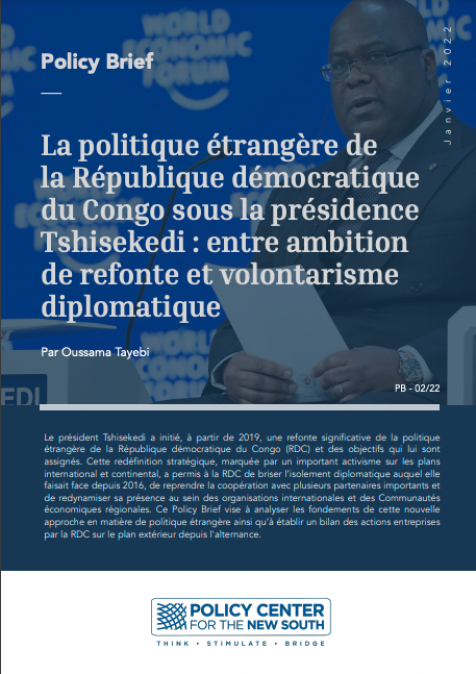
La politique étrangère de la République démocratique du Congo sous la présidence Tshisekedi : entre ambition de refonte et volontarisme diplomatique
Authors
January 10, 2022

Le président Tshisekedi a initié, à partir de 2019, une refonte significative de la politique étrangère de la République démocratique du Congo (RDC) et des objectifs qui lui sont assignés. Cette redéfinition stratégique, marquée par un important activisme sur les plans international et continental, a permis à la RDC de briser l’isolement diplomatique auquel elle faisait face depuis 2016, de reprendre la coopération avec plusieurs partenaires importants et de redynamiser sa présence au sein des organisations internationales et des Communautés économiques régionales. Ce Policy Brief vise à analyser les fondements de cette nouvelle approche en matière de politique étrangère ainsi qu’à établir un bilan des actions entreprises par la RDC sur le plan extérieur depuis l'alternance.
RELATED CONTENT

  • Authors
    November 16, 2026
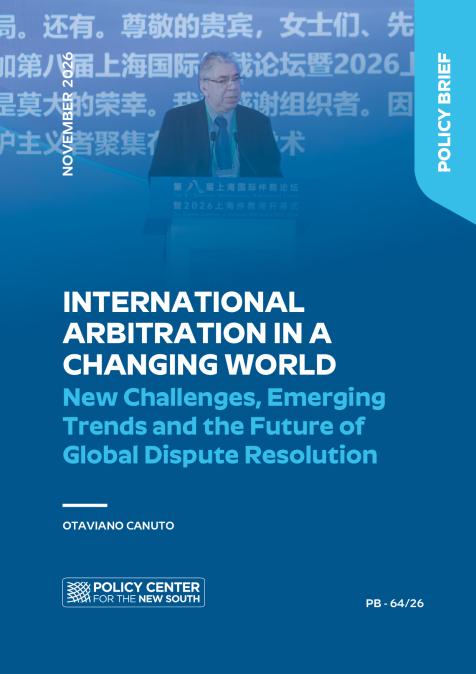
    How can international arbitration preserve its core principles of neutrality, party autonomy and enforceability while adapting to a world increasingly characterized by geopolitical fragmentation, technological disruption and competing regulatory interests? Meeting this challenge demands a collective effort, bringing together arbitral institutions, national courts, governments, international organizations, academics and practitioners. It requires openness to institutional innovation, ...
  • Authors
    Giovanna Rinaldo
    November 4, 2026
    Brazil’s presidential election, which concluded on October 25, 2026, was above all a digital battle. This is nothing new; the impact of social media on elections has been widely analyzed since Barack Obama's 2008 win marked a turning point for digital campaigning worldwide. Almost two decades later, social media is an entirely different breed, with a life of its own – and still very little regulation within electoral politics. The danger, however, is that digital players now also in ...
  • October 22, 2026
    Strategic hedging is rational when it preserves a worthwhile choice at a tolerable cost while respecting existing commitments. Drawing on the literature on hedging and Latin American autonomy, this Policy Brief examines contrasting illustrations of that proposition. It distinguishes ambiguity about future alignment from uncertainty about existing obligations and explains how clearly bounded commitments can reconcile autonomy with credibility. The cases reveal different vulnerabiliti ...
  • Authors
    Florent Parmentier
    October 12, 2026
    Cet article soutient que le Chief Geopolitical Officer (CGO) doit être repensé à partir de l’expérience des entreprises africaines. Dans un environnement multipolaire et fragmenté, leur principal défi n’est pas seulement la gestion des risques, mais la préservation de plusieurs options stratégiques simultanément selon une logique de hedging. Trois modèles de CGO sont à distinguer : l’intermédiation (Office chérifien des Phosphates (OCP), Tanger Med), l’intégration régionale (Ethiopi ...
  • Authors
    Paul Isbell
    October 9, 2026
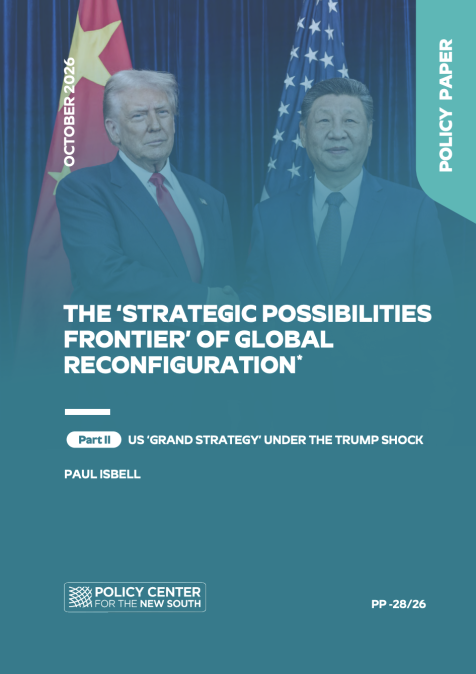
    In the first seven Policy Briefs of this ongoing series of analysis on Pan-Atlanticism: The Atlantic Basin in a Multipolar-Transnational World, we developed the argument that the strategic significance of the Atlantic Basin is on the rise for a range of international actors (states, regions and non-state agents) and from distinct political or ideological perspectives. In addition, in the most recently published Policy Brief -- “The U.S. and the Current International Reconfiguration: ...
  • Authors
    Marie-Noelle Nwokolo
    October 6, 2026
    The author of this opinion, Marie-Noelle Nwokolo, is a 2024 alumna of the Atlantic Dialogues Emerging Leaders Program.In September 1978, delegations from 138 countries gathered in Buenos Aires, Argentina, around a powerful idea: developing countries had knowledge, experience and capabilities worth sharing with one another. The Buenos Aires Plan of Action gave institutional form to what we now call South-South Cooperation, part of a wider post-colonial effort by developing ...
  • October 02, 2026
    Building on his Policy Brief "Latin America, World Politics and the Great Powers", Nizar Messari examines how recent developments are reshaping U.S. influence in the region and affecting ...
  • Authors
    September 30, 2026
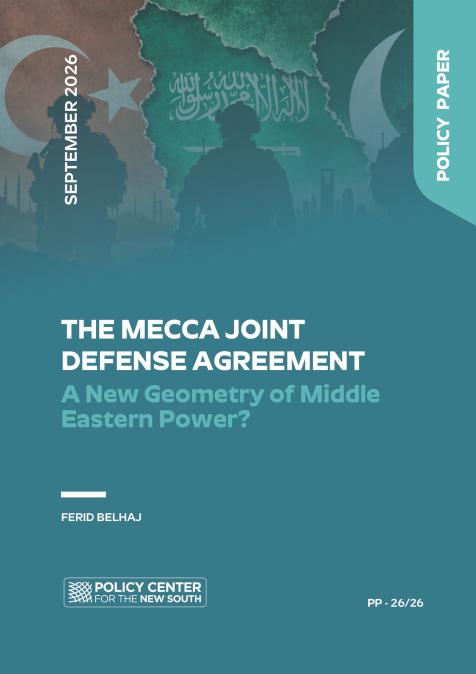
    On August 7, 2026, Saudi Arabia, Turkey, and Pakistan signed the Mecca Joint Défense Agreement, a collective-defense pact widely compared to NATO’s Article 5. This essay argues that the comparison is misleading. Mecca borrows NATO’s language of solidarity without yet possessing NATO’s institutional machinery, and the Houthi offensive against Saudi Arabia in September 2026 provided an early and revealing test of what the agreement actually means in practice. Neither Pakistan nor Turk ...