Publications /
Policy Brief
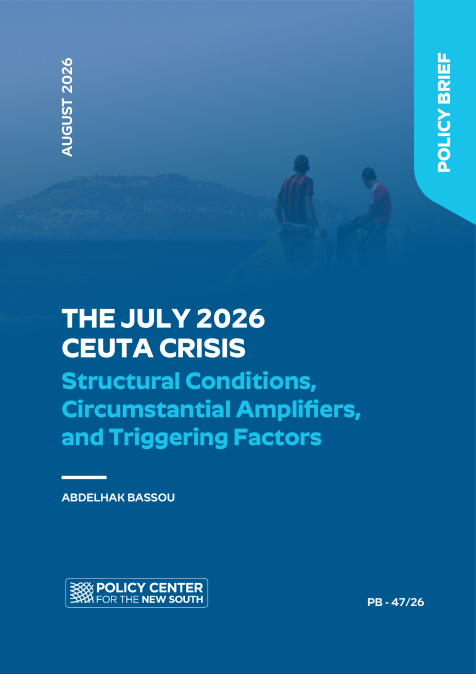
When a crisis erupts, it sets crisis-management reflexes in motion and prompts efforts to contain its effects. Analysts then begin looking for the malfunctions, oversights, and failures that caused it. In some cases, conspiracy theories creep in, and speculation turns to who engineered the crisis, and to what end.
Crisis-management theory teaches us, however, that a crisis unfolds under conditions that favor its emergence. Crises take shape in an environment where latent vulnerabilities are amplified by accelerants that erode vigilance and resilience, before triggering factors finally light the fuse.
The Ceuta crisis is no exception to this rule. What, then, were its underlying structural drivers, what circumstances amplified them, and what actually set it off?
INTRODUCTION
Commentary on the July 2026 Ceuta crisis has followed a familiar interpretive reflex: hunt for the cause or causes, name those responsible, and cite either the stated motives or, failing that, the ones that supposedly went unstated. Some point to a geopolitical dispute between Morocco and Spain, with Algeria in the background. Others dismiss the episode as a calculated Moroccan maneuver, automatically drawing a parallel with the similar but not identical crisis of 2021. Still others treat it as nothing more than an ordinary socio-economic crisis.
The broader literature on crises, whatever their nature or scale, tells us that such events never erupt out of nowhere, and that no single cause can fully explain them. What happened between July 30 and 31, 2026 is no different. As with every crisis, July's events resulted from the convergence of three distinct yet interdependent layers: deep, permanent structural conditions; amplifying circumstantial factors; and situational triggers. This three-tier framework helps make sense not only of what has already happened, but also of how to better anticipate future crises, by working, over the long term, to reshape structural conditions, adapt to shifting circumstances, and stay ahead of potential triggers.
That is the argument of this Policy Brief: to lay out how a range of different conditions combined to produce not only last July's events, but similar crises in the past, and will likely fuel new tensions to come.
Examining the crisis through this three-dimensional lens does more than place it in proper context; it also makes it possible to anticipate how it might evolve going forward. While some structural elements are hard to change, it remains possible, with varying degrees of effort, to monitor for anything that might deepen an existing vulnerability, and, above all, to head off the triggers that could set off another explosion.
I. STRUCTURAL AND LATENT CONDITIONS
1. Morocco's Socio-economic Environment, Primarily Unemployment
Most of those attempting to migrate through Ceuta, or any other potential crossing point, are driven by economic motives, a reflection of the structural employment crisis that persists in Morocco despite sustained economic performance that has placed the Kingdom among middle-income countries. According to Morocco's High Commission for Planning (HCP), the national unemployment rate stood at 13% in 2025, with sharp disparities: 37.2% among 15-24 year-olds, 20.5% among women, and 19.1% among graduates.1
Even more telling of the problem's structural nature: 52.9% of the unemployed had never held a job, and 64.8% had been out of work for a year or more. Average unemployment duration rose from 31 to 33 months. These figures do not describe a temporary employment shortfall; unemployment is increasingly a structural driver of Moroccan migration.
International Monetary Fund (IMF) data confirms this trajectory, with the Fund projecting Moroccan unemployment at 12.1% in 2026, following a peak of 13.4% in 2024. The UN Development Programme (UNDP) further estimates that 6.4% of Morocco's population is classified as vulnerable to multidimensional poverty.2 The World Bank, for its part, notes that while poverty declined to 3.9% in 2022, inequality remains significant and urban-rural gaps remain wide. Internal migration flows are therefore substantial, moving from rural regions toward major cities and, for a share of these internal migrants, toward northern Morocco as a final staging point before attempting to cross into Europe. Fnideq, like Tangier or Nador, is the endpoint of a journey that often begins hundreds of kilometers away.
2. Ceuta, a Strategic Chokepoint of Global Significance
Ceuta is not merely an administrative anomaly; it is a geostrategic node that humanitarian framing often reduces to its migratory dimension alone. In reality, the enclave needs to be examined against the real stakes involved and set within its broader geopolitical environment:
- Even though Morocco does not publicly press the question of Ceuta's Moroccan status, preferring a measured approach, the issue remains firmly embedded in Moroccan public opinion. No Moroccan institution or citizen accepts Ceuta's status as Spanish. That Ceuta and Melilla are European territories in Africa (Morocco) is already a source of friction, particularly on migration, how can population flows to and from a territory Moroccans regard as an integral part of their own country be restricted?
- The Strait of Gibraltar is one of the busiest shipping lanes in the world, and its traffic figures speak to its strategic weight: more than 100,000 commercial vessels pass through it each year, roughly 300 a day. It is the gateway between the Atlantic and the Mediterranean, between Europe and Africa, between East and West. Morocco's investment in Tanger Med, now Africa's leading port, having handled 10.2 million TEUs (Twenty-foot Equivalent Units) in 2024, has considerably strengthened the Kingdom's role in managing this strategic corridor.
- This dimension has grown even more significant amid the crises now affecting eastern maritime corridors. With the Strait of Hormuz and the Bab el-Mandeb Strait effectively paralyzed, Gibraltar is no longer just a border between Morocco and Spain, it has become a vital artery of the global economy.
Spain places Morocco (of which Ceuta is geographically part) at the center of its strategic reading of Europe's southern flank. In its 2025 national security report, Madrid directly links Moroccan stability to the migratory, economic, energy, and security balance not only of the Iberian Peninsula but of Europe, and indeed the wider West. A crisis in Ceuta is therefore never purely a migration issue, it immediately reverberates through Morocco's own strategic calculations, given that Rabat regards the enclave as an integral part of national territory, just as it registers in Madrid, Brussels, London, and Washington, all of which view it through a broader geostrategic lens.
3. Migration Management as an Instrument of Leverage
Coverage and analysis of the July 2026 crisis has inevitably drawn comparisons with 2021. In May of that year, during the crisis triggered by Spain's decision to admit Polisario leader Brahim Ghali, Spain's then defense minister accused Morocco of "blackmail" and "aggression." That reaction echoes the European Union's stance toward Turkey during the 2015 Syrian migrant crisis, or Poland's toward Belarus in 2021.
Migration management between neighboring states is almost inevitably politicized. It lends itself readily to mutual accusations whenever the state of bilateral relations allows for it, and the possibility of deliberate manipulation by one's neighbor is, rightly or wrongly, never entirely dismissed.
The crises of May 2021 and July 2026 are similar in substance but differ in their parameters, most notably in their officially recognized trigger (judicial in 2026, diplomatic in 2021) and, above all, in Madrid's response: this time, unlike in 2021, Spain did not accuse Morocco of orchestrating the movement. Even so, the 2021 precedent entrenched a perception that the Ceuta border is a negotiable space, a barometer of bilateral relations, and a potential instrument of pressure.
Since the Brahim Ghali episode, perceptions in Spain and Europe have been shaped by an underlying bias toward Morocco, under which any migration-related incident is automatically read as a political signal.
II. AMPLIFYING FACTORS AND TRIGGERING ELEMENTS
1. Amplifying Factors
- A Rising Trend in Crossings, Particularly by Sea, since Early 2026.
Irregular crossings into Ceuta had already been trending upward since January 2026. Over the first half of the year (January-June), Spain's Interior Ministry recorded around 2,582 irregular entries into Ceuta, more than double the 978 recorded over the same period in 2025. This increase becomes even more significant when factoring in the surge from early July onward: attempts to bypass the land border by sea, via Fnideq or Benzú, intensified to reach roughly 2,826 entries by July 15.
The July 2026 crisis, then, did not come out of nowhere. From the start of the year, the sea route had progressively become the main way into the enclave, with migrants setting out from Fnideq to the south or Benzú to the north to get around a heavily militarized land border. The trend was well documented ,the system was already under strain before the trigger hit.
The shift toward the sea route predates the Spanish court ruling on migrants arriving by sea, and reflects the reinforcement of land-border controls.
This shift from land to sea crossings weakened border surveillance and, as a result, facilitated and reinforced the modus operandi behind the late-July surge.
- Spain's Regularization Plan3 and Its Pull Effect
Spain's plan to regularize 500,000 undocumented migrants, adopted on January 27 and completed by June 30, 2026, sent a powerful signal. By early July 2026, nearly 1.2 million undocumented migrants in Spain had applied for regularization, more than double the expected number. Although this scheme applied only to people already on Spanish soil, prospective migrants read it as an opening, a sign that the door was ajar.4 It reinforced the perception that Spain had become more accessible than before, a perception social media amplified further.
For Moroccan candidates for irregular migration, especially those hit hardest by unemployment, the regularization drive fed a growing sense that Spanish territory offered a solution to their troubles.
2. Triggering Elements
- The Spanish Supreme Court's July 8, 2026 Ruling: The Basis for Algorithm-Driven Disinformation
On July 8, 2026, Spain's General Council of the Judiciary (CGPJ) published ruling STS 2965/2026, issued on June 29, 2026, by the Administrative Litigation Chamber. The high court found that summary pushbacks at sea, carried out without prior procedure, were unlawful. The ruling itself did not say that swimming across guaranteed regularization, but it created a real, and readily exploitable, legal ambiguity. This was a trigger of a legal nature, one that might have had little effect on its own had the amplifying factors not already put the system under strain.
A deliberately distorted reading of the ruling, claiming that swimming across would guarantee protection from expulsion, or even regularization, spread quickly, paired with a time-stamped rumor that the border would be "open at 10 pm" that Wednesday night. As a point of comparison, a viral TikTok video calling for a mass crossing in September 2024 had racked up 500,000 views and led Moroccan authorities to detain 4,455 people within a week. In July 2026, the same mechanism produced an effect of an entirely different magnitude. The difference between 2024 and 2026 lies not in how the rumor spread, but in the state of the system that absorbed it. By 2026, structural conditions and circumstantial amplifiers had already weakened the system enough for the same spark to set off a blaze.
- A Self-Sustaining mass effect
Once the first few thousand had crossed, a third trigger came into play: crowd dynamics and social contagion. Against a backdrop of rumors that "the border is open," the sight of thousands of people actually crossing functioned as irrefutable social proof. Real-time images circulating on social media fed successive waves, creating a self-sustaining phenomenon that quickly outpaced both sides' capacity to respond.
CONCLUSION
This three-tier model yields several lessons for understanding the crisis and anticipating what comes next:
- Responsibility is bilateral, and must be treated as such. A strong security response remains essential to protect lives, control crossings, and dismantle criminal smuggling networks, but it cannot, on its own, amount to a public policy. On the Spanish side, the lesson cuts the same way: a court ruling whose foreseeable consequences were flagged by Rabat and ignored by Madrid reflects a governance failure that talk of "Moroccan manipulation" cannot paper over.
- The Ceuta crisis demonstrated that targeted disinformation can now trigger, in under twenty-four hours, a human and political shock on par with an actual show of force. Digital borders now matter as much as physical ones. Without a system for monitoring and swiftly countering rumors circulating on social media in departure areas, the same scenes could easily recur.
- As long as government action fails to address what makes a rumor more believable than an official statement, the same scenes will likely recur. Young people cannot be asked to give up on a dangerous crossing without being offered a credible alternative. The real question, then, is not how to prevent the next Ceuta crisis, it is how to make young Moroccans, across every region of the country, less susceptible to a rumor promising a virtual paradise.