Publications /
Opinion
This Opinion was originally published on policyedge.in
The weakening of global institutions creates both risk and opportunity, placing India at the center of debates on reform and renewal.
The global order is not collapsing outright but is gradually hollowing out, as institutions lose normative coherence and great power contestation reshapes rules from within. This moment of transition creates both risks of fragmentation and opportunities for redesign. For India, rising economic weight and a multi-aligned diplomatic posture position it at the center of this shift. The key question is whether India can translate its convening power and Global South leadership into durable institutional influence and coalition-driven reform.
A World in Rupture
International politics is undergoing a period of profound upheaval in the decade of the 2020s. Indeed, observers note that there has been more change in recent years than in the past three decades, and further, that the world order is in rupture. While it remains largely unclear what a future global order might look like, and how long the current transition will last, there is a sense that the global institutional architecture in place since World War II is crumbling. Several actors – from China to Russia and not least the USA, are contesting the old order, its norms and institutions.
Since the beginning of Donald Trump’s second term in office, existing norms and standards have in many respects been undermined. In several areas they are even being confronted aggressively. Even before Trump returned to the White House, pronounced tensions existed in international politics, and power relations had been shifting, prompting intense debate about the trajectory of international relations. While the G7 are still at the helm of economic power, their shares of global output have declined from roughly two-thirds to less than one-third today.
In the meantime, the center of global economic gravity has shifted from West to East, anchored around China, India, Indonesia among others. This reality is not reflected in the current multilateral institutional architecture, and has long been a source of simmering tension between the South and North. For example, despite China’s much more dominant role in the global economy, its voting quota at the IMF remains only 6.4 percent compared to the combined EU share of 26.2 percent.
China’s economic rise has long been accompanied by an increasingly assertive ambition to shape global structures. The Chinese Global Governance Initiative, published in September 2025, is a case in point. It outlines President Xi Jinping’s vision for the future of international politics. Russia’s war against Ukraine, recent wars in Gaza, the American- and Israel-led war in Iran and US hostilities in Venezuela have likewise marked a turning point for key principles of international order and international law.
The Uncertain Future of Multilateralism
It is little wonder that debates about the future of multilateralism are flourishing. One prominent example is the widely noted argument by Canadian Prime Minister Mark Carney that middle powers are not entirely powerless in the face of great-power rivalry. Critics, however, caution that middle powers do not automatically play constructive roles in their regions, and that assumptions about liberal and cooperative middle powers are often overly idealized.
Persistent calls for multilateral institutional reform have become a rallying call for establishing non-western groups such as the BRICS and the Shanghai Cooperation Organization (SCO) to support Global South countries in securing their interests, even though Russia (as a BRICS and SCO member) is not part of the Global South.
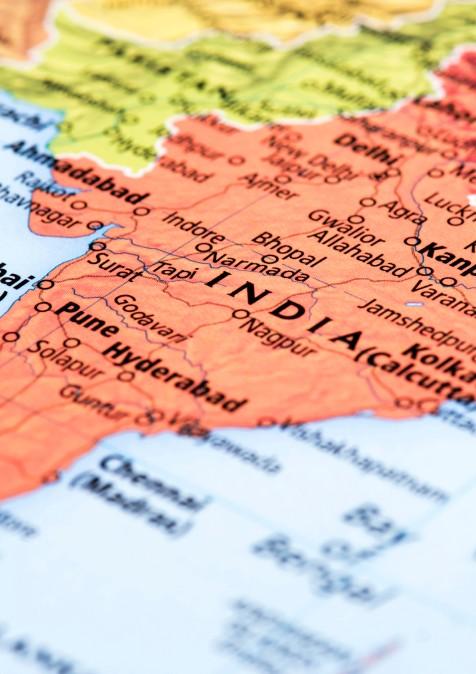
India is the world’s six-largest economy in nominal GDP in 2025, with a GDP of almost $4 trillion. It is a leader in the Global South, and often an important strategic partner of Western powers. What is frequently perceived in the West as a crisis of the international order may thus appear as an opportunity to fundamentally rebalance and reshape global governance structures for many in the Global South. This crisis is multifaceted. It includes questions of legitimacy, growing fragmentation of cooperation mechanisms, and the limited reform capacity of many international organizations.
India’s Growing Strategic Importance
In all of these debates, India’s role and voice are becoming increasingly important, and it is undoubtedly among the most courted global actors. The steady flow of western leaders to China recently was matched by visits to India. Recent visits in 2026 included those by the Canadian Prime Minister, the
Finnish and French Presidents, Austria’s Chancellor, and senior EU and US officials to discuss trade and wider strategic cooperation. Its importance stems not only from its socio-economic weight, but also from its independent approach to international issues, conflicts, and crises embedded in its posture of multi-alignment. While this independence has drawn criticism, it has also enabled India to act autonomously and to advance its own international initiatives, leveraging multiple roles. For example, as host of the G20 in 2023 (“Vasudhaiva Kutumbakam“ - “One Earth, One Family, One Future”), as a member and partner of diverse platforms such as the Quad (Quadrilateral Security Dialogue; together with the United States, Japan and Australia), and as a driver of dialogue through initiatives like the Raisina Dialogue in New Delhi.
India has leveraged all platforms in support of Global South development. Prime Minister Modi’s convening the first ‘Voices of the Global South’ Summit (January 2023), the recent hosting of the Global AI Impact Summit as the incoming BRICS Chair (February 2026) and efforts with South Africa to waive intellectual property rights for COVID-19 vaccines at the WTO are illustrative.
The Quiet Erosion of Multilateralism
A further erosion of multilateralism may become one of the most significant risks in the years ahead. Even if states formally remain members of international organizations, they can increasingly hollow out their substance and normative foundations from within. The challenge is no longer about states withdrawing from institutions, but about the gradual weakening of values and commitments from within. Remaining inside international forums can, paradoxically, make this easier by allowing norms to be diluted without formal rupture. Civil and political human rights and issues related to Agenda 2030 and its Sustainable Development Goals (SDGs), are already struggling to find a place on agendas shaped by Trump. It is difficult to envision major international agreements that could generate meaningful progress in global cooperation. While alliances of like-minded states and “pockets of effectiveness” exist, they would need to become significantly more professionalized to achieve broader impact.
For proponents of multilateralism, a key question is emerging: what should be the substantive core of a renewed multilateral order? The ongoing UN80 reform process highlights that efficiency gains and institutional reforms are necessary, but without a clear normative compass, they risk weakening the political substance of international cooperation.
Continued Advocacy for Fairer Global Governance
India’s efforts to promote more equitable international arrangements have deep roots. Current efforts should be strengthened to include issues pertaining to representation and inclusion; financing for development, debt and the cost of capital; and climate and energy transition justice. India has positioned itself as a key voice of the Global South, there remains, however, scope to build more effective and durable structures, which may include cooperation with China around issues of development and with the Alliance of Small Island Developing States (AOSIS) on issues of climate and clean energy diplomacy.
Building Further Coalitions and Partnerships
India should continue to seek alliances with like-minded partners including those from the Global North to push for change more effectively. Initiatives such as the Asia-Africa Growth Corridor (AAGC) and the India–Middle East–Europe Economic Corridor (IMEC) should be expanded in an effort to amplify shared priorities and increase political leverage. At the same time, trends toward autocratisation are reshaping both domestic and international landscapes. In this context, democratic partnerships matter. India’s participation in IBSA (India, Brazil and South Africa) is an important asset that could be used more strategically.
Expanding Track 1.5 and Track 2 diplomacy and Leveraging Digital Diplomacy
Dialogue remains essential and India has demonstrated its ability to convene trusted platforms. These include platforms such as the Delhi Process on South–South cooperation and the emerging Nalanda Development Dialogues, alongside established forums like the Raisina Dialogue. Recent efforts, such as the joint UNU-WIDER and Institute for Studies in Industrial Development (ISID) conference in New Delhi on “Green industrialization and inclusive growth in a fractured world order,” further underline this strength. India’s multi-alignment also positions it to play a greater role in mediating global conflicts. India should leverage its scalable low-cost digital public infrastructure to support digital information and digital diplomacy across the Global South.
India at a Defining Strategic Juncture
The global order is not simply weakening. It is being reshaped. Whether this transformation leads to fragmentation or renewal will depend on how states respond in this critical phase. India is uniquely positioned to play a bridging role between North and South, between competing power centers, and between competing visions of global order. How it chooses to act now will help shape not only its own trajectory, but also the future of international cooperation.