Publications /
Policy Brief

Back
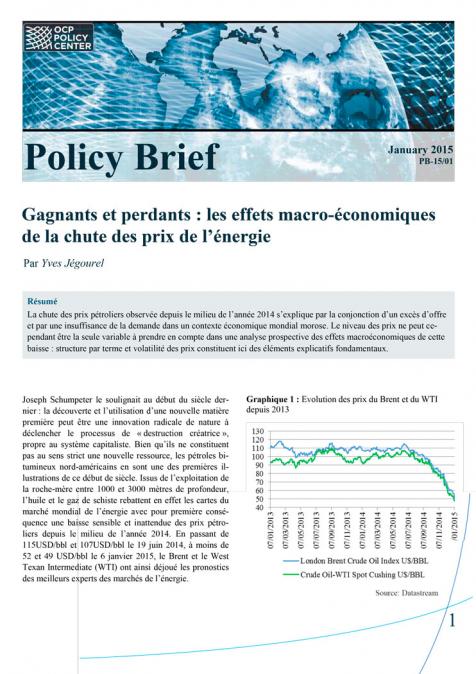
Gagnant et perdant: effects macroéconomiques de la chute des prix de l’énergie
Authors
January 10, 2015

La chute des prix pétroliers observée depuis le milieu de l’année 2014 s’explique par la conjonction d’un excès d’offre et par une insuffisance de la demande dans un contexte économique mondial morose. Le niveau des prix ne peut cependant être la seule variable à prendre en compte dans une analyse prospective des effets macroéconomiques de cette baisse : structure par terme et volatilité des prix constituent ici des éléments explicatifs fondamentaux.

RELATED CONTENT

  • Authors
    Francisco Cordoba Otalora
    April 21, 2020
    We are entering an economic cycle with a changing nature of consumption focusing on necessities. It seems like the times of luxury, entertainment and vacations are over, at least until the discovery of a vaccine for COVID-19. The unfolding of the health crisis that we have been witnessing in Italy, Spain and other advanced economies will not be as severe as the economic crisis that the Coronavirus will unleash. The International Monetary Fund has been warning us that the financial ...
  • Authors
    Seleman Kitenge
    March 30, 2020
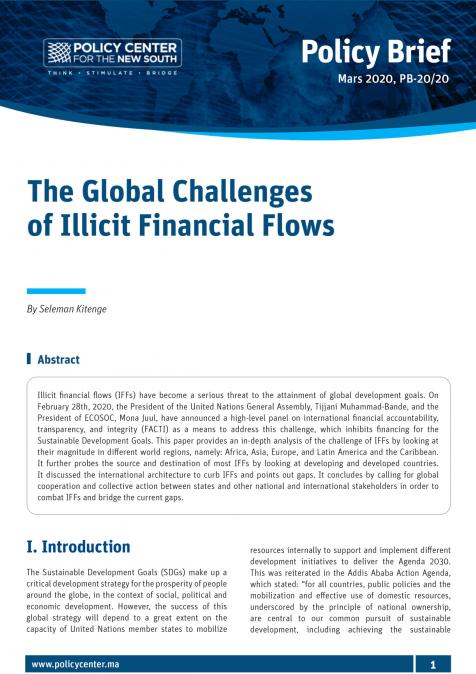
    Illicit financial flows (IFFs) have become a serious threat to the attainment of global development goals. On February 28th, 2020, the President of the United Nations General Assembly, Tijjani Muhammad-Bande, and the President of ECOSOC, Mona Juul, have announced a high-level panel on international financial accountability, transparency, and integrity (FACTI) as a means to address this challenge, which inhibits financing for the Sustainable Development Goals. This paper provides an ...
  • Authors
    Mehmet Sait Akman
    Shiro Armstrong
    Anabel Gonzalez
    Fukunari Kimura
    Junji Nakagawa
    Peter Rashish
    Akihiko Tamura
    Carlos A. Primo Braga
    February 9, 2020
    In the context of his role as chair of the T20 task force « Trade, Investment and Globalization », our senior fellow, Uri Dadush has led the T20 brief under the theme "World Trading System Under Stress: Scenarios for the Future", which has been published in Global Policy. The world trading system has been remarkably successful in many respects but is now under great strain. The causes are deep‐seated and require a strategic response. The future of the system depends critically on r ...
  • December 19, 2019
    Emerging market and developing economies: Engine of the global economic growth despite some vulnerabilities1 After a long spell of slow growth post-crisis, the global economy’s recovery was mainly supported by the improvement of emerging markets and developing economies growth. However, this recovery is subject to wide-ranging uncertainties and is now in some danger. According to the IMF, the global economic growth is expected to fall to 3 % in 2019, the lowest level since 2008. Th ...
  • December 17, 2019
    L’Inde est confrontée, aujourd’hui, à plusieurs défis énergétiques : - Assurer la sécurité énergétique du pays, en généralisant l’accès pour tous à l’électricité. Ce qui n’est pas le cas en 2019. - Le faire en réduisant sa dépendance aux énergies fossiles, afin de mieux répondre aux orientations des Conférences des parties, COP 21 et COP 22. Pour cela, les autorités gouvernementales vont mener, dès 1981, une réflexion sur les énergies renouvelables, les conduisant à privilégier l ...
  • Authors
    Elhadj EZZAHID
    July 19, 2019
    Les recherches sur les sources de croissance de long terme des économies montrent qu’elle dépend plus de la croissance de la productivité que de la croissance des volumes des inputs accumulés. Au Maroc, les résultats disponibles fournissent des évidences sur le rythme très lent de la croissance de la productivité mesurée par la PTF ou le rapport production-travail. Des simulations montrent que seule une augmentation de la PTF permettra d’atteindre une croissance suffisamment élevée. ...
  • Authors
    Matheus Cavallari
    Tiago Ribeiro dos Santos
    July 19, 2019
    Multilateral Development Banks (MDBs) have two financing windows, with different terms, dedicated to low- and middle-income countries. Countries are presumed to cross those windows as their income per capita rises, with middle-income countries (MICs) eventually “graduating” to a non-client status once they reach some criteria. However, due to what may be called “middle-income traps”, such progression toward graduation has been limited to a small number of countries. ...
  • Authors
    March 5, 2019
    China’s economic growth has been in a downslide trend since 2011, while its economic structure has gradually rebalanced toward lower dependence on investments and current-account surpluses. Steadiness in that trajectory has been accompanied by rising levels of domestic private debt, as well as slow progress in rebalancing private and public sector roles. As the ongoing trade war with the US continues to unfold, it remains unclear at which growth pace China’s rebalancing will tend to ...
  • Authors
    Bouchra Rahmouni
    October 19, 2018
    There are various definitions of Energy Security (ES) and numerous ways of understanding the concept. For this blog’s purpose, we will choose the familiar understanding of the latter as put forward by the George W. Bush Administration, i.e. it represents a situation where four characteristics are met, an energy supply that is: (1) Reliable (2) affordable (3) environmentally sound and (4) accessible.  Thus, ES represents the situation where there’s availability of energy a ...