Publications /
Policy Brief
Once upon a time, there was the G5 Sahel...
In 2014, five Sahel countries - Mauritania, Mali, Burkina Faso, Niger and Chad - decided, with the support of a European power, to form a group of states called the G5 Sahel. The five countries shared a number of characteristics, chief among them the desert-like nature of their territory, with consequent vulnerability to climate change, the vastness of their territorial areas (with the exception of Burkina Faso), low population density, landlocked status in terms of access to the sea (with the exception of Mauritania), and a certain economic precariousness (none of these countries had a GDP exceeding US$20 billion in 2022).
What's more, these countries were either infested by Islamist terrorism (Mali, Burkina Faso and Niger) or threatened by it, despite the measures taken and because of their shared borders with the three aforementioned countries (Chad and Mauritania).
It was because of this situation that the G5 Sahel charter focused on two main objectives: security and development. These two objectives, theoretically set out in the G5 Sahel Charter, did not benefit from the same implementation efforts on the ground, where the security aspect monopolized all action, relegating development to oblivion.
Alongside the G5 Sahel force, which had divided the region into intervention corridors to combat terrorism, France, which supports the group, had set up its Barkhane mission in Mali, a force of 4,000 to 5,000 men with the aim of combating jihadist groups.
After eight years of unsuccessful efforts to combat terrorism, a certain frustration has begun to emerge among the populations of Mali, Burkina Faso, and Niger, expressed through popular protests that themselves led to a series of coups d'état bringing the military juntas of Mali, Burkina Faso, and Niger to power. The new authorities cut all ties with France and withdrew unannounced from the G5 Sahel, which is now slowly dying. Since then, all its institutions have led a zombie-like existence, becoming a sort of body without a soul.
The French presence is replaced by a Russian one, through the "Africa Corps", and the three Liptako-Gourma countries form a coalition called the Alliance des États du Sahel (AES), which in 2024 becomes the Confédération des États du Sahel (CES).
The G5 Sahel is dead. Does the AES/CES replace it? If so, what about Mauritania and Chad?
THE G5 SAHEL "MISSING", THE ARAB MAGHREB UNION (AMU) FROZEN OR BLOCKED, AND THE AES OUT OF ECOWAS: A SITUATION THAT CHALLENGES MOROCCO AND MOTIVATES ITS COOPERATION PROPOSALS
Morocco observes that:
- The Arab Maghreb Union is clinically dead due to the conflict between the Kingdom and Algeria, on one hand, and the situation in Libya and the turmoil in Tunisia, on the other. The possibilities for development and the establishment of a climate of peace, security, and stability prove to be almost impossible in this environment.
- The Liptako Gourma states, which are forming a confederation, are leaving ECOWAS, and may be followed by other states. The West African organization - the most successful of Africa's regional economic communities - thus risks being weakened or even dismantled.
- There is a real risk that the development potential of the Sahel-Atlantic region will be lost. The region lacks an integration framework capable of capitalizing on its potential to ensure its prosperity. Hesitancy to prioritize security or development is blocking initiatives, and states remain confined to traditional configurations that have been overtaken by new regional and international circumstances.
In response to this situation, which is detrimental to development and peace in the region, Morocco, which sees itself as a force for initiative and proposal, is launching ideas and programs designed to promote geopolitical spaces that can serve as a matrix for West African and Atlantic cooperation within a framework of solidarity, South–South cooperation and mutually beneficial partnerships:
The Abuja-Tanger Gas Pipeline: in 2016, during his visit to Abuja (Nigeria), His Majesty King Mohammed VI, together with President Muhammad Buhari, launched the project for a gas pipeline linking Nigeria to Morocco, which could then serve Europe. In September 2022, the initiative was the subject of a Memorandum of Understanding between Morocco, Nigeria and the Economic Community of West African States. Bringing together thirteen countries on the Atlantic coast, the gas pipeline project must be seen beyond its energy or economic value. It is an expression of interdependence, solidarity and mutual support between these countries, giving rise to a shared perception of the interests to be safeguarded and the threats to be warded off. Today, the project is progressing satisfactorily and, according to Moroccan officials, the first results could be seen as early as 2029.
- The Process of the Atlantic African States:
- The Moroccan Atlantic Africa Initiative was launched in 2022 to establish a framework for cooperation between African countries bordering the Atlantic Ocean, in a changing geopolitical and economic context. The main aims of this initiative, now known as the Atlantic African States Process (AASP), are to:
- strengthen maritime security to combat piracy, terrorist attacks, drug and human trafficking, and improve maritime surveillance in the region. This process includes the establishment of regional cooperation mechanisms to combat maritime crime and promote peace and stability in the African Atlantic;
- promote the blue economy and maritime connectivity by aiming for the sustainable exploitation of maritime resources, while supporting the development of port infrastructure, maritime connectivity, and international trade.
- fight against climate change and protect marine ecosystems. This includes the protection of the marine environment, coastal zone management, biodiversity preservation, and combating ocean pollution, while supporting the energy transition to renewable sources, particularly offshore wind and solar energy.
- ensure economic development and regional integration. The Initiative aims to stimulate economic integration and sustainable development in the Atlantic African region. This includes strengthening supply chains, partnerships in strategic sectors such as agriculture, fisheries and maritime transport, and improving port and logistics infrastructures.
Since its launch, the Initiative has progressed through several important stages:
- first ministerial meeting - June 2022: it led to the Rabat Declaration and laid the foundations for the Initiative, defining the common priorities of the participating states;
- second ministerial meeting - September 2022: held on the sidelines of the United Nations General Assembly in New York, it allowed for the expansion of the Initiative's agenda. Participants discussed the implementation of an Action Program focused on concrete projects in maritime security, trade, energy transition, and regional cooperation;
- third ministerial meeting - July 2023: it was marked by the adoption of the Rabat II Declaration and a detailed action program. This meeting emphasized the implementation of short- and medium-term projects, the coordination of countries through thematic working groups, and the creation of follow-up structures.
The opening up of the Sahel states: a framework for South-South cooperation and solidarity
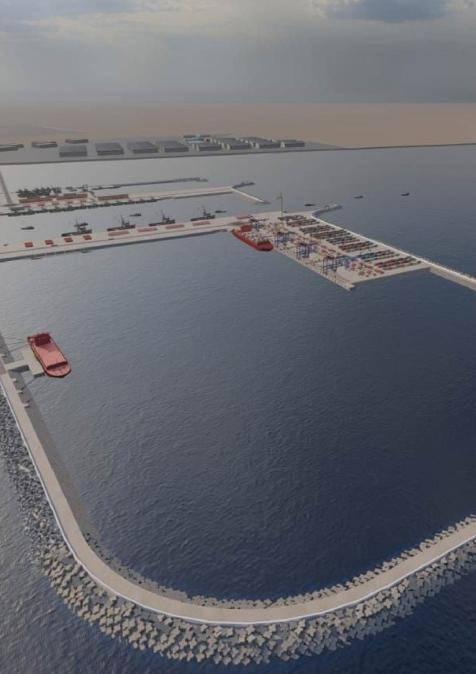
The Atlantic Africa project is accompanied by an initiative to give four Sahel countries - Mali, Niger, Burkina Faso and Chad - access to the Atlantic. This initiative aims to open up these countries by giving them access to the Atlantic within the framework of South-South cooperation. In proposing such a project to its African and international peers, Morocco is acting in line with its status as a historical and strategic partner of the Sahel countries. It intends to participate in the efforts of the countries in the region (Mauritania and Senegal) to meet the multiple challenges facing the Sahel-Atlantic area, notably the lack of infrastructure and security issues.
MAURITANIA: WHAT IF THINGS BECAME CLEARER IN RELATIONS WITH MOROCCO?
On the evening of December 18, 2024, the Mauritanian presidential plane left Nouakchott bound for Rabat, confirming the rumors that had circulated some 24 hours earlier about a private visit by the Mauritanian president to Morocco. Relations between the two countries are so mixed that few took the rumors seriously, and even when they were confirmed, the private nature of the visit did not augur any change in relations, even for the most optimistic analysts. President Mohamed Ould Cheikh El Ghazouani was only visiting his wife, who had undergone surgery at the Rabat military hospital. No program or official contact was announced, so no change was to be expected in a relationship that has warmed and relaxed without becoming a true alliance, and cooled and strained without breaking.
However, a few hot-off-the-press analyses highlighted two important elements:
- this is the first visit to Morocco by a Mauritanian president in more than 15 years; and
- This visit comes just a few days after the Algerian President’s visit to Nouakchott on December 9.
These two elements fueled a series of speculations that, apart from the stated reason (to enquire about the wife's condition), offered no convincing explanation as to why the visit had taken place.
One very important fact, however, is overturning the analyses. His Majesty King Mohammed VI, despite the period of convalescence prescribed for him by his doctors, receives President El Ghazouani at his palace in Casablanca. Consideration of the subject then becomes more serious. Two heads of state almost never meet for mere social occasions. The Mauritanian head of state's visit becomes quasi-official, and however private the exchanges during the meeting, they are bound to concern the affairs of both states.
Is this a turning point in the relations between Morocco and Mauritania?
It's a legitimate question, and given the facts and circumstances, everything suggests that it is, especially as there's another fact that will tip the balance in favor of a change that's on the horizon.
His Majesty the King begins a private visit to the United Arab Emirates on Thursday the 26th, where a tripartite meeting brings together the Moroccan sovereign, Emir Mohamed Ibn Zayed, and the Mauritanian President Ould Cheikh El Ghazouani. This is far from mere coincidence. Are the relations between Morocco and Mauritania moving towards greater clarity instead of the ambiguity that has characterized them so far? The field would then be open to a denser, more coordinated, and therefore more fruitful cooperation between Morocco and Mauritania; moreover, if unable to revitalize the Maghreb, the two neighbors can revive the G5 Sahel by revisiting and transforming it, giving it an Atlantic color in addition to the Sahelian one that characterizes it.
SENEGAL, AN ACTIVE PLAYER IN THE SAHELO-ATLANTIC AND WEST AFRICAN SPACE
While Senegal is an influential and active member of the Economic Community of West African States, it must be concluded that any other structure in the region, notably involving Atlantic and Sahelian states, would certainly benefit from Senegal's membership. This would be the case for the project that would enable Morocco and Mauritania to open up the Sahel states within the framework of a geopolitical space to be created.
By joining this space, Senegal, which would then belong to both groups, would act as a link between it and ECOWAS, enhancing synergy between the two entities.
It would also complete the implementation of a geopolitical axis, stretching from Rabat to Dakar via Nouakchott, historically aspired to by generations of heads of state and political elites of the three countries since their independence.
Senegal not only borders the Sahel countries through Mali, but also belongs with them to the West African Economic and Monetary Union (UEMOA). Joining a regional initiative to open up the region would be fully in line with the spirit of solidarity and African cooperation that inspires Senegal's elite, particularly those currently in power.
THE SAHEL-ATLANTIC G7 TO REPLACE THE G5 SAHEL AND REBALANCE THE SCALES BETWEEN SECURITY AND DEVELOPMENT
Retaining the former G5 Sahel and expanding it to include Morocco and Senegal raises major strategic issues in redefining the balance between security and development in the Sahel region. This hypothesis is based on the possibility of creating a geopolitical space of cooperation and solidarity capable of responding to the region's multidimensional challenges.
Firstly, the integration of Morocco and Senegal would bring significant added value in terms of skills and resources. Morocco has recognized expertise in diplomacy, security and economic development, and a well-established strategy in sub-Saharan Africa. For its part, Senegal, often perceived as a pole of stability in West Africa, has a successful track record in managing community development initiatives and strengthening democratic institutions. These two countries could complement the efforts of the current G5 Sahel members (Burkina Faso, Mali, Mauritania, Niger, Chad) who are more focused on security emergencies.
In terms of security, the participation of Morocco and Senegal would strengthen the G5 Sahel's operational capabilities. Morocco, with its counter-terrorism expertise and extensive intelligence network, could help improve regional cooperation in the field of counter-terrorism. Senegal, which is already actively involved in international peace missions, could play a central role in training and equipping the region's defense and security forces.
However, the value of this enlargement lies above all in the balance it would strike between security and development. Until now, the G5 Sahel dynamic has been dominated by military considerations, often to the detriment of long-term development initiatives. By integrating Morocco and Senegal, the strategy could evolve towards a more comprehensive approach, where economic development, infrastructure improvement, and the strengthening of state institutions are treated as priorities.
This development would be based on several strategic axes. Firstly, Morocco could play a crucial role in transferring expertise and supporting agricultural, energy and educational development projects. For example, its expertise in the field of renewable energies could support the electrification of rural areas in the Sahel, thereby contributing to greater economic inclusion of marginalized populations. Senegal, for its part, could be a model for the implementation of microfinance and community development programs, aimed at reducing poverty and strengthening social cohesion.
In addition, expansion to include Morocco and Senegal would diversify the G5 Sahel's international partnerships. Morocco has strong relations with the European Union, the United States and several Gulf countries, which could encourage new investment and financial support for development projects. Senegal, for its part, could mobilize its historic relationships with strategic partners such as France and international institutions like the World Bank and the International Monetary Fund.
Nevertheless, this transformation would require strong political will and close coordination between the various players. The current members of the G5 Sahel will have to agree to share their leadership and integrate innovative approaches to crisis management. Furthermore, Morocco and Senegal will have to show solidarity and adapt their ambitions to the complex realities of the Sahel, which were not taken into account during the "G5 Sahel" experiment.
Furthermore, the integration of Morocco and Senegal, which would transform the former G5 into a G7, will strengthen and support the potential of Mauritania, the most stable country in the former G5 Sahel, enabling it to continue along the path of development and lasting security.
In conclusion, a Sahel-Atlantic G7 would be a unique opportunity to rebalance the scales between security and development in the region. By joining forces, these countries would not only be able to address immediate security challenges, but also lay the foundations for sustainable, inclusive development—an essential condition for long-term stability in the region.
- According to Amina Benkhadra, Director General of ONHYM, gas flows through the first two sections are expected to begin by 2029. See: https://medias24.com/2024/12/13/gazoduc-nigeria-maroc-les-deux-premiers-troncons-seront-operationnels-des-2029-a-benkhadra/