Publications /
Policy Paper

Back
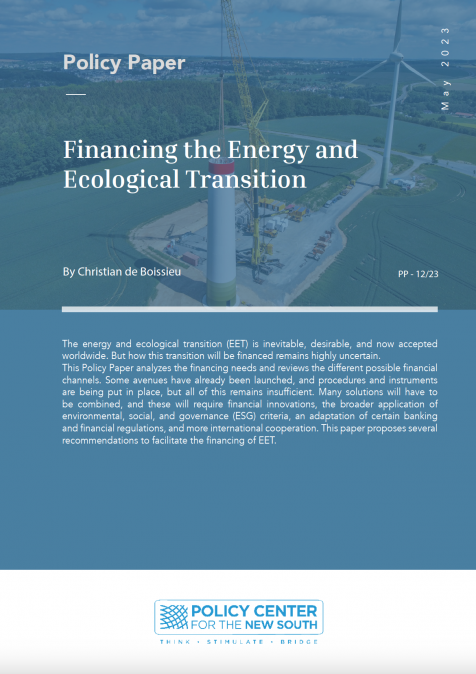
Financing the Energy and Ecological Transition
May 26, 2023

The energy and ecological transition (EET) is inevitable, desirable, and now accepted worldwide. But how this transition will be financed remains highly uncertain. This Policy Paper analyzes the financing needs and reviews the different possible financial channels. Some avenues have already been launched, and procedures and instruments are being put in place, but all of this remains insufficient. Many solutions will have to be combined, and these will require financial innovations, the broader application of environmental, social, and governance (ESG) criteria, an adaptation of certain banking and financial regulations, and more international cooperation. This paper proposes several recommendations to facilitate the financing of EET.
RELATED CONTENT

  • Authors
    Chami Abdelilah
    Derj Atar
    Hammi Ibtissem
    Morazzo Mariano
    Naciri Yassine
    with the technical support of AFRY
    June 28, 2021
    Lors de la Conférence des Parties à la Convention-cadre des Nations unies sur les changements climatiques (CCNUCC) qui s'est tenue à Paris en 2015, les gouvernements se sont engagés à limiter l'augmentation de la température mondiale à un niveau bien inférieur à 2°C par rapport aux niveaux préindustriels. Ils se sont également engagés à atteindre, dès que possible, un pic de leurs émissions et à parvenir à la neutralité carbone au cours de la seconde moitié du siècle. Pour autant, m ...
  • Authors
    Chami Abdelilah
    Derj Atar
    Hammi Ibtissem
    Morazzo Mariano
    Naciri Yassine
    with the technical support of AFRY
    June 28, 2021
    During the 2015 Paris Conference of the Parties to the United Nations Framework Convention on Climate Change (UNFCCC), governments pledged to limit the global temperature increase to well below 2°C above pre- industrial levels, to peak emissions as soon as possible, and to achieve carbon neutrality in the second half of the century. Yet, even assuming full implementation of the commitments made by governments in Paris, the global concentration of greenhouse-gas (GHG) emissions will ...
  • Authors
    December 7, 2020
    The pandemic is accelerating history, in the sense that it is leading to the speeding up of some recent trends. In the case of globalization, the pandemic will not reverse it, but it will reshape it. Here we take a bird’s eye view of global trade during the pandemic, relate it to previous trends, and guess how global value chain managers and government trade policymakers are likely to react. A Bird’s Eye View of Global Trade during the Pandemic World trade took a deep dive during ...
  • Authors
    February 17, 2020
    - There are three possible justifications for central banks to engage with climate change issues: financial risks, macroeconomic impacts, and mitigation/adaptation policies. - Regardless of the extent to which individual central banks take action in each of the three areas, they can no longer ignore climate change. Last year, extreme weather events associated with climate change – floods, violent storms, droughts, and forest fires –occurred on all inhabited continents. In at least ...
  • From

    26
    5:30 pm May 2026
    تعالج هذه الحلقة تصاعد التوترات حول مضيق هرمز وانعكاساتها على استقرار أسواق الطاقة العالمية، في ظل عالم يشهد تحولات جيوسياسية متسارعة. وتناقش كيف كشفت الأزمة هشاشة نظام الطاقة الدولي واعتماده على ممرات استراتيجية حساسة، كما تتوقف عند تداعيات أي اضطراب محتمل على أسعار النفط والتضخم والنمو الاقتصادي العالمي. وتسعى الحلقة إلى فهم ما إذا كان العالم يعيش أزمة ظرفية أم بداية تفكك تدريجي للنظام الطاقي الذي حكم العقود الماضية  ...