Publications /
Book / Report

Back
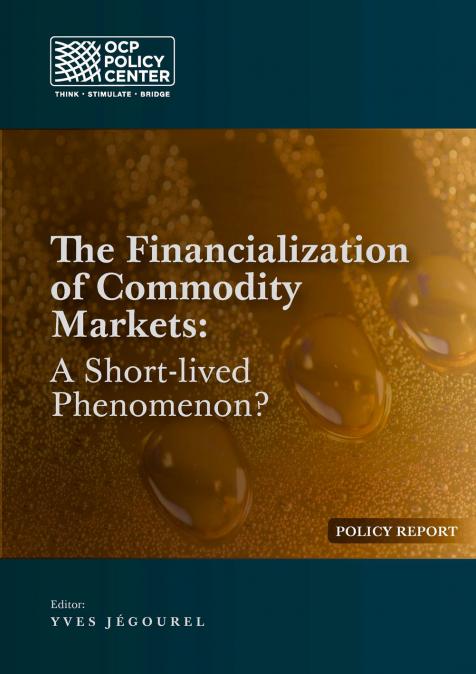
The Financialization of Commodity Markets: A Short-lived Phenomenon?
Authors
March 14, 2018

Commodities are at the very heart of economic activity. From oil to wheat, from aluminum to coffee or rubber, we are all, in one way or another and to varying degrees, dependent on commodities. Different in terms of their physical properties but governed by common economic mechanisms, traded on global and oligopolistic markets, subject to intense competitive pressures and speculative bets, often marked by highly volatile prices, objects of geopolitical rivalries or cooperatives strategies: commodities are certainly products unlike any other in the economic world. It is therefore essential to understand not only the mechanisms governing their price formation, but also the profound changes which affect their markets. From this point of view, the financialization of commodity markets, defined both as the boom in commodity investment funds during the so-called “commodity super-cycle”, and the increased role played by financial derivatives markets in commodity industries, is a major economic development that needs to be analyzed extensively. This is the ambition of this book. Written by recognized experts from the academic world or major international institutions, it aims to explore the different facets of this complex and often misunderstood phenomenon. What role can futures markets play in determining commodity prices? How have they evolved in modern times? To what extent has speculation shaped the commodity super-cycle? How can we understand that some commodities have known this financialization phenomenon for a very long time while others have not? Are there any significant differences in the way commodity industries, whether agricultural, metal or energy, become financialized? Finally, if we accept the idea that financialization is part of an irrevocable process, what forms could it take in the years to come? These are among the many questions addressed here which make this book a new and useful contribution to public debates.
RELATED CONTENT

  • Authors
    August 12, 2026
    La géographie mondiale des hydrocarbures n'est évidemment pas figée. De nouveaux producteurs de pétrole et/ou de gaz naturel apparaissent suite à des découvertes, le plus souvent réalisées par des compagnies pétrolières internationales. On pense notamment au Mozambique, qui produit et exporte du gaz naturel liquéfié (GNL) depuis la fin 2022, au Sénégal, qui est un producteur de pétrole offshore depuis la mi-2024, et au Sénégal et à la Mauritanie, qui sont devenus conjointement expor ...
  • Authors
    August 5, 2026
    This paper addresses the persistent challenge of resource dependence in the world's poorest countries, focusing on the ten poorest African nations where natural- resource rents average 14% of income. It argues that four decades of conventional policy advice, which treated resource dependence primarily as a revenue management problem, have failed to help these countries. While stabilization funds and permanent-income frameworks aim to smooth consumption, they do not answer the fundam ...
  • July 29, 2026
    En un siècle, le cours de l’once d’or est passé de 20 dollars à 5 300 dollars au premier trimestre 2026. Cette étude, consacrée à l’analyse de cette envolée, comporte deux parties.La première privilégie une approche historique. Elle retrace tout d’abord le changement de statut du précieux métal jaune, monétisable jusqu’en 1971 puis démonétisé par la suite. Elle rappelle ensuite que cette évolution, loin d’être linéaire, est ponctuée de phases de forte hausse, de stagnation et d ...
  • Authors
    July 17, 2026
    The close relationship between energy and geopolitics is well established. The same holds true for several armed conflicts. In recent years, however, the conflict most closely intertwined with energy has been the 2026 Iran War, which began on February 28. A ceasefire has been in effect since April 8, and a Memorandum of Understanding (MoU) was signed by Iran and the United States on June 17. Nevertheless, as demonstrated by Iran's attacks on commercial vessels and recent U.S. strike ...
  • Authors
    July 17, 2026
    Les relations, très étroites, entre l’énergie et la géopolitique sont bien connues. Cela vaut aussi pour plusieurs conflits armés. Mais, dans la période récente, le conflit le plus lié à l’énergie est la guerre d’Iran de 2026, qui a débuté le 28 février. Un cessez-le-feu est en vigueur depuis le 8 avril et un protocole d’accord a été signé le 17 juin par l’Iran et les États-Unis. Mais, comme le montrent les attaques de l’Iran contre des navires et les frappes américaines de ces dern ...
  • Authors
    July 9, 2026
    Cet essai analyse la guerre Iran–États-Unis–Israël de 2026 comme un révélateur de la transformation profonde de l’ordre international. À travers le prisme du droit de la mer, du détroit d’Ormuz, des alliances fragmentées, des câbles sous-marins et des flux énergétiques, il montre que le pouvoir mondial se déplace progressivement du contrôle des territoires vers la maîtrise des infrastructures de circulation. Loin de disparaître, la mondialisation entre dans une phase de connectivité ...
  • Authors
    July 2, 2026
    Africa is facing a massive electricity deficit that is impacting its economic and social development, and its ability to catch up with the rest of the world. It is imperative that the continent increase its electricity production to connect the 600 million people who are currently without access and to improve the quality of service for the millions who are suffering from frequent blackouts and load-shedding. Economic development in the 21st century will crucially depend on the digi ...
  • Authors
    June 16, 2026
    Geopolitical rivalries, and especially the competition for access to critical minerals, could be an opportunity for Africa. The objective of African mineral exporters is to diversify their partners and increase processing and value addition on the continent in order to create jobs and enhance export revenues.[1] To succeed, African exporters of critical minerals need to strengthen their coordination and develop joint infrastructure projects and regional value chains. The creation of ...
  • June 11, 2026
    The global energy system has entered a period of acute structural stress following the strikes by the United States and Israel on Iran in late February 2026, and the subsequent disruption of flows through the Strait of Hormuz. According to the International Energy Agency, the resulting shock marks the most severe disruption to global energy markets since the 1970s oil crises, with systemic characteristics comparable to the combined effects of those crises and the 2022 Russia-Ukraine ...