Publications /
Policy Paper

Back
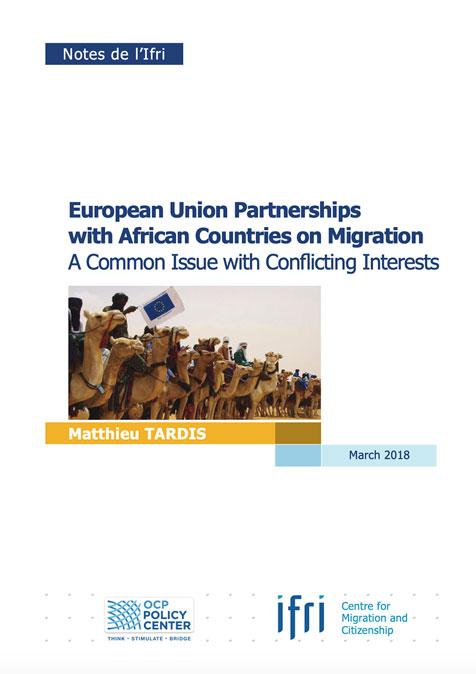
European Union Partnerships with African Countries on Migration. A Common Issue with Conflicting Interests
Authors
Matthieu Tardis
March 23, 2018

Since 2015 and the refugee crisis, the dialogue between the European Union (EU) and African countries on migration issues has assumed a new intensity. The EU, wishing to put an end to irregular arrivals in the central Mediterranean and increase the number of returning irregular migrants, proposed a new partnership framework with third countries in the wake of the March 2016 agreement with Turkey. This partnership framework is specifically aimed at African countries, as countries of origin and transit for migrants arriving in Europe. It gives a new scope to the external dimension of European asylum and immigration policy, whose effects have so far been very limited. This is now fully integrated into the EU’s and its Member States’ external relations. In other words, the migration issue is at the centre of European foreign policy.

The EU has a financial instrument to achieve its objectives, which has quickly become the most noticeable tool of the migration partnership policy. The Emergency Trust Fund for Africa (EUTF), introduced during the Valletta Summit in November 2015, has become the sign of a closer synergy, or even an alignment, between migration policy, security and development objectives. However, far from meeting the principles of partnership and shared responsibility, the EUTF, like the other dialogue frameworks, remains in the hands of the Europeans, who impose their objectives and control their implementation. The African countries find little leeway where they could be involved in setting the objectives and means of action. 

The asymmetry of the partnership frameworks emphasises the contrast between the various partners’ challenges and expectations. Indeed, the European and African countries’ interests seem divergent or even conflicting, due to the two continents’ different social and political realities. On the one hand, the Europeans are seeking better co-operation from the African countries on the return of irregular migrants, border control and refugee protection. On the other hand, the African countries wish to develop legal migration channels to the EU, whether for their workforce or refugees. 

Although the asymmetry of the partnership frameworks allows the EU to impose its objectives, however it must be careful to better consider the interests and challenges of its African partners at the risk of further destabilising this already fragile continent. Thus, intra-African regional dynamics have been put to the test by the problemisation and securitisation of the migration issue, whereas this has traditionally been seen as an economic opportunity by the people of Africa. The worsening situation of migrants and the people of the Agadez region in Niger is an example of the unanticipated effects of the European approach. The latter may jeopardize African countries’ efforts to establish freedom of movement in Africa which however has been a factor of prosperity and peace in Europe. 

RELATED CONTENT

  • January 13, 2022
    Africafé est une émission du Policy Center for the New South qui décrypte l’actualité des organisations africaines et de l’Afrique. A travers de courtes interviews, l’émission tente de proposer d’aborder de manière pédagogique les enjeux des organisations africaines et l’actualité du co...
  • Authors
    January 12, 2022
    Feeble eyesight may hinder you from finding Puntland on a map, the unrecognized Federal member state in Somalia, Khaatumo State, Jubaland, or Somaliland, concerning the planet’s size just large enough to be covered by the shadow of a palm tree. Arab entities surrounded by sun and sand and the Gulf of Aden, Somaliland is surviving as a self-declared nation, located on the southern coast of the Gulf of Aden bordered by Djibouti to the northwest, Ethiopia to the south and west, Somalia ...
  • December 27, 2021
    Dans un pays aussi stable que l’Allemagne, les changements de Chancelier sont rares. Angela Merkel est restée seize ans au pouvoir, tout comme en son temps Helmut Kohl. La nouvelle coalition à trois partis (sociaux-démocrates, verts, libéraux) entend faire bouger le pays. Comment l’Afrique doit-elle aborder le nouveau pouvoir ? Celui-ci peut-il insuffler de la dynamique aux relations euro-africaines ? Peut-on attendre de Berlin une appréhension fine des enjeux de développement et de ...
  • December 10, 2021
    The Cabo insurgency constitutes one of the most significant threats to peace and security in Southern Africa subregion. This podcast explores the various challenges the insurgency in this ...
  • Authors
    Patricia Ahanda
    December 7, 2021
    Le 28ème Sommet Afrique-France, tenu à Montpellier le 8 octobre 2021, s’inscrit dans une lignée d’actions promues par le président français Emmanuel Macron pour renforcer la coopération entre la France et l’Afrique. Ces initiatives interviennent dans un contexte national (France) marqué par la recrudescence du thème de l’immigration africaine et international où l’Afrique est le terrain d’une nouvelle compétition géopolitique, avec la présence de puissances telles que la Russie et l ...
  • Authors
    Seleman Yusuph Kitenge
    December 1, 2021
    Tanzania has been closely following the evolution of the security situation in the region of Cabo Delgado in Mozambique. Worsening living conditions and safety in this bordering region suggest the eruption of a multifaceted security and human threat of transnational magnitude. This paper looks at the different cultural, linguistic, and socio-economic ties that link Tanzania and Mozambique, while exploring how the security situation in Cabo Delgado might impact national security in T ...
  • November 30, 2021
    Almost three years since the ousting of former president Omar al-Bashir, and the formation of a transitional government composed of civilians and members of the military, the situation in Sudan is far from stable. Indeed, although progress has been achieved since December 2018, the democratic transition remains very fragile, with the political and economic sectors still facing significant uncertainty. This paper explains the fragility of the Sudanese transition, plagued by decades o ...