Publications /
Paper in Academic Journals
Back
Educational Effectiveness in Rural Areas: What SDIs Teach Us About Multigrade Classes
January 5, 2026

This Paper was originally published on sciencedirect.com


This study provides an original and significant contribution to evaluating educational service quality in Morocco by leveraging, for the first time, microdata from the Service Delivery Indicators (SDI) survey. The survey covers a nationally representative sample of 300 public and private primary schools across rural and urban areas. The use of SDI data represents a major methodological advancement, shifting away from perception-based assessments toward objective indicators, including classroom observations, unannounced school visits, and standardized tests administered to teachers and students. A key added value of the study lies in its focus on rural education effectiveness, a topic that remains largely underexplored. In rural areas, where structural heterogeneity is high, education is mainly delivered through community and satellite schools. The research offers an in-depth analysis of multigrade classrooms, a common solution to teacher shortages and infrastructure limitations in remote regions, though their pedagogical effectiveness remains debated. Methodologically, the study employs a two-step approach—Data Envelopment Analysis and truncated regression—to assess and explain variations in school performance. It finds that while community schools tend to be more stable, they are generally less efficient. Additionally, preschool attendance and infrastructure renovation emerge as key positive drivers of educational effectiveness, offering clear policy insights.
RELATED CONTENT

  • August 16, 2023
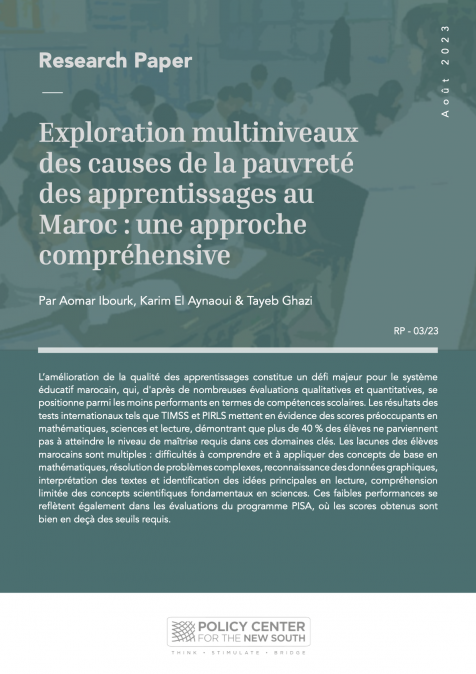
    L’amélioration de la qualité des apprentissages constitue un défi majeur pour le système éducatif marocain, qui, d'après de nombreuses évaluations qualitatives et quantitatives, se positionne parmi les moins performants en termes de compétences scolaires. Les résultats des tests internationaux tels que TIMSS et PIRLS mettent en évidence des scores préoccupants en mathématiques, sciences et lecture, démontrant que plus de 40 % des élèves ne parviennent pas à atteindre ...
  • June 26, 2023
    L’amélioration de la qualité des apprentissages constitue un défi majeur pour le système éducatif marocain. D’après de nombreuses évaluations, aussi bien qualitatives que quantitatives, le Maroc se place parmi les pays les moins performants en matière de qualité des acquis scolaires. Un autre aspect des faibles réalisations du pays au niveau des tests internationaux est le poids des élèves dits « peu performants1 », et considérés comme particulièrement à risque. L’importance de ce ...
  • Authors
    Thomas Pereira da Silva
    March 7, 2018
    This proposal seeks to contribute to reduce, in a cost-effective way, Morocco’s unusually high, persistent and growing unemployment level for university graduates1. It complements and enhances the existing Université Internationale de Rabat (UIR) Public-Private Partnership (PPP). Tertiary enrolment in Morocco has been increasing above what seems to be labor market absorptive capacity. Over the past decade, the share of the unemployed with university degrees as a percentage of total ...
  • Authors
    June 16, 2016
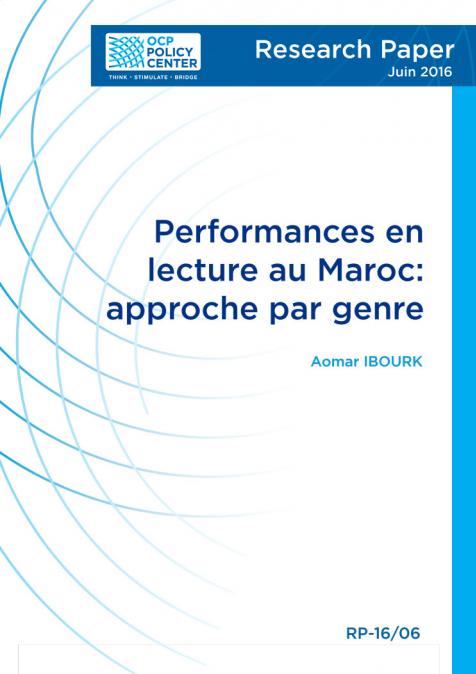
    L’écart entre filles et garçons en termes de scolarisation, au Maroc, a longtemps préoccupé tant les académiciens que les décideurs. En revanche, très peu d’études se sont penchées sur l’analyse de cet écart sous une toile de fond quantitative. Ce présent travail s’intéresse à l’écart genre en termes d’acquis scolaires en lecture. La finalité étant de mettre en exergue les facteurs influençant les différences de performance entre les genres ainsi que leur ampleur. Pour ce faire, une ...
  • Authors
    May 20, 2016
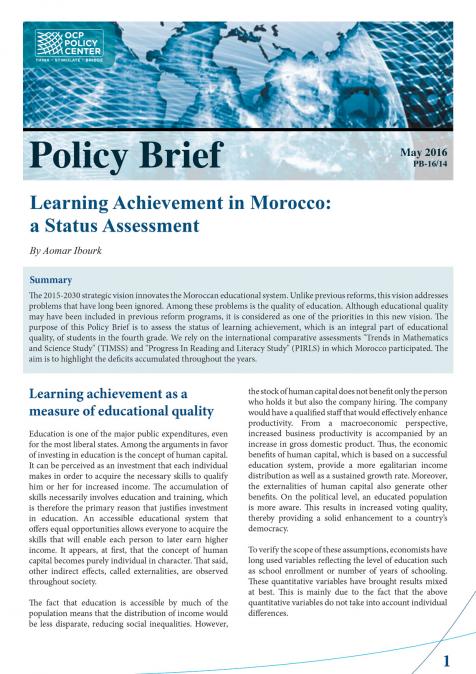
    The 2015-2030 strategic vision innovates the Moroccan educational system. Unlike previous reforms, this vision addresses problems that have long been ignored. Among these problems is the quality of education. Although educational quality may have been included in previous reform programs, it is considered as one of the priorities in this new vision. The purpose of this Policy Brief is to assess the status of learning achievement, which is an integral part of educational quality, of ...