Publications /
Policy Brief
THE END OF AN ERA
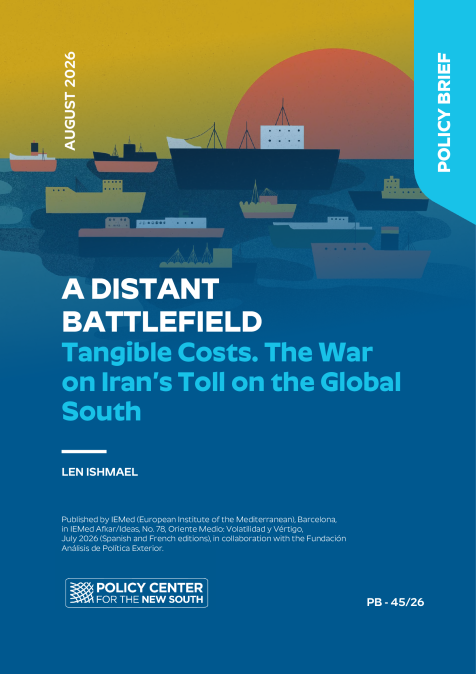
The US-Israeli war on Iran, a 'little excursion' envisaged to be over within a matter of weeks, has entered its fourth month. Shock waves ripple across the globe. This war is just one in a series of recent crises which have fractured the international community, making the decades of the 2020's among the most disruptive in recent history. Each crisis compounds the deleterious effects of those which came before. The war in Iran is no exception. It abruptly stalled economic momentum for countries of the Global South struggling to regain conditions of stability within which prospects for growth might improve. Crippled by skyrocketing energy costs, supply chain disruptions, and debt crises, these countries face a harsh reality: for most, recovery is stunted, as inflation, recession and insolvency continue to spiral. Shifts in the balance of world power add to the sense of crisis. On multiple fronts, the world, as we know it, is changing. And while there is no clarity regarding the final contours of what comes next, it does seem certain that the status quo is no more; much trust has been lost; there will be no going back.
The Liberal World Order, its rules, norms and principles founded on the idea of open markets, free trade and multilateral cooperation, engineered primarily by the United States and Western allies in the wake of World War II, is disintegrating. It is contested and undermined, not only by external actors, but also by its architects. The rules-based framework which provided the veneer of legality and blunted the force of unregulated raw power, is being dismantled. In the process, the vision of Post War idealism constructed around concepts of the common good and shared prosperity, is being replaced by more narrowly defined objectives anchored in national interests.
The Western Alliance – once the pillar of the Post World War Order – lies among the casualties. In many Western countries, polls show that the level of citizens trust in their governments and institutions is at an all-time low. For many, the capitalist model has failed to safeguard their interests. The rise of populism underscores the steady drifting of societies away from the values of liberalism, towards narrow definitions of national identity and belonging.
CHANGING FACE OF MULTILATERALISM
Contestation of the old order extends, also, to the Bretton Woods and other multilateral institutions. Once the custodians of the rules, norms and principles, they now seem to sit on the sidelines of current challenges. Countries of the Global South, small and poorer states have the most to lose. Despite the fact that they have long advocated for multilateral institutional reform, these institutions have provided the regulated space within which to exercise sovereignty in representing their interests. Each crisis, however, has raised questions about the integrity of existing multilateralism frameworks, and their capacity to respond to changing times and modern challenges.
FOR THE GLOBAL SOUTH, THIS PERIOD OF CRISIS BRINGS DISRUPTION, BUT ALSO OPPORTUNITY TO REBALANCE A SYSTEM OF GLOBAL GOVERNANCE LONG VIEWED AS BUILT BY THE WEST, TO SERVE ITS INTERESTS.
When the global pandemic hit – the world divided into those who had access to vaccines and most of the rest, who did not. The first to provide vaccines and other related supplies to countries of the Global South were China, India and Russia. Instruments such as the Debt Service Suspension Initiative (DSSI) designed to respond to the burgeoning debt of Global South countries, provided a fraction of what was required. Despite being encouraged by the International Monetary Fund (IMF) to borrow as much as they could to prepare for reopening of borders after the pandemic, these countries paid punitive interest rates of 14%-16%, significantly higher than the 1-2 % paid by rich countries. Global South was forgoing development to pay for debt.
In a crisis triggered by heavy pandemic era domestic spending, collapsed revenues and severe external shocks – including aggressive interest rate hikes by Western central banks, and inflation following COVID-19 and the war in Ukraine – Sri Lanka, Zambia, Ghana, Lebanon, Argentina, Ecuador, Suriname and Belize joined the steady procession of countries who defaulted on their debt. While Financing for Development Summits such as Seville (2025) have seeded new modalities to address developing country debt – the latter remains one of the most complex and politically divisive issues between countries of the North and South. The war in Iran adds fuel to this debate.
The wars in Ukraine and Gaza have deepened polarization within the international structure. Countries of the Global South have denounced the flagrant disregard for the UN Charter and the hypocrisy, double standards and inconsistency in application of rules and sanctions on matters pertaining to territorial integrity, the rights of sovereign states and human rights. The erosion of trust which has ensued has resulted in the loss of Western soft power and the fragmentation of the world into blocks. It has also prompted the development of new forms of multilateralism. Though less universal in scope, Ishmael, Klingebiel and Sumner argue that 'like-minded coalitions' and the 'new flexi-lateralism' are pragmatic responses to a fragmented world order designed to by-pass the grid lock of traditional forum, when universal consensus is not possible.
Smaller exclusive diplomatic 'clubs', such as the US led Americas Peace Shield and The Gaza Board of Peace, are also being constructed outside regular multilateral frameworks. OECD reports suggest that this era of crises has also broken the traditional template for development cooperation. Official Development Assistance (ODA) contracted by 23% in 2025. The US has withdrawn from 66 UN agencies and other multilateral frameworks including the Paris Accords and abruptly disbanded the US Agency for International Development (USAID) whose $43 billion budget funded humanitarian aid and international development across 120 countries.
Contraction in development budgets is not limited to the US. Across the West, countries are diverting resources away from development cooperation towards military, security and defense sectors. Economic securitization has become a vital element of the national strategic calculus. How to do more with less in a fragmented world – was a common theme at the recent OECD conference on the Future of Development Cooperation in Paris, this past May. Together, the consequences for the vulnerable and poor have been enormous.
These events are taking place against the backdrop of shifts within the international economic structure. Global output is shifting from West to East. Depending on how Gross Domestic Product (GDP) is measured (using Purchasing Power Parity (PPP) or Nominal GDP), three of the world's top four economies – China, India and Indonesia – will be in the East by 2030, or by 2050. Either way, the United States is slated to be in third place after China and India.
China is also a superpower dominating multiple sectors ranging from manufacturing to renewable energy and high tech. The country's Belt and Road Initiative (BRI) unveiled in 2013, is valued at over $1.4 trillion. Spanning the globe, the BRI has delivered not only investments and capital infrastructure, but also a ready conduit for the projection of China's soft power and influence, not only across the Global South, but also into Western blocs such as the EU. While the West is being viewed through increasingly jaded lens – for many in the Global South, China is becoming a more attractive partner.
SHOCK AFTER SHOCK – THE TOLL ON THE GLOBAL SOUTH
The war on Iran compounds the effects of other recent crises on the Global South and underscores the systemic interdependencies created by globalization which have enabled the transmission of impacts across all countries, to varying degrees. A snapshot of selected impacts on the Global South is presented below:
- Effects on Global Output. The OECD, World Bank and IMF have all downgraded their forecasts for the global economy should this war continue. In its June (2026) Global Economic Output Report, the OECD forecasted growth of 2.6% in 2026, from 3.5% in 2025, dropping to 2.1% in 2026 and 1.8% in 2027, in the event of prolonged hostilities.
- Macroeconomic Effects. Macroeconomic ripple effects have severely compromised the recovery of Global South countries already deeply impacted by the pandemic and war in Ukraine. Higher interest rates have triggered capital flight to safe haven Western assets. Currency depreciation has increased the cost of debt servicing. The stability required to return resource allocation to social investments is further delayed, compounding deficits in critical areas such as health, education, and housing.
- Price and Debt Shocks. The economic outlook for the Global South is deeply fragile, characterized by 'acute price and debt shocks.' While a few oil exporting countries – Guyana, Brazil, Venezuela for example – are experiencing temporary windfalls, most Global South countries face economic downgrades, soaring import bills and a food security crisis. The United Nations Center for Trade and Development (UNCTAD) calculates that the surge in energy price is adding $20 billion annually to the import bills of the most vulnerable countries. Inflationary prices are already rising. Gas prices in Chile increased by 54% in March 2026. Islands in the Eastern Caribbean, already paying some of the world's highest electricity prices, have seen surges to unprecedented levels. In many parts of Africa, South Asia and the Caribbean, countries face significant fiscal distress as public finances are being depleted to keep domestic fuel and electricity running. The International Energy Agency (IEA) identifies the disruption of the Strait of Hormuz as the largest supply disruption in global oil market history, effectively splitting the Global South into a few short-term winners and highly exposed losers.
- Green Energy Transition. The effects of the war in Iran affects the green energy transition in countries of the Global South. As higher prices distort energy markets – the commitment to energy transition by wealthier countries is being replaced by renewed focus on energy security. Norway has formally committed to reopening three dormant North Sea fields. The United States has authorized renewed exploration in fragile ecosystems including within Alaska's Arctic National Wildlife Refuge. Oil producing countries in Africa, having been advised for years to wind up the fossil fuel industry on which their economies depend – are now being urged to drill more. Concerns over stranded assets when this crisis is over, loom large.
- Climate Change Crisis. While fossil fuel producers are entering a highly profitable expansionary phase, countries in the Global South, including Small Island Developing States (SIDS) and several in Africa, responsible for less than 4% of global carbon emissions, stand at the frontlines of the climate crisis. Climate forecasters have confirmed that a highly intense "Super El Niño" is rapidly developing over the Pacific Ocean; its extreme weather anomalies are explicitly projected to impact the Caribbean in 2026 through 2027. Severe weather associated with the climate crisis has caused billions in damages across the Caribbean, Southeast Asia and Africa. Hurricane Melissia's landfall in Jamaica as a Category 5 storm, on October 25th, 2025, for example, inflicted catastrophic damages estimated at $8.8 billion, equivalent to 41% of GDP. The Carbon Brief notes that impacts such as these are compounded by slower recovery mechanisms, lack of insurance coverage and an adaptation finance shortfall running in the hundreds of billions.
- Effects on the Informal sector. The war has affected the capacity of ordinary people to subsist on low wages. In India, for example, the cumulative effects of shortages and significant increases in the prices of LPG and cooking gas cylinders, from 1000 – 2500 rupees (12 – 26 USD) forced thousands of migrant workers to abandon jobs and return to their rural home villages. While industries across several sectors have been impacted – the effects of critical shortages and price hikes have been especially difficult for workers in India's informal sector, one of the largest in the world, employing almost 90% of the total workforce (around 550 million people), and contributing more than 45% of the country's GDP.
- Tourism and Livelihoods. Similar crises and threats to livelihoods are being experienced elsewhere. The case of the Caribbean region, one of those most dependent on tourism, is illustrative. Travel and Tour World notes that flight cancellation in response to rising costs and fuel shortage and traveler cancellations due to significant increases in flight prices have placed the economies countries, including Mexico, Jamaica, Barbados, St Lucia and others, at risk, given the dominant role played by this sector. The IMF calculates that tourism contributes from 7% – 90% of GDP depending on the country, and the World Tourism and Travel Council reports that the sector directly or indirectly supports 60% of all jobs, contributes 2.75 million jobs, and upwards of $80 billion to the regional economy, annually.
- Agriculture and Food Security. Effects of the war in Iran have compounded earlier shortages of fertilizers resulting from the Russia-Ukraine war. Various reports note that damages to Qatar's Ras Laffan hub have impacted prices by as much as 30%. Such effects threaten some of the world's largest agricultural producers such as Brazil and Argentina, increasing fears that global grain stocks could drop by 5-10 %. Phosphate rich countries such as Morocco, however, are filling the gap in current supplies benefiting from trade links with Brazil and Argentina and joint agricultural projects with several African countries including Ethiopia.
GLOBAL SOUTH PERSPECTIVES AND STRATEGY
The war on Iran does not serve the interests of the Global South. Actions which destabilize the global economy are inimical to their primary focus of enhancing prospects for development and job creation. Instead, this war adds another layer to existing fragility while the unravelling Liberal World Order provides another shock to be navigated. Managing several shocks, while securing their interests, is a strategic imperative. Western middle powers also confront new realities: a fractured Western Alliance, a bevy of new global actors, and a Global South exercising agency. In what some have termed a 'frenzy of coalition shopping', countries of the West are attempting to reduce dependence on hegemonic power. The steady stream of Western leaders visiting China and India recently, underscores the current trend of partnership diversification. These instincts of survival have long been the modus operandi of the Global South.
- Not Choosing Sides. Countries of the Global South refuse to pick sides in this period of resurging great power rivalry. Imbedded in this stance of active multi-alignment is also the view that 'working with one group does not mean working against any other group'. Singapore in the Indo-Pacific and others in the South China Sea for example, depend on the US for security arrangements while identifying China as their principal trade and investment partner. India, South Africa, Türkeye, and the Gulf States, similarly demonstrate multi-alignment across multiple domains.
- Partnerships Beyond Aid. Global South countries prioritize partnerships and investments which allow scaling up the value chain ladder, adding more value at home, delivering jobs and clear paths to industrialization. Bolivia, Chile and Argentina in South America's Lithium Triangle have touted plans to create an OPEC type cartel for lithium; Indonesia with its nickel assets, and Ghana with cocoa, exemplify this trend.
- Expanding Non-Western Groupings. Countries of the Global South are securing their interests in coalitions of 'like-minded' others. Not anti-Western, but pro-South, groupings such as the BRICS and Shanghai Cooperation Organization (SCO) provide poles around which to secure interests and reduce exposure to the weaponization of western institutional architecture. New institutions and mechanisms are being constructed. SCO recently unveiled plans for a Development Bank to finance trade and Infrastructure projects with the Chinese yuan as the operating currency. The expanded BRICS continue to roll out mechanisms to protect their members from currency volatility. Initiatives also include currency swaps, cross border payment systems, a digital settlement asset, and a new Multilateral Guarantee Fund. These reduce dependence on the US dollar.
- Growing South-South Cooperation. The OECD has identified South-South cooperation as the fastest growing element of development cooperation. In recent publications, Ishmael documents the growing diplomatic initiatives, trade, investment and transportation linkages crisscrossing the Southern Atlantic. As the West becomes preoccupied with national interests, the rest of the world expands networks of connectivity. China announced zero free tariffs on trade with 54 African countries in May, and visa and research grants to attract foreign scholars. The IMF notes that remittances are consistently outstripping both foreign direct investment (FDI) and ODA inflows in several countries. India, Mexico and the Philippines are among those channeling remittances into development instruments aimed at financing capital infrastructure projects.
- Pooling Sovereignty & Statecraft. Leaders in the Global South are pooling sovereignty in advocating for changes in global governance architecture. Indonesia, India, Brazil and South Africa have used global platforms, including their presidencies of the G20, to place issues of development on the agenda. Coinciding with India's chairmanship of the BRICS, Presidents Modi and Lula unveiled commitments to ensure inclusive citizen access to AI at the India AI Impact Summit 2026. India and South Africa jointly led the push in October 2020, for a temporary waiver of the Agreement on Trade Related Aspects of Intellectual Property Rights (TRIPS), to allow Global South countries to produce COVID-19 vaccines without threat of patent infringement.
For the Global South, this period of crisis brings disruption, but also opportunity to fulfill long-standing actions spanning decades, by the Non-Aligned Movement of the 1950's, the G77's UN Resolution for a New International Economic Order in May 1974, the North-South Commission of 1980, and the countless efforts of leaders across Africa, Latin America, the Caribbean and Asia, to rebalance a system of global governance long viewed as built by the West, to serve its interests. While the G7 still controls much power, the pendulum is shifting, and Global South countries seek active participation in shaping the contours of what comes next, in the company of like-minded Western partners./