Publications /
Annual Report
Book / Report
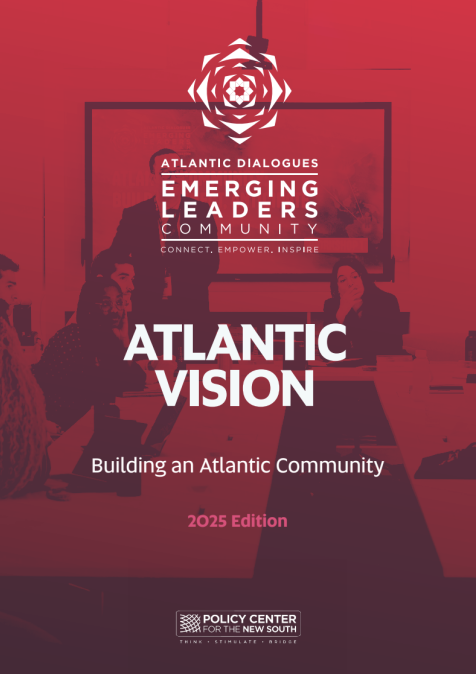
Since 2018, the Atlantic Vision exercise has provided a structured space within the Atlantic Dialogues Emerging Leaders program for successive cohorts to reflect collectively on the future of the Atlantic Basin. Each year, participants are divided into economic, political, and social working groups and tasked with identifying the region’s most pressing challenges and proposing forward-looking solutions. Over time, these reports have formed a coherent intellectual trajectory.
The first edition established a baseline diagnosis. It identified structural obstacles to the emergence of a genuine Atlantic Community, including economic asymmetries, fragmented governance, weak coordination mechanisms, and persistent social inequalities. Subsequent cohorts expanded this agenda, responding to evolving geopolitical tensions, climate pressures, democratic stress, technological disruption, and widening inequality. The economic strand evolved from outlining a foundational roadmap to calling for structural reforms in financing, connectivity, and regulatory alignment. The political strand moved from diagnosing fragmented initiatives and misleading narratives to envisioning governance architectures capable of aligning regional strategies and elevating local voices. The social strand progressed from mapping structural injustices rooted in colonial legacies to designing participatory and narrative tools aimed at strengthening cohesion in diverse and unequal societies.
Across editions, several cross-cutting messages have become increasingly clear. The Atlantic Community remains under-constructed and insufficiently tangible in citizens’ daily lives. Youth leadership is central, but it must be embedded within broader, intergenerational coalitions capable of scaling impact. Building, connecting, and anticipating are inseparable processes. Most importantly, the unfinished agenda is implementation. Cohorts have consistently converged on ambitious ideas; the challenge now lies in testing them, scaling what works, and embedding accountability mechanisms that endure beyond individual workshops.
In 2025, the original foresight horizon has been reached. This milestone marks not the end of the exercise, but its transformation. Rather than asking what should be achieved by 2025, this year’s cohort was invited to engage with a retrospective of previous reports and to confront a new and more demanding question:
What would a credible, shared Atlantic Community look like by 2035 and beyond, and what concrete steps must be taken now to make it operational?
The shift is deliberate. The Atlantic Basin is one of the world’s busiest oceanic corridors—a vital artery for global trade, energy flows, and commercial exchange—and an increasingly strategic geopolitical space. Yet, despite growing economic interdependence and the emergence of multiple cooperation initiatives across security, trade, climate, and blue economy governance, fragmentation persists. The region’s institutional landscape remains dense but insufficiently aligned. Trust gaps endure between North and South. Social protection systems struggle to keep pace with climate disruption and technological change. Economic value chains remain vulnerable to external shocks. Against this backdrop, the 2025 cohort focused less on broad crisis mapping and more on the structural bottlenecks that prevent the Atlantic from functioning as a coherent and resilient community