Publications /
Research Paper

Back
Assessing the Economic Impacts of Al-Haouz Earthquake: Damages and Recovery Strategy
April 30, 2024

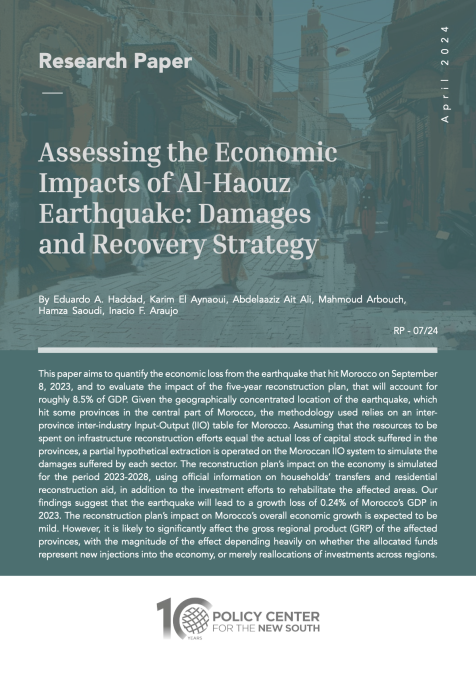
This paper aims to quantify the economic loss from the earthquake that hit Morocco on September 8, 2023, and to evaluate the impact of the five-year reconstruction plan, that will account for roughly 8.5% of GDP. Given the geographically concentrated location of the earthquake, which hit some provinces in the central part of Morocco, the methodology used relies on an inter- province inter-industry Input-Output (IIO) table for Morocco. Assuming that the resources to be spent on infrastructure reconstruction efforts equal the actual loss of capital stock suffered in the provinces, a partial hypothetical extraction is operated on the Moroccan IIO system to simulate the damages suffered by each sector. The reconstruction plan’s impact on the economy is simulated for the period 2023-2028, using official information on households’ transfers and residential reconstruction aid, in addition to the investment efforts to rehabilitate the affected areas. Our findings suggest that the earthquake will lead to a growth loss of 0.24% of Morocco’s GDP in 2023. The reconstruction plan’s impact on Morocco’s overall economic growth is expected to be mild. However, it is likely to significantly affect the gross regional product (GRP) of the affected provinces, with the magnitude of the effect depending heavily on whether the allocated funds represent new injections into the economy, or merely reallocations of investments across regions.

RELATED CONTENT

  • April 6, 2020
    Depuis l'entrée en vigueur de l'Accord de libre-échange (ALE) entre le Maroc et l'Union européenne (UE), il y a près de deux décennies, les performances des exportations marocaines vers les marchés de l'UE ont été plutôt décevantes, tandis que le déficit commercial du Maroc avec l'UE a augmenté de manière significative. Cela a conduit de nombreux observateurs à percevoir l'accord d'un oeil critique. Cependant, les balances commerciales bilatérales ne sont pas toujours suffisantes po ...
  • Authors
    Youssef El Jai
    April 1, 2020
    « Economists have a bad track record in predictions, so I will not try my hand at predicting the effect of the novel coronavirus (COVID-19) on the global financial system or the global economy. » Thorsten Beck .ctc ul{padding-left:30px; } .ctc ul li{list-style:disc;} Comme le dit si bien Thorsten Beck, il serait illusoire de prévoir à ce stade, compte tenu de l’information disponible, un impact chiffré de la crise sur l’économie. A l’issue de son Conseil du17 mars 2020, ...
  • March 9, 2020
    The Moroccan diaspora contributes in major ways to Morocco’s economic development. Moroccan migrants ease the country’s chronic unemployment and underemployment problems, send remittances, invest in the home country, and typically visit Morocco frequently as tourists. In addition to that migrants usually retain close links with Morocco, and help in less direct ways to forge trade and third-party investment links between Morocco and their host countries. Drawing on the relatively sma ...
  • February 14, 2020
    L’écosystème aéronautique marocain représente l’un des plus beaux cas de réussite industrielle dans un pays en développement. Bien sûr, le Maroc ne produit pas d’avions. Le marché mondial de l’aviation est dominé par un duopole constitué de l’Américain Boeing et de l’Européen Airbus. Une suprématie écrasante, renforcée encore récemment par l’acquisition des divisions commerciales des deux derniers concurrents significatifs dans le domaine des monocouloirs courts courriers : le Canad ...
  • February 10, 2020
    This book studies Morocco’s growth and employment prospects in the context of a new growth model aimed at avoiding a middle-income trap, in a rapidly changing international environment marked by increased competition from low-wage economies and growing automation of low-skilled jobs. Chapter 1 discusses the changing nature of the international environment facing Morocco and provides the rationale for changing the country’s growth model. Chapter 2 reviews the growth model that Morocc ...
  • Authors
    January 20, 2020
    Le 3 octobre 2016, la Turquie a déposé une plainte contre le Maroc devant l’Organisation Mondiale du Commerce (OMC) au sujet des mesures antidumping appliquées par le Maroc contre les exportations turques en Acier laminé à chaud.1 Suite à l’échec des consultations entre les deux pays, la Turquie a demandé, le 12 janvier 2017, l’établissement d’un groupe spécial pour examiner la conformité des mesures prises par le Maroc avec le droit de l’OMC. Demande qui marque le passage du litige ...
  • Authors
    Numéro spécial du cahier du plan - Volume 2
    December 18, 2019
    Lors du colloque autour du thème « Croissance économique au Maroc : théories, évidences et leçons des expériences récentes », organisé conjointement par le Haut-Commissariat au Plan (HCP) et le Policy Center for the New South et accueilli par le HCP en mai 2017 dans ses locaux à Rabat, des experts et praticiens de près de 30 institutions académiques et non académiques ont échangé et débattu de la croissance économique au Maroc dans un framework transverse alliant le théorique au pra ...
  • November 29, 2019
    Questions : 1/ Est ce que le Maroc remplit les critères de l’émergence économique selon vous? 2/ Quels sont les ingrédients secrets de l’émergence ? 3/ Quels sont les défis qu'il reste à relever en matière de développement économique ? 4/ Si vous aviez une baguette magique et que vous p...
  • November 5, 2019
    In this brief, we review the evidence on Morocco’s export concentration, discuss its causes, and then draw some policy implications. The main message is that Morocco needs to raise its game in some less familiar markets and move outside its comfort zone. This implies not only investments by private firms, greater efforts on export promotion by the government and professional associations, but also deeper changes within Morocco, including in its educational system. Over the past two ...
  • September 24, 2019
    En pleine transition ordonnée de son régime de change, sous l'autorité bienveillante du Fonds monétaire international (FMI), le Royaume du Maroc est un exemple très concret des avantages et des inconvénients des deux régimes de change dominants ces dernières décennies/change fixe et change flottant /. L’objet de cette note est de rappeler, tout d'abord, les fondamentaux économiques des deux systèmes et leur environnement historique (I). Ensuite, à la lumière de ces fondamentaux, pré ...