Publications /
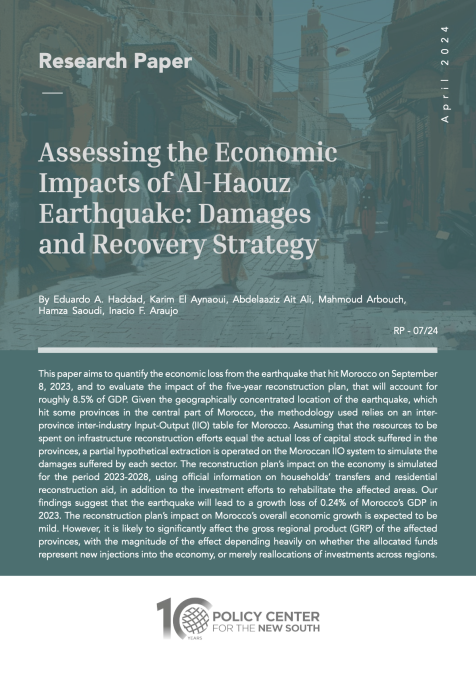
Research Paper

Back
Assessing the Economic Impacts of Al-Haouz Earthquake: Damages and Recovery Strategy
April 30, 2024

This paper aims to quantify the economic loss from the earthquake that hit Morocco on September 8, 2023, and to evaluate the impact of the five-year reconstruction plan, that will account for roughly 8.5% of GDP. Given the geographically concentrated location of the earthquake, which hit some provinces in the central part of Morocco, the methodology used relies on an inter- province inter-industry Input-Output (IIO) table for Morocco. Assuming that the resources to be spent on infrastructure reconstruction efforts equal the actual loss of capital stock suffered in the provinces, a partial hypothetical extraction is operated on the Moroccan IIO system to simulate the damages suffered by each sector. The reconstruction plan’s impact on the economy is simulated for the period 2023-2028, using official information on households’ transfers and residential reconstruction aid, in addition to the investment efforts to rehabilitate the affected areas. Our findings suggest that the earthquake will lead to a growth loss of 0.24% of Morocco’s GDP in 2023. The reconstruction plan’s impact on Morocco’s overall economic growth is expected to be mild. However, it is likely to significantly affect the gross regional product (GRP) of the affected provinces, with the magnitude of the effect depending heavily on whether the allocated funds represent new injections into the economy, or merely reallocations of investments across regions.
RELATED CONTENT

  • December 16, 2021
    حدد المغرب أهدافه للتنمية الإقليمية استنادا على مختلف أدوات التدخل كسياسات التنمية القروية وبرامج الهياكل الأساسية والخدمات الاجتماعية، وكذلك برامج التنمية المستدامة والبرامج المتعلقة بأقاليم محددة كالواحات والجبال والمناطق الحدودية. وقد أكد تقرير نموذج التنمية الجديد على ضرورة تعزيز قد...
  • Authors
    Raffaele Della Croce
    Miguel Vazquez
    September 29, 2021
    In order to close the financing gap in green technologies, finding new mechanisms to enhance the participation of the private sector, combined with that of the public sector, in financing sustainable and climate-resilient infrastructure is a must. In this context, some unlisted instruments are going to be needed to enhance financing of green infrastructure. Besides, the development of properly structured projects, with risks and returns in line with the preferences of the different ...
  • August 24, 2021
    تجدون أقوى لحظات حديث الثلاثاء حول المواضيع الاقتصادية لهذه السنة : رؤى استشرافية لما بعد الجائحة، الاقتصاد غير المهيكل، دور القطاع الثالث، المغرب وسلاسل القيمة الاقليمية مع خبراء وباحثين اقتصادين ...
  • Authors
    Chami Abdelilah
    Derj Atar
    Hammi Ibtissem
    Morazzo Mariano
    Naciri Yassine
    with the technical support of AFRY
    July 29, 2021
    As decarbonization is a long-term process and requires significant investments, specific financial and non- financial measures will need to be implemented, both in the short and long term, to facilitate this transition. In Part II of Morocco’s decarbonization pathway Policy Brief series, an update of the decarbonization scenarios was presented. It revealed that the Increased Ambition and Green Development scenarios achieve higher decarbonization targets than current policy. It showe ...
  • Authors
    Chami Abdelilah
    Derj Atar
    Hammi Ibtissem
    Morazzo Mariano
    Naciri Yassine
    with the technical support of AFRY
    July 23, 2021
    La décarbonisation est un processus à long terme qui nécessite des investissements importants. Ainsi, des mesures financières et non financières spécifiques devront être mises en œuvre, à la fois à court et à long termes, pour faciliter cette transition. Dans la deuxième partie de la série de Policy Briefs sur la trajectoire de décarbonisation du Maroc, une mise à jour des scénarios de décarbonisation a été présentée. Elle révèle que les scénarios « Ambition accélérée » et « Dévelop ...
  • Authors
    Chami Abdelilah
    Derj Atar
    Hammi Ibtissem
    Morazzo Mariano
    Naciri Yassine
    with the technical support of AFRY
    July 19, 2021
    Morocco's significant renewable energy resources offer an unprecedented opportunity to anchor the country’s economic and political choices in the energy transition, and to turn the transition into an essential lever for economic development. This is all the more relevant as the costs of renewable energies have dropped over the past 10 years2, and now offer strong potential, not only for creating green jobs but for ensuring a dynamic and resilient economic growth as well. In 2020, ne ...
  • Authors
    Chami Abdelilah
    Derj Atar
    Hammi Ibtissem
    Morazzo Mariano
    Naciri Yassine
    with the technical support of AFRY
    July 9, 2021
    The consequences of climate change are becoming progressively more visible in Morocco. Changes in rainfall patterns and drought, increases in average temperatures and heatwaves, flooding, and rising sea levels are increasingly affecting several regions. Yet, Morocco has a relatively low greenhouse gas (GHG) emission rate, compared to other countries. In 20162, Morocco’s total GHG emissions reached 86127.7 gigagram of carbon dioxide equivalent (Gg CO2-eq), totaling around 0.2% of glo ...