Publications /
Policy Brief

Back
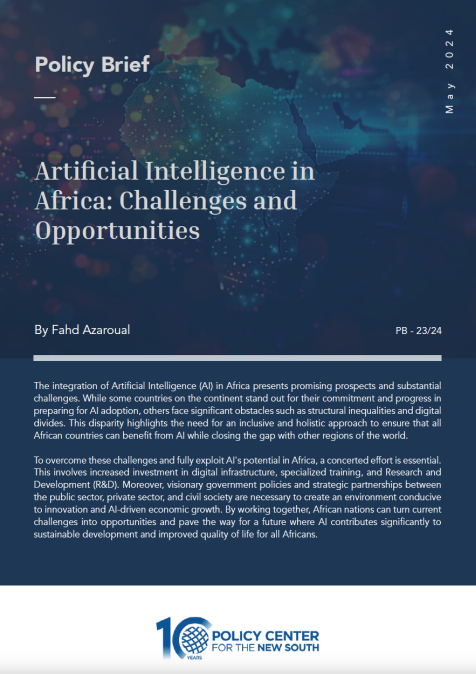
Artificial Intelligence in Africa: Challenges and Opportunities
Authors
May 16, 2024

The integration of Artificial Intelligence (AI) in Africa presents promising prospects and substantial challenges. While some countries on the continent stand out for their commitment and progress in preparing for AI adoption, others face significant obstacles such as structural inequalities and digital divides. This disparity highlights the need for an inclusive and holistic approach to ensure that all African countries can benefit from AI while closing the gap with other regions of the world.

To overcome these challenges and fully exploit AI's potential in Africa, a concerted effort is essential. This involves increased investment in digital infrastructure, specialized training, and Research and Development (R&D). Moreover, visionary government policies and strategic partnerships between the public sector, private sector, and civil society are necessary to create an environment conducive to innovation and AI-driven economic growth. By working together, African nations can turn current challenges into opportunities and pave the way for a future where AI contributes significantly to sustainable development and improved quality of life for all Africans.
RELATED CONTENT

  • January 6, 2026
    La création de l’Alliance des États du Sahel (AES) symbolise une rupture politique et géostratégique majeure, appuyée sur un discours souverainiste et anti-occidental. Deux ans après, Mali, Burkina Faso et Niger peinent à assurer leur intégrité territoriale, à stabiliser leur sécurité intérieure et à bâtir une gouvernance solide. L’intégrité territoriale est un problème commun aux trois États, car dans ces pays, la cohésion de l’État et le contrôle du territoire sont directement men ...
  • January 5, 2026
    This Paper was originally published on sciencedirect.com This study provides an original and significant contribution to evaluating educational service quality in Morocco by leveraging, for the first time, microdata from the Service Delivery Indicators (SDI) survey. The survey covers a nationally representative sample of 300 public and private primary schools across rural and urban areas. The use of SDI data represents a major methodological advancement, shifting away from perc ...
  • January 2, 2026
    Ce Policy Paper analyse les enjeux politiques, économiques et opérationnels du Fonds pour les pertes et dommages, créé pour répondre aux impacts climatiques irréversibles subis par les pays les plus vulnérables. Il clarifie d’abord la notion de pertes et dommages, qui mêle effets économiques et non économiques, et souligne les défis d’attribution liés à la superposition entre chocs climatiques et fragilités structurelles. L’analyse met ensuite en lumière les tensions d’économie poli ...
  • December 22, 2025
    This paper presents the theoretical specification and current developments of a Spatial (Interprovincial) Computable General Equilibrium (SCGE) model for Morocco. The model is formulated as a Johansen-type CGE system, solved in linearized form, and is designed to analyze the regional and national impacts of policy shocks within an integrated interregional economic framework. The Moroccan economy is disaggregated into 72 provinces, 20 production sectors, multiple institutional agents ...
  • Authors
    Ahmed Ouhnini
    December 5, 2025
    L’« uberisation », terme né du nom de l’entreprise américaine Uber au début des années 2010, désigne initialement un modèle économique fondé sur la mise en relation directe entre offre et demande via des plateformes numériques. Rapidement popularisé, le concept s’est élargi, avec Airbnb dans l’hébergement, puis à une multitude d’autres secteurs : livraison de repas, services à domicile, commerce en ligne, voire des métiers traditionnellement régulés ou corporatistes. Ce néologisme t ...
  • December 2, 2025
    في هذه الحلقة، نحاول اكتشاف ما الذي يجعل المغرب يعيش اليوم تحولاً لافتاً في عالم المدفوعات الرقمية. كيف أصبحت التكنولوجيا المالية أحد مفاتيح الشمول المالي ومحركاً لنمو جديد؟ وكيف يغيّر الاعتماد المتزايد لوسائل الدفع الحديثة حياة التجار الصغار والمقاولات الصغيرة والمتوسطة ويخلق لهم فرصاً...
  • Authors
    December 2, 2025
    This paper assesses the economic and environmental implications of Morocco’s strategic transition from internal combustion engine vehicle (ICEV) manufacturing to electric vehicle (EV) production, with a particular focus on the regional impacts of localizing high-value battery manufacturing. Using an interregional input-output model, extended with environmental satellite accounts, the study simulates a structural shock related to the wholesale substitution of ICEV-specific inputs wit ...
  • Authors
    Arkebe Oqubay
    November 17, 2025
    Morocco has emerged as one of Africa's success stories, achieving significant progress in economic transformation and the green transition over the past 25 years. Continuing and deepening this transformation is essential to reach the country’s goal of becoming a high-income economy in the coming decades. Significant challenges include managing the risk of the middle-income trap, addressing demographic pressures, promoting inclusive growth, ensuring environmental sustainability, and ...
  • November 4, 2025
    في هذه الحلقة، نناقش مستجدّات قانون المالية لسنة 2026، بما يشمل الإصلاحات الضريبية والتعديلات على الضرائب المباشرة وغير المباشرة، سياسات الإنفاق العمومي الجديدة، التحفيزات الاقتصادية للاستثمار والابتكار، والتدابير الاجتماعية لدعم الفئات الهشة، مع إبراز التحديات والآفاق المستقبلية للاقتص...