Publications /
Book / Report

Back
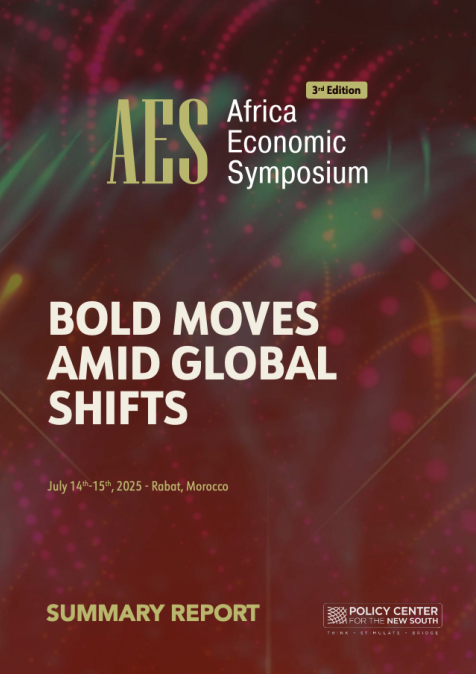
Africa Economic Symposium (AES) 3nd edition - SUMMARY REPORT
Authors
General rapporteur Mahmoud Arbouch
September 2, 2025

The Africa Economic Symposium (AES) has firmly established itself as one of the flagship annual events of the Policy Center for the New South, alongside the Atlantic Dialogues and the African Peace and Security Annual Conference (APSACO). Now in its third edition, AES continues to provide a unique platform for economists, policymakers, and academics from across the continent and beyond to exchange perspectives on the pressing macroeconomic and structural challenges facing Africa. Its mission remains to foster rigorous, evidence-based debates that inform policymaking and support long-term strategies for Africa’s development in an era of uncertainty. 

The 2025 edition, convened under the theme “Bold Moves amid Global Shifts,” explored the difficult policy trade-offs confronting African governments as they navigate a volatile global environment. The continent’s recovery from COVID-19 has been uneven, while debt pressures, supply chain disruptions, and geopolitical tensions weigh heavily on fiscal and economic resilience. Structural challenges such as persistent unemployment, low productivity, and the exclusion of Africa’s youth continue to hinder inclusive growth, even as policymakers are called upon to adapt to deep systemic uncertainty. 

The symposium underscored that many African states are increasingly resorting to short-term stabilization measures—such as accumulating reserves and postponing reforms—that may provide immediate security but risk delaying the structural transformation urgently needed. Against this backdrop, AES 2025 called for a careful balance between fiscal prudence, social investment, and the pursuit of sustainable growth, placing emphasis on reforming governance, improving macroeconomic management, and accelerating structural change. 

The discussions highlighted the urgent need to rethink Africa’s economic strategies in a shifting global order. From debt sustainability and the role of central banks to the promise of financial innovation, digital inclusion, and new instruments such as central bank digital currencies, the symposium emphasized that policy choices must align with long-term transformation goals. The debates also explored the opportunities and challenges of regional integration, trade connectivity, and development finance, all of which are essential levers for Africa’s resilience and prosperity. 

As in previous editions, the Annual Report on African Economies was launched alongside the symposium, offering an in-depth analysis of the continent’s macroeconomic dynamics and structural transformation pathways. More than just a publication, the report reflects the collective intellectual effort of leading scholars and practitioners, providing evidence-based insights to guide decision- makers. Together, the symposium and the report reinforced the Policy Center for the New South’s commitment to fostering forward-looking economic thinking that moves beyond short-term headlines to tackle Africa’s enduring challenges.
RELATED CONTENT

  • Authors
    April 27, 2023
    Recent initiatives and policy moves by China and other countries to extend the reach of use of the renminbi in the international monetary system, while the U.S. dollar share in global reserves has slightly shrunk in relative terms, have sparked frequent discussions about a hypothetical “de-dollarization” of the global economy. We approach here what that would mean in terms of global currency functions as means of payment and store of value. While we point out a relative decline of ...
  • Authors
    April 26, 2023
    It is estimated that $1 trillion to $6 trillion per year (up to 2050) needs to be invested globally if the world is to stay below the 2°C global warming ceiling of the Paris Agreement and to meet its adaptation goals. Currently, investments stand at about $630 billion per year, way below the original target. And although great efforts have been made in the climate-finance area, more than 70% of the funds deployed have gone to one sector, renewable energy, followed by the transportat ...
  • April 10, 2023
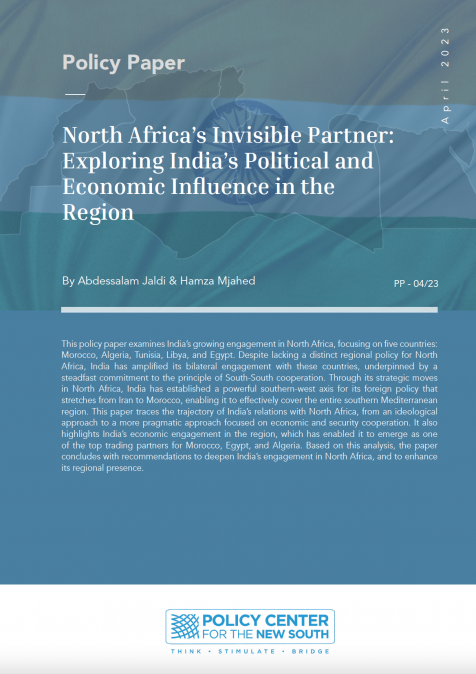
    This policy paper examines India’s growing engagement in North Africa, focusing on five countries: Morocco, Algeria, Tunisia, Libya, and Egypt. Despite lacking a distinct regional policy for North Africa, India has amplified its bilateral engagement with these countries, underpinned by a steadfast commitment to the principle of South-South cooperation. Through its strategic moves in North Africa, India has established a powerful southern-west axis for its foreign policy that stretch ...
  • Authors
    April 10, 2023
    The contemporary global energy landscape is experiencing noteworthy changes in demand, supply, technology, markets, and investment. These developments transcend conventional oil and gas security considerations. Renewable energy sources, such as wind and solar power, have become increasingly cost-effective compared to fossil fuels, and the minerals required to produce them are gaining importance. Nevertheless, recent events such as the Covid-19 pandemic and the conflict in Ukraine ha ...
  • Authors
    Hala Boumaiz
    April 7, 2023
    In an attempt to bring the World Cup back to Europe and Africa, Morocco has joined Spain and Portugal in a three-way bid to host the 2030 FIFA World Cup. While there are still talks of Ukraine remaining in the bid, the three confirmed countries are hoping to score big with major economic, cultural, and political benefits. Although not as large as the Olympics in terms of logistics, the FIFA World Cup is one of the most prestigious and watched sporting events in the world. Early figu ...
  • Authors
    April 5, 2023
    The Policy Center for the New South and the Economic Research Forum held on March 20 a workshop titled ‘Stabilization and adjustment towards inclusive and sustainable policies in MENA: The Moroccan case study’. The event took place at the PCNS headquarters in Rabat, Morocco. It brought together renowned Moroccan economists and scholars to discuss the issue of public debt sustainability in the context of the Moroccan economy. It was an occasion to revisit the main features of the Mor ...
  • April 4, 2023
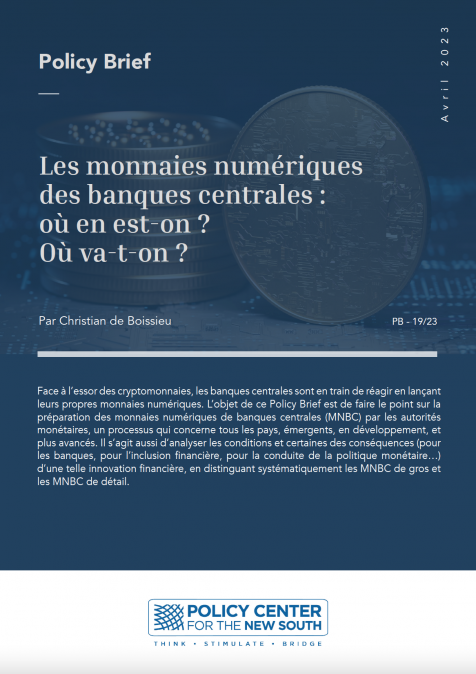
    Face à l’essor des cryptomonnaies, les banques centrales sont en train de réagir en lançant leurs propres monnaies numériques. L’objet de ce Policy Brief est de faire le point sur la préparation des monnaies numériques de banques centrales (MNBC) par les autorités monétaires, un processus qui concerne tous les pays, émergents, en développement, et plus avancés. Il s’agit aussi d’analyser les conditions et certaines des conséquences (pour les banques, pour l’inclusion fin ...
  • April 4, 2023
    Faced with the rise of cryptocurrencies, central banks are responding by launching their digital currencies. The purpose of this Policy Brief is to provide an update on the preparation of central bank digital currencies (CBDs) by monetary authorities, a process that concerns all emerging, developing, and more advanced countries. It is also about analyzing the conditions and some of the consequences (for banks, for financial inclusion, for the conduct of monetary policy...) of such a ...