The Political Economy of Inclusive Growth in MENA: Understanding the Challenges and Opportunities

July 14, 2023

The International Monetary Fund (IMF) and the Policy Center for the New South (PCNS) organized a joint event titled “Renewing the Dialogue on Inclusive Growth in MENA: Re-Framing the Debate and Setting the Agenda” took place on Friday 16th of June 2023, started at 10:30 am (Rabat time GMT+1) at the Policy Center for The New South’ HQ, at Mohammed VI Polytechnic University campus, Rabat, Morocco. The event hold in two sessions: a panel discussion under the theme “The Political Economy of Inclusive Growth in MENA: Understanding the Challenges and Opportunities” and a closed-door experts roundtable to delve deeper on “The Role of Multilateral Organizations in Promoting Inclusive Growth in the Region.” Despite gains in poverty reduction, literacy and lifespans, many MENA economies have struggled to ensure that the benefits of economic development accrue equally to all segments of their population. Among the main issues that remain unresolved are the high share of inactive youth, large gaps in economic opportunities for women, fragmented social protection systems, and underdeveloped private sectors with tight regulation and limited access to credit that stifle the creation of new firms and growth in output, employment, and incomes. The recent confluence of negative shocks threatens to widen these gaps. The pandemic has pushed additional 75 million people over the world into extreme poverty in 2021, and its impact has been felt especially by the low-skilled, the young, women, refugees, and migrant workers. Higher commodity prices and the spike in inflation have exacerbated this phenomenon, adding to the challenges facing the poor and resulting in increased food insecurity. The greater demand for protection and recovery against these shocks is running up against the constraints from weaker fiscal positions and the need to tighten monetary policy conditions. A few global trends are also weighing on MENA prospects for strong and inclusive growth. Climate change is already posing significant challenges to many economies in the region, by causing more frequent and intense weather-related disasters. And the increased use of automation and artificial intelligence in production processes mean that MENA labor markets will look quite different in the future, with new challenges and opportunities that are still difficult to appreciate fully. The roundtable provides an opportunity to reassess the inclusive growth agenda in the MENA region considering the rapidly changing world.

Speakers
Nour Amache
Journalist, Asharq TV
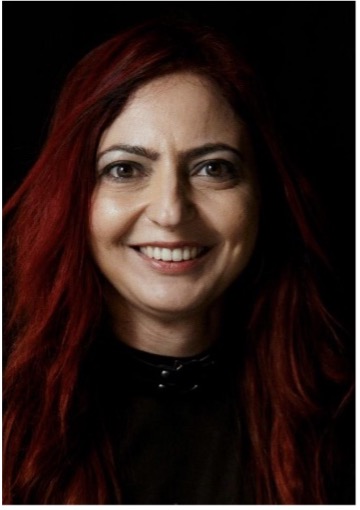
Nour Amache is Business News expert and Economist who anchors the show "Mo'asherat Asharq- Asharq Indices” on Asharq Business with Bloomberg, while covering with other anchors other daily business news shows. Her main show “Mo'asherat Asharq -Asharq Indices” is a daily two-hours show that covers GCC, MENA, and Global Markets, with a focus on economic and geopolitical developments.  The other shows she anchors also follow global markets, with a daily focus on GCC & emerging markets', in addition to U.S., Asian & European markets and economies. Amache was formerly an economics lecturer at the Lebanese American University, where she taught Macroeconomics, Microeconomics, Fiscal Policy, and Public Finance. Amache holds a Masters' degree in Public Policy from Northwe ...
Ibrahim Elbadawi
Managing Director, Economic Research Forum
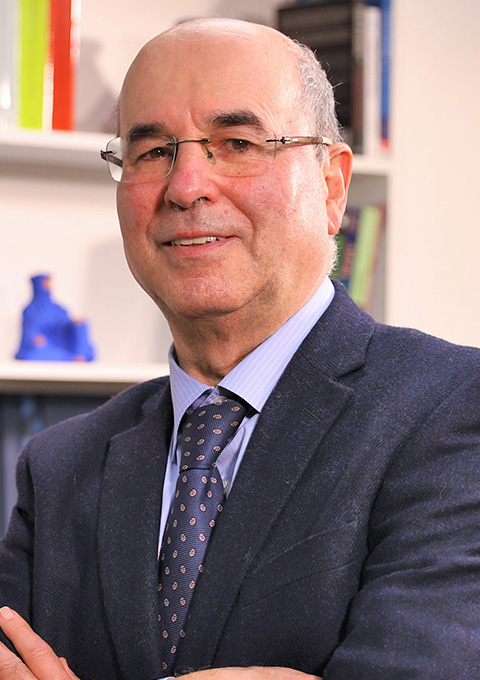
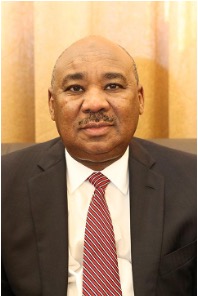
Ibrahim Elbadawi is the Managing Director of the Economic Research Forum (since January 2017- August 2019; August 2020- present). Minister of Finance and Economic Planning, Republic of Sudan (Sept 2019-July 2020). Professor Emeritus, University of Khartoum. Before that he was Director at the Economic Policy & Research Center, the Dubai Economic Council (2009-2016); Lead Economist at the Development Research Group of the World Bank, which he joined in 1989; and Professor of economics at the University of Gezira in Sudan. He holds a PhD in economics and statistics from North Carolina State and Northwestern universities in the USA. During his work at the World Bank he also served as Research Director of the African Economic Research Consortium (Nairobi, 1993-1998), on externa ...
Joseph Bahout
Director, Issam Fares Institute for Public Policy and International Affairs
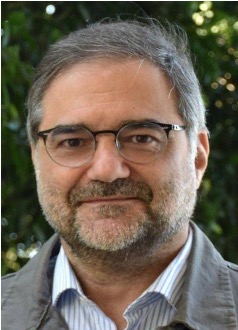
Joseph Bahout, PhD, is the director of the Issam Fares Institute and an associate professor of practice in the PSPA Department at AUB. Until recently, Joseph Bahout was a scholar at Carnegie Endowment in Washington DC, professor at Sciences-Po Paris, and consultant to the policy planning unit of the French MoFA. Prior to that, he was an assistant professor at USJ, and researcher at CERMOC. He also had political and consultancy activities with various ministries and public bodies in Lebanon. In France, he was a senior advisor to the SG of Académie Diplomatique Internationale.  Bahout has been a fellow with the Crown Center for Middle East Studies at Brandeis University, with the Geneva Center for Security Policy, ...
Ziad Bahaa Eldin
Former Deputy Prime Minister for Economic Development and Minister of International Cooperation, Egypt
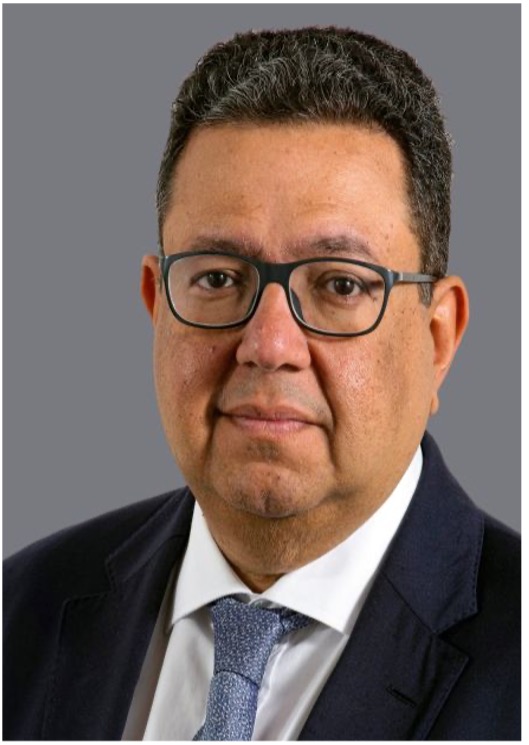
Dr. Ziad Ahmed Bahaa-Eldin is an Egyptian lawyer and expert on financial law, investment and company laws, governance, compliance, and economic legislation. He is currently the managing partner at Thebes Consultancy and a non-executive member on several company boards of directors including the National Bank of Egypt UK, Arabian Cement Company, AXA Egypt, Allam Holding, MTI, Samcrete for Industrial Development, and Saray Capital (Dubai International Financial Centre). He previously held several public positions including the Deputy Prime Minister for Economic Development and Minister of International Cooperation (2013-2014), Member of Parliament representing South Assiut (2012), Chairman of the Financial Regulatory Authority “FRA” (2009-2011), and Chairman of the General Autho ...
Larabi Jaïdi
Senior Fellow
Larabi Jaïdi is a Senior Fellow at the Policy Center for the New South and an Affiliate Professor at Mohammed VI Polytechnic University. His areas of expertise include international economy, economic policies, international economic relations, regional economies, social development, international relations, and Mediterranean studies. He also served on the Special Commission on the New Development Model of Morocco, a consultative body created in November 2019 to formulate the country's new developmental guidelines. Jaïdi is a former Professor at Mohamed V University in Rabat-Agdal and a founding member of both the Centre Marocain de Conjoncture and the Groupement d’Etudes et de Recherches sur la Méditerranée.   Prof. Jaïdi previously served as Advisor to the Prime Minist ...
Lina Khatib
Director, SOAS University Middle East Institute
Lina Khatib is an internationally renowned authority on the Middle East. Before becoming Director of the SOAS Middle East Institute, she directed policy research programs at some of the world’s leading policy institutes. She served as director of the Middle East and North Africa Programme at Chatham House and was director of the Carnegie Middle East Center at the Carnegie Endowment for International Peace. Prior to that she co-founded and led the Program on Arab Reform and Democracy at Stanford University’s Center on Democracy, Development, and the Rule of Law. Before moving to Stanford, she lectured at Royal Holloway, University of London. Her work is firmly interdisciplinary, spanning the study and practice of international affairs, political transitions, and visual culture ...

RELATED CONTENT

  • Authors
    Liel Maghen
    May 11, 2026
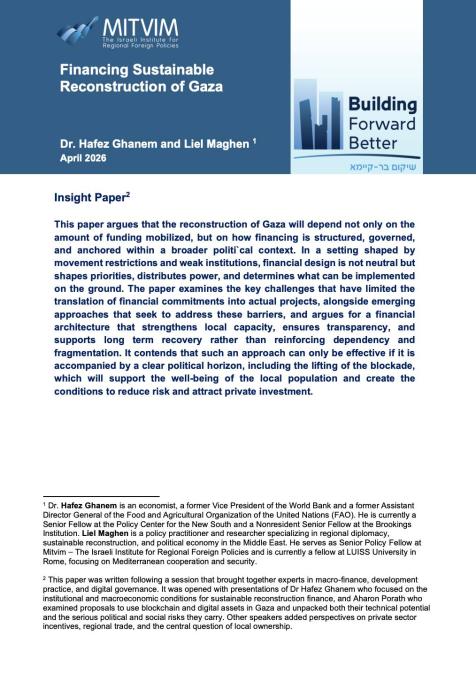
    This Paper was originally published on mitvim.org.il This paper argues that the reconstruction of Gaza will depend not only on the amount of funding mobilized, but on how financing is structured, governed, and anchored within a broader politi`cal context. In a setting shaped by movement restrictions and weak institutions, financial design is not neutral but shapes priorities, distributes power, and determines what can be implemented on the ground. The paper examines the key cha ...
  • Authors
    April 8, 2026
    This report was originally published on the website of the Middle East Institute ( mei.edu) The following study discusses the role of Lebanon’s gold reserves in the establishment of a currency board and evaluates four policy options: a true currency board, constrained central bank reform, full dollarization, and a unified managed float. Gold reserves are relevant under all four. The conclusion is consistent across them: no monetary framework, however carefully designed and howe ...
  • Authors
    April 1, 2026
    We are now in the fifth week since the U.S. airstrike that killed top leaders of the Iranian regime, initiating a war involving the United States and Israel against the country. More than a month of mutual bombardments between Iran and Israel has ensued, extending to other Persian Gulf nations, U.S. military installations—and even Cyprus. From a global perspective, the impact has stemmed primarily from disruptions to regional production of goods and the blockade of the Strait of Hor ...
  • Authors
    January 23, 2026
    Introduction: COP30 as a Test of Reality, Not AmbitionCOP30 in Belém was never going to be a breakthrough. In a world marked by fiscal exhaustion, geopolitical rivalry, and eroding trust in multilateralism, expecting transformational climate cooperation bordered on denial. The choice of the Amazon as host carried symbolic weight, but symbolism does not override power, interests, or institutional capacity.The outcome of COP30 confirms a deeper truth: the global climate regime has ent ...
  • Authors
    November 28, 2025
    The adoption of United Nations Security Council Resolution 2803 on November 17, 2025, endorsing the “Comprehensive Plan to End the Gaza Conflict,” is a step in the right direction, but it must be accompanied by the implementation of a Gaza development and post-conflict reconstruction program. Paragraph 6 of Resolution 2803 “calls upon the World Bank and other financial institutions to facilitate and provide financial resources to support the reconstruction and development of Ga ...
  • Authors
    October 28, 2025
    Now that a cease-fire is in place, it is time to consider Gaza’s reconstruction. This will be the fifth such effort in less than twenty years. Lessons from the previous four indicate that rebuilding houses, bridges, and roads is relatively straightforward. Far more challenging is building a thriving Gazan economy and society—one where young people live with dignity, have jobs, feel heard and included in their communities, and are hopeful about their future. Achieving this requires n ...
  • Authors
    El Hussein Fouad
    June 17, 2025
    This paper analyses the stabilization experience in the MENA region, focusing on Egypt, Morocco, Tunisia, and Jordan over the past century. It seeks to answer the question: To what extent have these countries succeeded in achieving resilience to shocks and stresses? Key policy elements included significant fiscal adjustments—varying in scale across countries—and exchange rate developments supported by monetary policies aimed at combating inflationary pressures. The outcomes involved ...
  • May 18, 2023
    Le Policy Center for the New South (PCNS) et le Fonds Monétaire International (FMI) ont organisé, le 28 avril, à Rabat, une table ronde d'experts sur le thème "Fighting Inflation and Building Resilience : the Outlook for MENA and Morocco". Au niveau international, la lutte contre l’inflation constitue la principale préoccupation des politiques économiques dans la majorité des pays. La détection des risques inflationnistes a pris du retard après la crise sanitaire parce que les aut ...