Publications /
Book / Report

Back
Africa Economic Symposium (AES) 3nd edition - SUMMARY REPORT
Authors
General rapporteur Mahmoud Arbouch
September 2, 2025

The Africa Economic Symposium (AES) has firmly established itself as one of the flagship annual events of the Policy Center for the New South, alongside the Atlantic Dialogues and the African Peace and Security Annual Conference (APSACO). Now in its third edition, AES continues to provide a unique platform for economists, policymakers, and academics from across the continent and beyond to exchange perspectives on the pressing macroeconomic and structural challenges facing Africa. Its mission remains to foster rigorous, evidence-based debates that inform policymaking and support long-term strategies for Africa’s development in an era of uncertainty. 

The 2025 edition, convened under the theme “Bold Moves amid Global Shifts,” explored the difficult policy trade-offs confronting African governments as they navigate a volatile global environment. The continent’s recovery from COVID-19 has been uneven, while debt pressures, supply chain disruptions, and geopolitical tensions weigh heavily on fiscal and economic resilience. Structural challenges such as persistent unemployment, low productivity, and the exclusion of Africa’s youth continue to hinder inclusive growth, even as policymakers are called upon to adapt to deep systemic uncertainty. 

The symposium underscored that many African states are increasingly resorting to short-term stabilization measures—such as accumulating reserves and postponing reforms—that may provide immediate security but risk delaying the structural transformation urgently needed. Against this backdrop, AES 2025 called for a careful balance between fiscal prudence, social investment, and the pursuit of sustainable growth, placing emphasis on reforming governance, improving macroeconomic management, and accelerating structural change. 

The discussions highlighted the urgent need to rethink Africa’s economic strategies in a shifting global order. From debt sustainability and the role of central banks to the promise of financial innovation, digital inclusion, and new instruments such as central bank digital currencies, the symposium emphasized that policy choices must align with long-term transformation goals. The debates also explored the opportunities and challenges of regional integration, trade connectivity, and development finance, all of which are essential levers for Africa’s resilience and prosperity. 

As in previous editions, the Annual Report on African Economies was launched alongside the symposium, offering an in-depth analysis of the continent’s macroeconomic dynamics and structural transformation pathways. More than just a publication, the report reflects the collective intellectual effort of leading scholars and practitioners, providing evidence-based insights to guide decision- makers. Together, the symposium and the report reinforced the Policy Center for the New South’s commitment to fostering forward-looking economic thinking that moves beyond short-term headlines to tackle Africa’s enduring challenges.

RELATED CONTENT

  • February 16, 2023
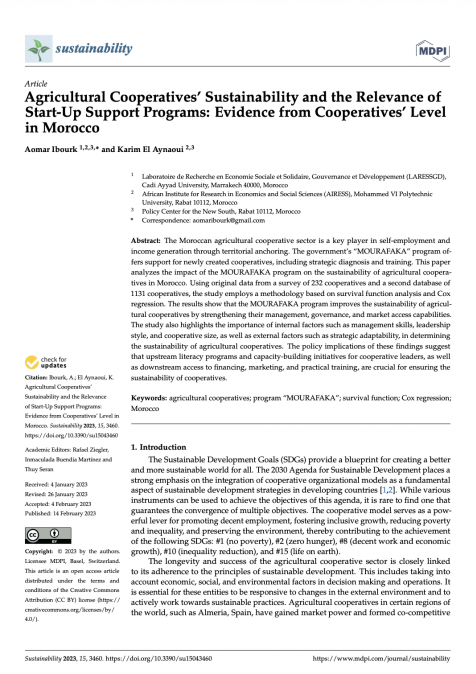
    This publication was originally published in https://www.mdpi.com/   The Moroccan agricultural cooperative sector is a key player in self-employment and income generation through territorial anchoring. The government’s “MOURAFAKA” program offers support for newly created cooperatives, including strategic diagnosis and training. This paper analyzes the impact of the MOURAFAKA program on the sustainability of agricultural cooperatives in Morocco. Using original data from a ...
  • Authors
    February 15, 2023
    China’s rate of economic growth has slowed. Chinese GDP ended 2022 up 3%, but this was the lowest growth rate in the last 40 years, except for 2020, the first year of the pandemic. In addition to problems in its real-estate sector, China’s severe ‘COVID zero’ confinement policy is one of the causes. The post-‘COVID zero’ reopening of the Chinese economy has improved its growth outlook. In the International Monetary Fund’s annual report on China, published in early February 2023, 5. ...
  • Authors
    Selassie Tay
    February 15, 2023
    Background The African Union in 2018 agreed to implement the world’s second-largest free-trade area measured by number of countries, people, and geographical size, with the signing of the African Continental Free Trade Agreement (AfCFTA). This agreement will ultimately lead to a continent-wide free trade area consisting of 54 countries with 1.3 billion people and a combined GDP of $3.4 trillion[1]. This equates to about 19%-20% of the GDP of the European Union and China, which ...
  • Authors
    February 13, 2023
    The volatility in energy markets since the outbreak of the Covid-19 pandemic in 2019/2020 has continued, with unprecedented uncertainty about global energy supply developing over the course of 2022 in the wake of Russia's invasion of Ukraine, against a backdrop of weakening macroeconomic conditions and high inflation. While some perceived this as a potential setback for the energy transition, others saw it as an opportunity to move away from fossil fuels and accelerate the developme ...
  • Authors
    February 10, 2023
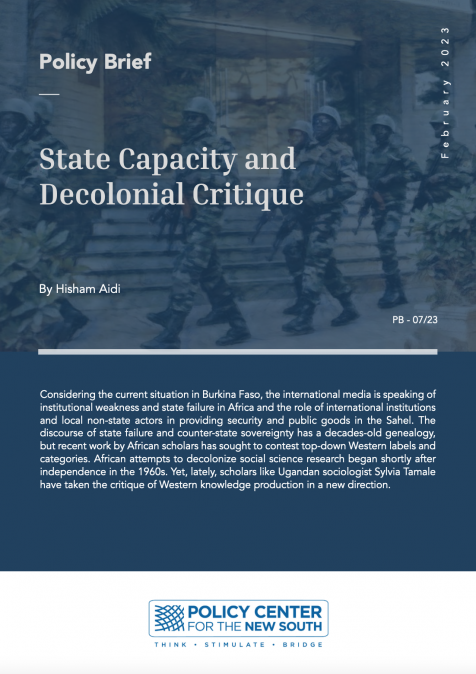
    Considering the current situation in Burkina Faso, the international media is speaking of institutional weakness and state failure in Africa and the role of international institutions and local non-state actors in providing security and public goods in the Sahel. The discourse of state failure and counter-state sovereignty has a decades-old genealogy, but recent work by African scholars has sought to contest top-down Western labels and categories. African attempts to decolonize soci ...
  • Authors
    February 3, 2023
    As the introductory textbook to economics by Nobel Prize Paul Samuelson, who served several generations of students, including mine, said: “It is easy to teach economics to a parrot. Two words are enough: supply and demand”. These two factors suggest 2023 will be a year of upward trend for most commodity prices. Last year was marked by shocks and volatility in commodity prices, with two distinct moments. After the sharp rise in the first half, due to the invasion of Ukraine by Russ ...
  • Authors
    Abdelmonim Amcharaa
    Hassnae Maad
    February 1, 2023
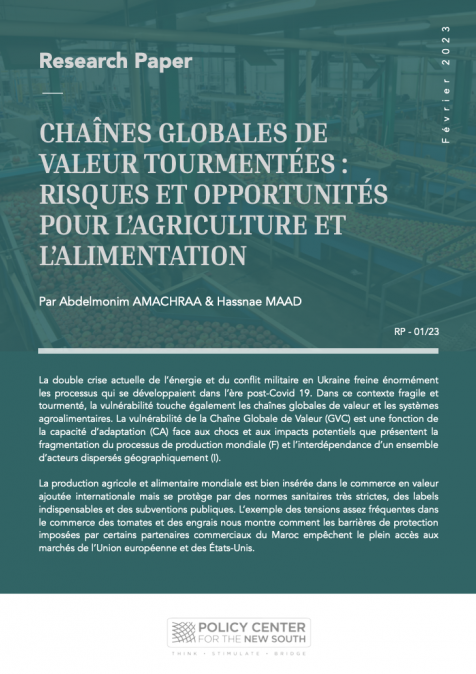
    La double crise actuelle de l’énergie et du conflit militaire en Ukraine freine énormément les processus qui se développaient dans l’ère post-Covid 19. Dans ce contexte fragile et tourmenté, la vulnérabilité touche également les chaînes globales de valeur et les systèmes agroalimentaires. La vulnérabilité de la Chaîne Globale de Valeur (GVC) est une fonction de la capacité d’adaptation (CA) face aux chocs et aux impacts potentiels que présentent la fragmentation du ...
  • January 31, 2023
    كثيرا ما ركّزت التعليقات والتحليلات على الأسباب المباشرة وشبه المباشرة والظرفية والدولية ألتي أدت الى موجة التضخم التي يشهدها العالم. في هذه الحلقة من برنامج حديث الثلاثاء، نقترح رؤية اكاديمية وعلمية للمفهوم، مقسّمين الظاهرة الى أجزاء ومكوّنات مختلفة. كما ستركّز هذه الحلقة على المغرب با...
  • Authors
    Davit Gondauri
    Nino Enukidze
    Mikheil Batiashvili
    January 31, 2023
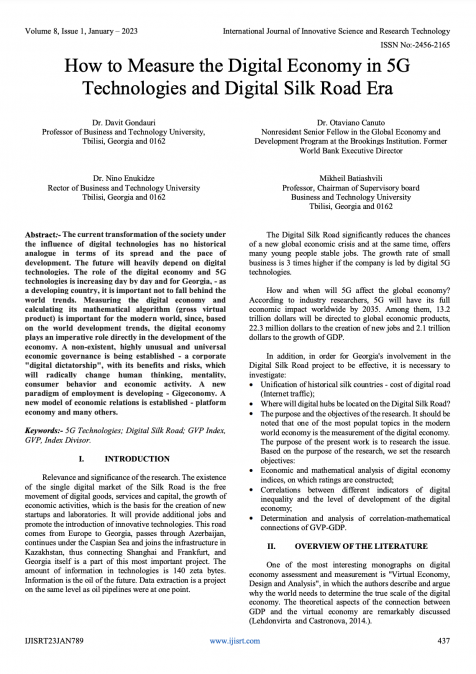
    This publication was originally published in https://ijisrt.com/assets/upload/files/IJISRT23JAN789.pdf   The current transformation of the society under the influence of digital technologies has no historical analogue in terms of its spread and the pace of development. The future will heavily depend on digital technologies. The role of the digital economy and 5G technologies is increasing day by day and for Georgia, - as a developing country, it is important not to fall ...