Publications /
Book / Report

Back
Africa Economic Symposium (AES) 3nd edition - SUMMARY REPORT
Authors
General rapporteur Mahmoud Arbouch
September 2, 2025

The Africa Economic Symposium (AES) has firmly established itself as one of the flagship annual events of the Policy Center for the New South, alongside the Atlantic Dialogues and the African Peace and Security Annual Conference (APSACO). Now in its third edition, AES continues to provide a unique platform for economists, policymakers, and academics from across the continent and beyond to exchange perspectives on the pressing macroeconomic and structural challenges facing Africa. Its mission remains to foster rigorous, evidence-based debates that inform policymaking and support long-term strategies for Africa’s development in an era of uncertainty. 

The 2025 edition, convened under the theme “Bold Moves amid Global Shifts,” explored the difficult policy trade-offs confronting African governments as they navigate a volatile global environment. The continent’s recovery from COVID-19 has been uneven, while debt pressures, supply chain disruptions, and geopolitical tensions weigh heavily on fiscal and economic resilience. Structural challenges such as persistent unemployment, low productivity, and the exclusion of Africa’s youth continue to hinder inclusive growth, even as policymakers are called upon to adapt to deep systemic uncertainty. 

The symposium underscored that many African states are increasingly resorting to short-term stabilization measures—such as accumulating reserves and postponing reforms—that may provide immediate security but risk delaying the structural transformation urgently needed. Against this backdrop, AES 2025 called for a careful balance between fiscal prudence, social investment, and the pursuit of sustainable growth, placing emphasis on reforming governance, improving macroeconomic management, and accelerating structural change. 

The discussions highlighted the urgent need to rethink Africa’s economic strategies in a shifting global order. From debt sustainability and the role of central banks to the promise of financial innovation, digital inclusion, and new instruments such as central bank digital currencies, the symposium emphasized that policy choices must align with long-term transformation goals. The debates also explored the opportunities and challenges of regional integration, trade connectivity, and development finance, all of which are essential levers for Africa’s resilience and prosperity. 

As in previous editions, the Annual Report on African Economies was launched alongside the symposium, offering an in-depth analysis of the continent’s macroeconomic dynamics and structural transformation pathways. More than just a publication, the report reflects the collective intellectual effort of leading scholars and practitioners, providing evidence-based insights to guide decision- makers. Together, the symposium and the report reinforced the Policy Center for the New South’s commitment to fostering forward-looking economic thinking that moves beyond short-term headlines to tackle Africa’s enduring challenges.


RELATED CONTENT

  • February 02, 2024
    In this podcast, Mr. Ferid Belhaj, Vice President - Middle East North Africa, World Bank Group shares his insights around the key takeaways from the Annual Meetings 2023 as well as his vi ...
  • Authors
    January 31, 2024
    En octobre 2023, la Chine a organisé le 3ème forum de l'Initiative « Ceinture et Route ». Le choix de la date n’était pas anodin, étant donné qu’elle coïncidait avec la célébration du 10ème anniversaire de l'Initiative. Une initiative aux multiples composantes L’Initiative « Ceinture et Route », également connue sous l’acronyme BRI (Belt and Road Initiative), a été initialement conçue pour permettre à la Chine de renforcer ses liens commerciaux avec les Etats ...
  • Authors
    Zakaria Elouaourti
    January 31, 2024
    This Paper was originally published on onlinelibrary.wiley.com This study aimed to unveil the evolving landscape of digital financial inclusion in African countries during the post-COVID-19 era. We examined factors influencing the access and usage of digital financial services and identified population segments facing increased exclusion due to the digital divide. First, by applying principal component analysis to data collected at the country level from 39 African countries i ...
  • Authors
    Mohamed Bassi
    January 30, 2024
    يتفحص هذا الموجز السياسي البحث الاقتصادي في إفريقيا بناءً على معطيات من منصة ورقات بحث في الاقتصاد. ويدرس إنتاجية الباحثين المنتسبين إلى المؤسسات الإفريقية، حيث أن بعضها غزير الإنتاج، بينما يظل المعدل الملاحظ على المستوى القاري أقل من المعايير الدولية. ونتيجة لذلك، لا تزال مساهمة إفريقيا في البحوث الاقتصادية العالمية متواضعة على الرغم من التحديات الاقتصادية الكبيرة التي تواجهها القارة. ثم تتناول الورقة مواضيع البحث الغالبة من خلال تحليل شفرات دراسات اقتصادية جديدة ومجلة الأدبيات الا ...
  • Authors
    Ilham Najib
    January 29, 2024
    Morocco is positioned as a new global hub of the automotive industry in an increasingly volatile international context, with various emerging countries competing intensively to gain the best returns on openness and globalization. The Moroccan automotive industry’s recent performance shows it to be the most dynamic sector in the economy: from 2014 to 2019, value-added in the automotive sector increased by almost 70% while the overall national value-added increased by only 15%. In the ...
  • January 26, 2024
    Since the 1980s, financial activities and assets have gained significant prominence in the global economy, surpassing the growth rate of underlying economic activity measured by global GD ...
  • Authors
    January 26, 2024
    Artificial intelligence (AI) is the name given to the broad spectrum of technologies by which machines can perceive, interpret, learn, and act by imitating human cognitive abilities. Automation was created to better fulfill repetitive tasks, increasing productivity. AI, with its impressive rate of evolution, can produce new content: texts, images, new computational codes, possibly medical diagnoses, interpretations of data, and so on. It is no coincidence that an AI-based technolog ...
  • Authors
    January 23, 2024
    The annual World Economic Forum took place in Davos, Switzerland, from January 15-19. Every year for 54 years, a global business elite has traveled there, whether to interact with customers and suppliers, with intellectual leaders on broad topics or, in an informal environment, with the representatives of governments and multilateral authorities who attend. Nothing is deliberated, of course, but over time the forum has established a reputation as a stage from which announcements ar ...
  • Authors
    João Gabriel Sacco
    January 23, 2024
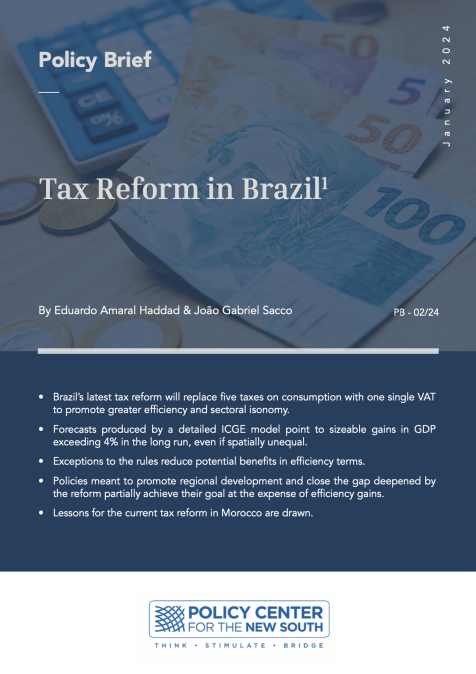
    - Brazil’s latest tax reform will replace five taxes on consumption with one single VAT to promote greater efficiency and sectoral isonomy. - Forecasts produced by a detailed ICGE model point to sizeable gains in GDP exceeding 4% in the long run, even if spatially unequal. - Exceptions to the rules reduce potential benefits in efficiency terms. - Policies meant to promote regional development and close the gap deepened by the reform partially achieve their goal at the expense of ...
  • Authors
    Soukaina Raoui
    January 22, 2024
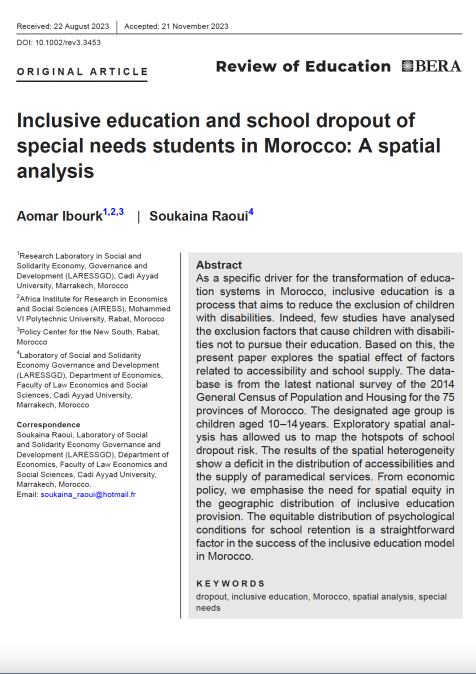
      This Paper was originally published on bera-journals.onlinelibrary.wiley.com   As a specific driver for the transformation of education systems in Morocco, inclusive education is a process that aims to reduce the exclusion of children with disabilities. Indeed, few studies have analysed the exclusion factors that cause children with disabilities not to pursue their education. Based on this, the present paper explores the spatial effect of factors related to acces ...